A Quantum Compass in Earth's Magnetic Field ✛
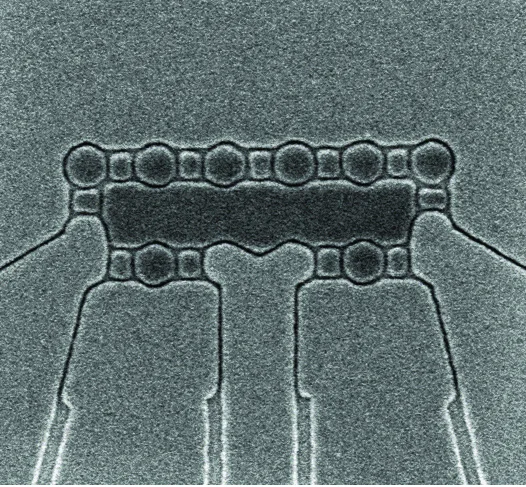
In a quiet room with no magnets anywhere, two electrons in a silicon trap still feel a faint trembling. It comes from the nuclei of silicon and germanium atoms, which spin randomly like the needles of broken compasses. This trembling was once considered noise, but now it has become a measuring instrument itself.
Physicists at HRL Laboratories fabricated a device with six quantum dots but used only two, labeled P5 and P6. Each dot holds one electron, and their spins can point in the same direction or in opposite directions. These two states are called triplet and singlet, and electrons switch between them at a frequency set by the exchange interaction. Usually, such switching requires an external magnet, but here it was replaced by a random gradient from 29Si and 73Ge nuclei.
To keep the signal from decaying too quickly, the researchers applied a series of short pulses that return the electrons to their initial state. This technique is like a skilled juggler keeping plates spinning without letting them fall. With seventy pulses, the coherence time grew from 1.17 to 74.8 microseconds, meaning the system preserved its quantum phase sixty times longer.
The measured oscillation phase allowed mapping the residual exchange across the charge cell: 30 kHz at the center, 64 kHz at the edge. The decay rate showed a broad maximum at exchange frequencies of 20–40 MHz, pointing to a hidden relaxation channel. It is like finding a secret door in an old house that no one knew about.
The method will be useful for hybrid circuits where semiconductor qubits sit next to superconducting resonators. An external magnetic field is unacceptable there, but the internal gradient always works. So the trembling of nuclei, once seen as a defect, has turned into a compass showing the state of a quantum system.
Earth's magnetic field in the lab is about 58 microtesla, giving a Zeeman splitting of 1.6 MHz. This is enough to suppress mixing with T± triplets, but the gradient from nuclei is 100 times weaker.
The idea of using random nuclear spins as an in-built compass echoes Greg Egan's novel 'Quarantine', where quantum states are controlled through interaction with the environment, not despite it.