Diagnosis by Reaction: What Healthy Brain Tissue Says About Disease ✛
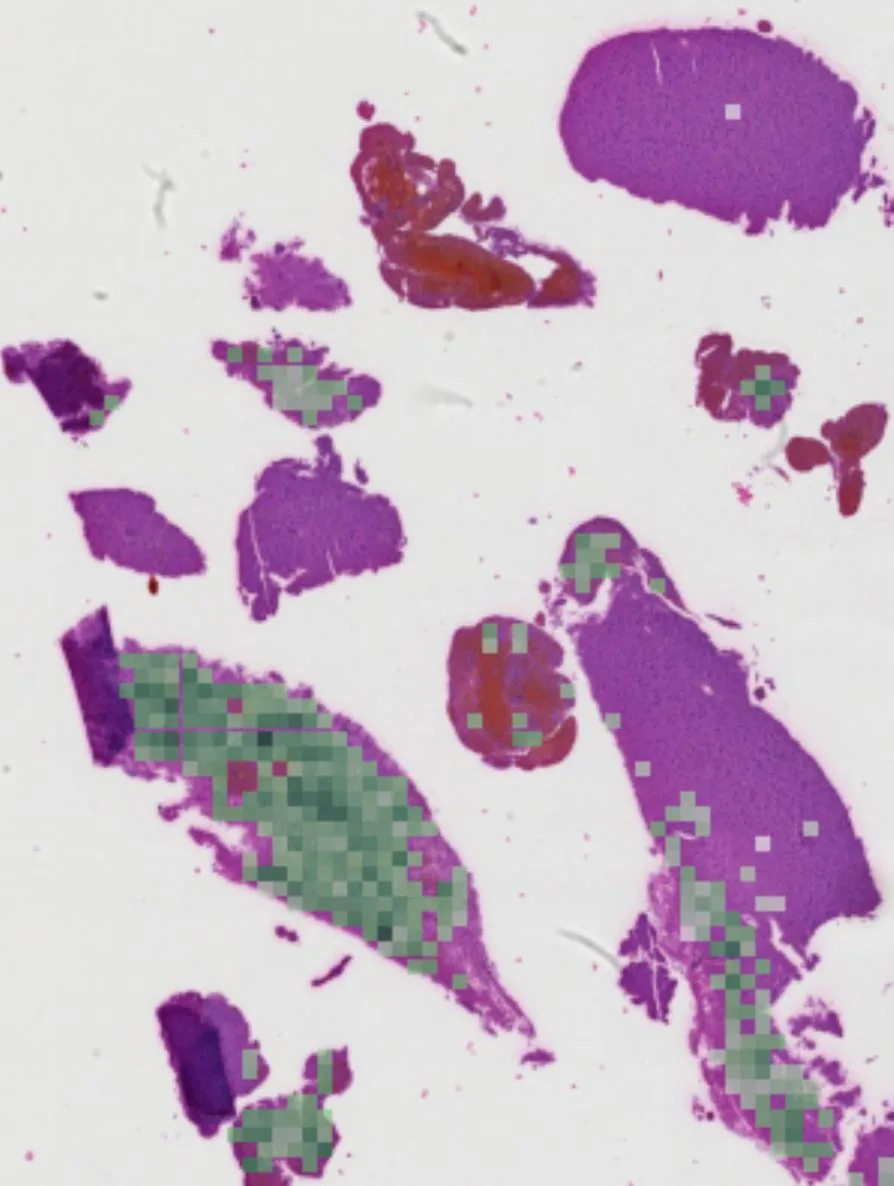
Imagine trying to figure out what happened in a room from the sound that lingers after a gunshot. The shot is gone, but the echo still bounces off the walls. That's roughly how a neuropathologist views a brain tissue section where the tumor itself is absent: the biopsy only captured healthy tissue that reacted to the disease. Up to 14% of brain biopsies contain no tumor cells, forcing the physician to tell the patient that the cause of their illness remains unknown. But what if that 'empty' tissue still hides a signal?
The authors took 245 stained sections from 186 patients with confirmed diagnoses. From each section, they manually removed tumor regions, leaving only reactive tissue: tissue that changed in response to the disease but is not itself tumor. Then they divided each section into small square patches and converted each patch into a numeric vector using four different encoder models. These vectors were aggregated into a single section vector via an attention mechanism that weighs the importance of different image regions. The model then learned to distinguish three classes: tumor, inflammation, and healthy tissue.
The first result was sobering. On the coarse task of 'tumor/inflammation/control,' the model barely outperformed a simple logistic regression that only considered section size: balanced accuracy of 0.798 versus 0.782. In other words, the model mostly learned to tell large sections from small ones, not disease from health. But on finer tasks, the situation changed. When the goal was to determine the glioma type or the organ of origin for a metastasis, section size no longer helped: the baseline dropped to chance level. Yet the models still classified significantly better than chance (p≤10⁻⁴ in a permutation test). This means that reactive tissue does indeed carry a signal that cannot be reduced to technical artifacts.
Interestingly, all four encoder models achieved identical accuracy: pairwise differences vanished after correction for multiple comparisons. This hints that the limitation lies not in how images are represented but in the signal itself: it is weak, diffuse, and hidden in tissue that pathologists traditionally consider non-diagnostic. Meanwhile, the models' attention was partly drawn to blood introduced during tissue collection: for one model, such patches accounted for 27% of the top-5, while for another only 4%. So models with equal accuracy may focus on completely different regions of the section, and a 'correct' answer does not guarantee that the model found a biologically meaningful feature.
This work shows for the first time that a disease signal persists in 'empty' parenchyma and can be extracted automatically. At the same time, it introduces a mandatory control: a baseline using only section size, which exposes false success on the coarse task. For the community, this is a signal: benchmarks in computational pathology must check whether a model is exploiting sample preparation artifacts. The echo after the gunshot can indeed be heard, but you must first ensure you are not just hearing the room's own reverberation.
Models with identical accuracy can focus on completely different regions of a slide: one fixates on hemorrhages from tissue collection, another on subtle glial changes. In other words, a "correct" answer does not guarantee that the model found a biologically meaningful feature.
The idea of reading disease from the body's reaction rather than the pathogen itself echoes stories of diagnosis by indirect clues, like in the TV series "House M.D.", where the team diagnoses based on subtle symptoms rather than an obvious cause.