Atomic Route of the Insulator–Metal Transition Under a Light Strike
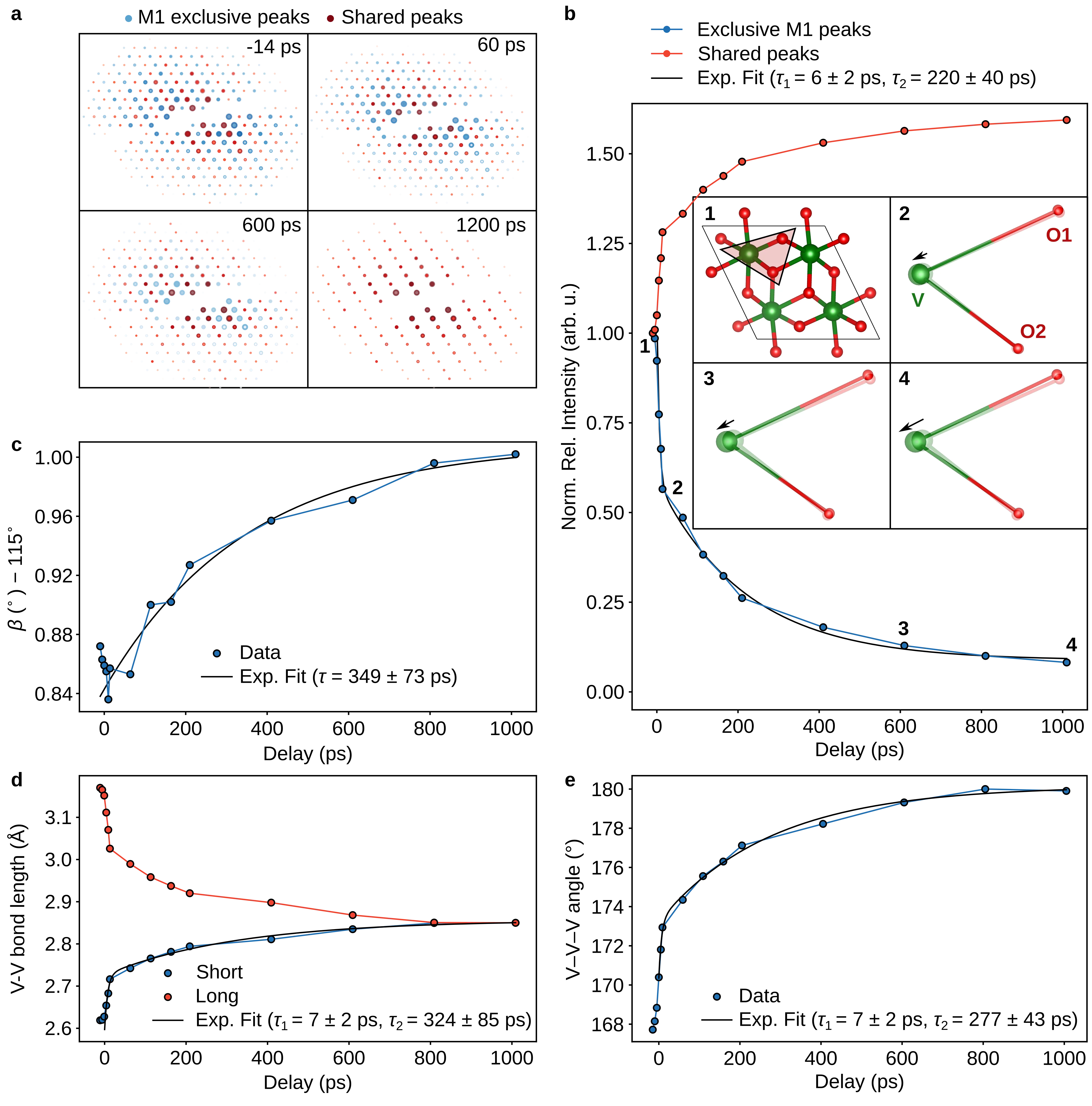
The camera captures not a race but a dance of atoms. In vanadium dioxide, the transition from an insulating to a metallic state occurs within trillionths of a second, yet until now no one had seen exactly how the vanadium and oxygen atoms move. Now, ultrafast electron diffraction has captured this route frame by frame.
The experiment is like filming a fast dance from different angles. A VO₂ crystal about 100 nanometers thick was excited by laser pulses of 300 femtoseconds duration, then probed with electron pulses of 1.5 picoseconds duration. The crystal was tilted at various angles, collecting hundreds of diffraction spots that assembled into a full three-dimensional picture. From these data, the coordinates of all atoms were reconstructed at each moment in time.
The main surprise: the gap in electronic energies disappears not because of the shift of the whole lattice, but because of the breaking of vanadium pairing. Calculations showed that if only the lattice shift is included, the material is already metallic, but if pairing is preserved, the gap remains. This changes previous ideas about the transition mechanism.
This approach turns diffraction from observing individual peaks into true crystallography of unstable phases. The method can be applied to other oxides and materials where light controls phase transitions, which is important for developing ultrafast switches and memory devices.
The camera stopped, and the atomic dance became clear: they move along a straight line, and the music of the gap falls silent when the vanadium pairs break apart. Now this route can serve as a benchmark for other materials.
Vanadium dioxide transitions to the metallic state at about 340 K, which is only slightly above room temperature. Because of this, it is used in smart windows that begin to reflect infrared radiation when heated.