Atomic Route of the Insulator–Metal Transition Under a Light Strike
Context
Neighboring works in the archive have already shown how ultrafast methods allow us to see the dynamics of materials over trillionths of a second, control light in crystals, and track the melting of magnetic order. This article follows the same vein but goes a step further: instead of tracking individual diffraction peaks, it reconstructs the full three-dimensional structure of the transition state. This turns diffraction from a tool for observing an order parameter into true crystallography of unstable phases.
Methods
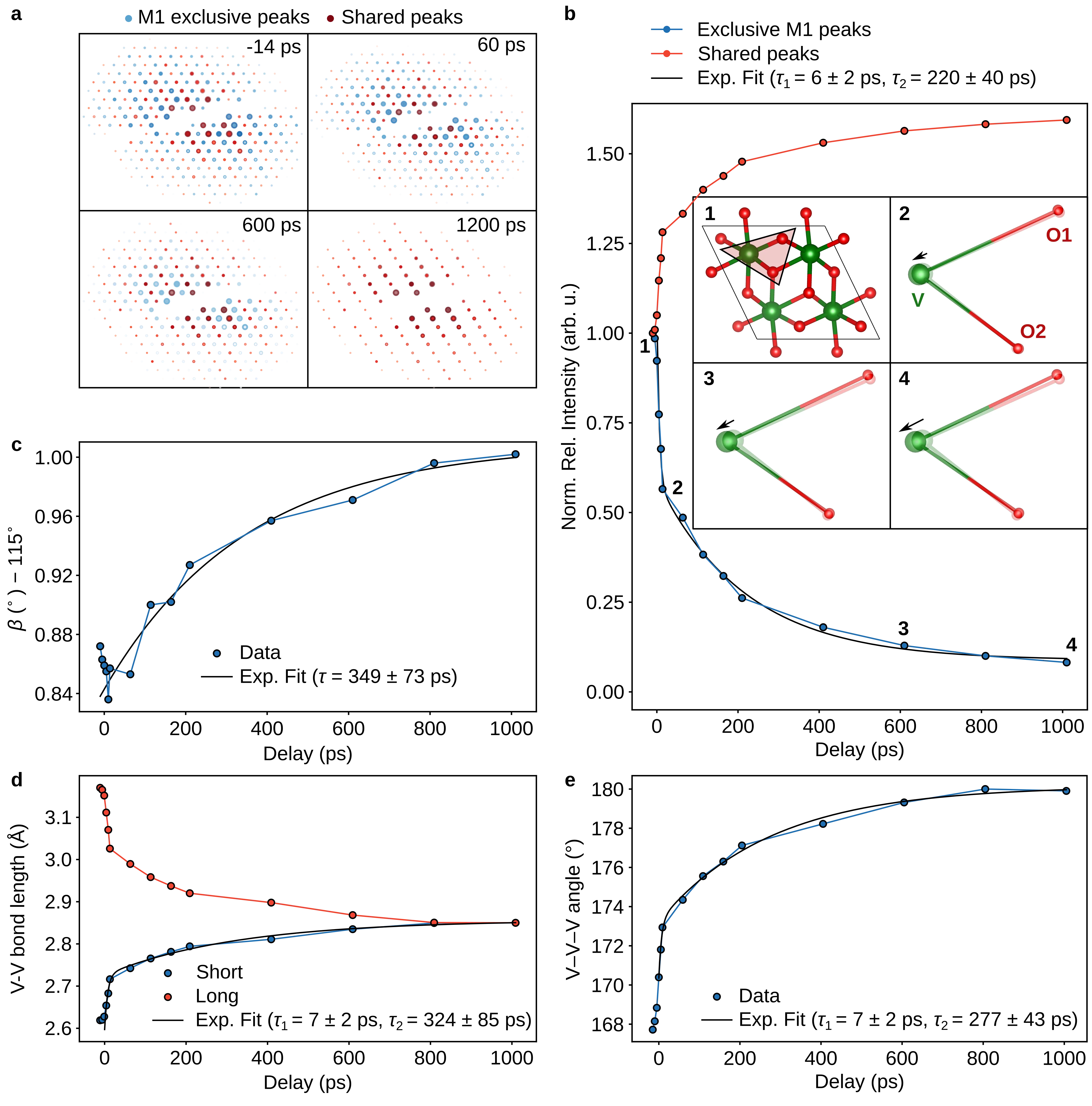
A VO₂ sample about 100 nm thick was excited by laser pulses with a photon energy of 1.2 eV and a duration of 300 fs, then probed by electron pulses with a duration of 1.5 ps at a repetition rate of 12 kHz. The crystal was tilted at various angles, and at each time delay hundreds of Bragg reflections were collected and merged into a three-dimensional dataset. Atomic coordinates were refined by two independent methods: a full set of reflections in the SHELXL program and a least-squares method using only peaks characteristic of the monoclinic phase. Both approaches gave consistent results.
Results
The intensity of peaks unique to the monoclinic phase decays as a double exponential: the fast component halves the signal in 10 ps, while the slow component completes the suppression in 400 ps. The monoclinic angle β changes more slowly, with a characteristic time of 380 ps. The vanadium and oxygen coordinates move almost along a straight line from the M1 to the R structure, with half of the displacement occurring in the first few picoseconds. Residual vanadium dimerization persists at a level of 15% even after a nanosecond. Cluster DMFT calculations for the refined structures yield a gap of 0.67 eV in the equilibrium state, matching experiment. If interactions are turned off, the gap disappears, although the splitting of the d|| orbitals due to dimerization remains about 1.5 eV. The structure with only a lattice shift turns out to be metallic.
Implications
Unlike neighboring works that tracked individual peaks or order parameters, here the full atomic coordinates in the transition state have been reconstructed for the first time. This allows a direct link between lattice geometry and electronic properties, rather than inferring it indirectly. The article shows that vanadium dimerization is the main structural factor opening the gap, while the lattice shift plays a supporting role. This approach could become a benchmark for studying other correlated materials.
Future development
The method of ultrafast three-dimensional electron diffraction can be extended to other transition metal oxides, chalcogenides, and organic crystals where phase transitions are driven by light. Improving the temporal resolution to tens of femtoseconds would allow observation of coherent lattice vibrations and their coupling to electronic excitations. Combining with GW+DMFT calculations would provide a more accurate description of nonlocal screened interactions.
Impact
The results are important for the physics of correlated electrons, oxide materials science, and the development of ultrafast switches based on metal–insulator transitions.
Next steps
To check whether the linear trajectory persists at other excitation energies and temperatures. To investigate the role of local distortions invisible to Bragg diffraction using diffuse scattering.
Key open problems
For condensed matter physics, the question of which structural distortions drive electronic transitions in correlated oxides remains open. This work links the disappearance of the gap to the loss of dimerization, but does not account for possible inhomogeneities and polaron effects that may affect local conductivity.
Vanadium dioxide transitions to the metallic state at about 340 K, which is only slightly above room temperature. Because of this, it is used in smart windows that begin to reflect infrared radiation when heated.
Key numbers
- sample thickness: 100 nm
- laser pulse duration: 300 fs
- electron probe duration: 1.5 ps
- fast decay constant: 10 ps
- slow decay constant: 400 ps
- calculated gap: 0.67 eV