Dusty Plasma Sorts Particles Like Escalators of Different Heights ✛
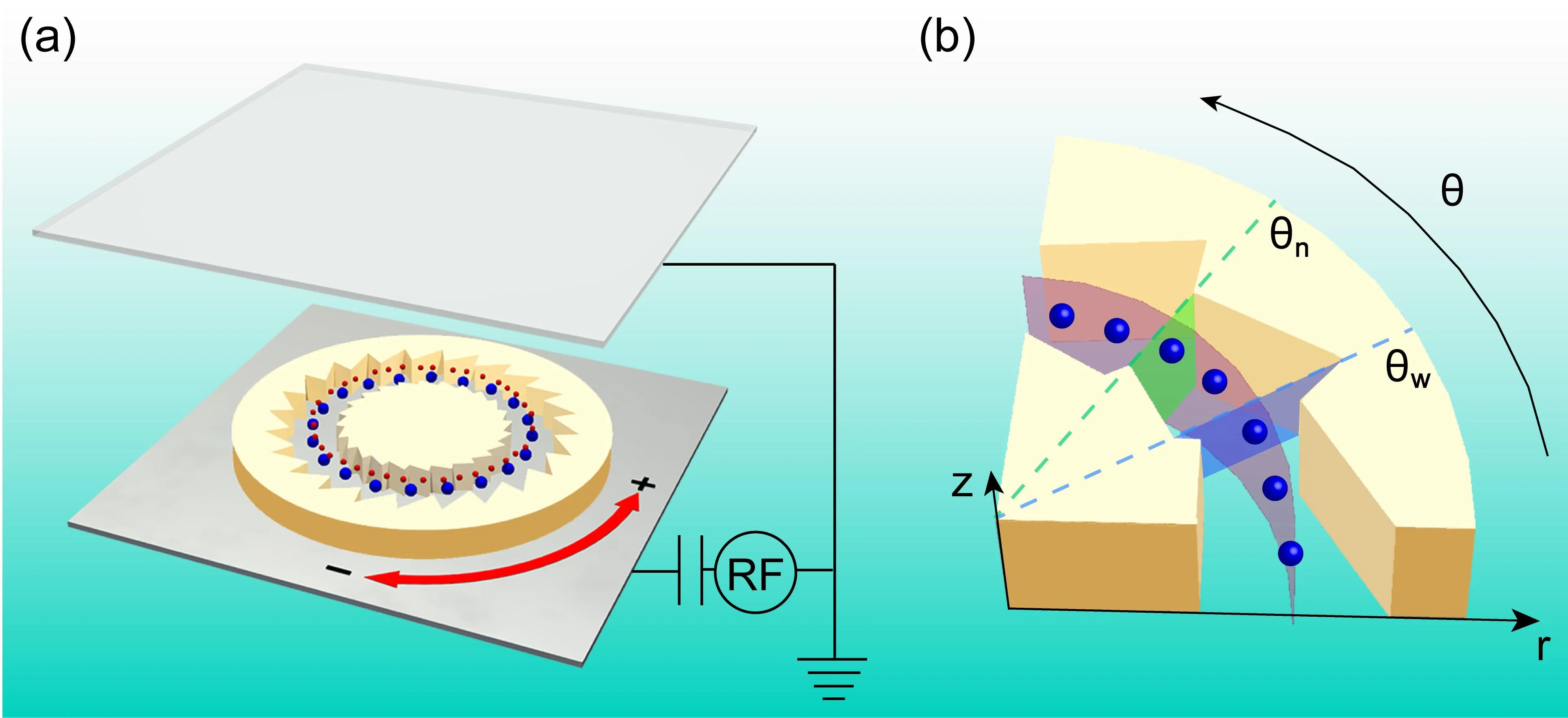
In a chamber with rarefied gas, an electric discharge is ignited. Tiny spheres float in it: some have a radius of 8 micrometers, others 14. The spheres become charged and repel each other. They hover at different heights: lighter ones higher, heavier ones lower. It's like escalators in a shopping mall that move in different directions for people of different heights.
The channel along which the spheres move is sawtooth-shaped. The teeth create an uneven electric landscape. If a sphere hovers high, it rolls to one side. If low, to the other. This mechanism is called a ratchet: it turns random jolts into directed motion.
By changing the discharge power and gas pressure, the scientists controlled the levitation height of the particles. At 25 watts, small particles moved one way and large ones the other. At 30 watts, both groups went in the same direction, but the small ones were three times faster. This could sort microparticles faster than in liquid, where they get stuck due to friction.
The flow speed of dust particles in this experiment reached 1 cm/s, comparable to the speed of a snail.
The idea of separating particles with an asymmetric potential is reminiscent of Maxwell's demon, which sorts molecules by speed, but here everything works without violating the second law of thermodynamics.