Dusty Plasma Sorts Microspheres Like Escalators of Different Heights ✛
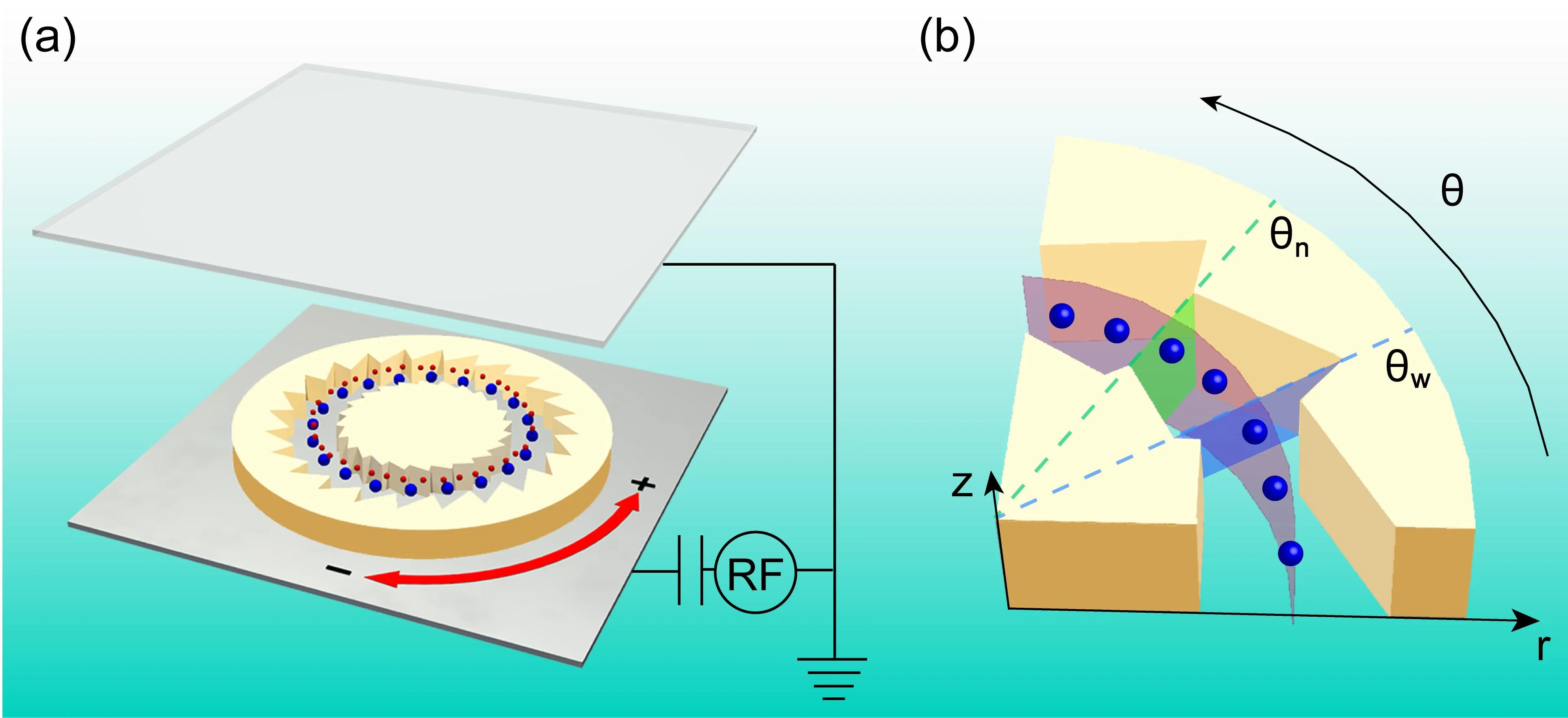
In a ring-shaped channel between two toothed rings, microspheres are suspended: some with a radius of 8 micrometers, others 14. The discharge is switched on, and the particles start moving. The small ones go one way, the large ones the other. It is like a shopping mall where escalators for people of different heights run in opposite directions.
Dusty plasma is simple in design: an electric discharge is ignited in a rarefied gas, and microscopic dust grains are suspended in it. The grains become charged, repel each other, and arrange into ordered layers. Above the lower electrode, they are held by a layer of plasma where the electric field is strongest. The levitation height depends on particle size: a light grain floats higher, a heavy one settles lower.
The channel through which the particles move has a sawtooth shape. The teeth create an uneven electric landscape, similar to a washboard. If a particle hovers high, it feels a tilt in one direction and rolls that way. If it hovers low, the tilt is opposite, and the particle moves back. This mechanism is called a ratchet: it rectifies random jolts into directed motion.
By adjusting the discharge power and gas pressure, the researchers changed the levitation height of the particles. At a power of 25 watts and a pressure of 25 pascals, the small particles moved in one direction, while the large ones went the other way. At 30 watts, both groups moved in the same direction, but the small ones were three times faster: their angular speed was 0.038 radians per second, while the large ones had 0.013. At 12 watts, both groups moved in the opposite direction, again at different speeds.
Previously, dusty plasma could only straighten the flow of identical particles. Now it is clear that particles of different sizes can be made to move independently, as if each size has its own escalator. This opens the way to plasma sorters that work faster than their liquid counterparts: in a liquid, microparticles get bogged down due to strong friction, whereas in plasma they glide almost freely.
The method has already been tested in air plasma, and a straight-line design with two outlets is ready for continuous sorting. What remains is to understand how to avoid the influence of the ion wake when the size difference between particles is small. But the first step is done: escalators for dust grains of different heights are running.
The flow speed of dust particles in this experiment reached 1 cm/s, comparable to the speed of a snail.
The idea of separating particles with an asymmetric potential is reminiscent of Maxwell's demon, which sorts molecules by speed, but here everything works without violating the second law of thermodynamics.