Dusty Plasma Sorts Microspheres by Size ✛
Context
Sorting particles by size is important in many fields, but in ordinary liquids particles move slowly due to strong friction. Dusty plasma, where microspheres are charged and weakly coupled to the gas, allows particles to move quickly, up to 1 cm/s. Nearby on the archive are studies of beam instabilities in plasma accelerators and plasma self-focusing, but this work stands apart: it uses a ratchet mechanism to separate particles, not to accelerate or focus them.
Methods
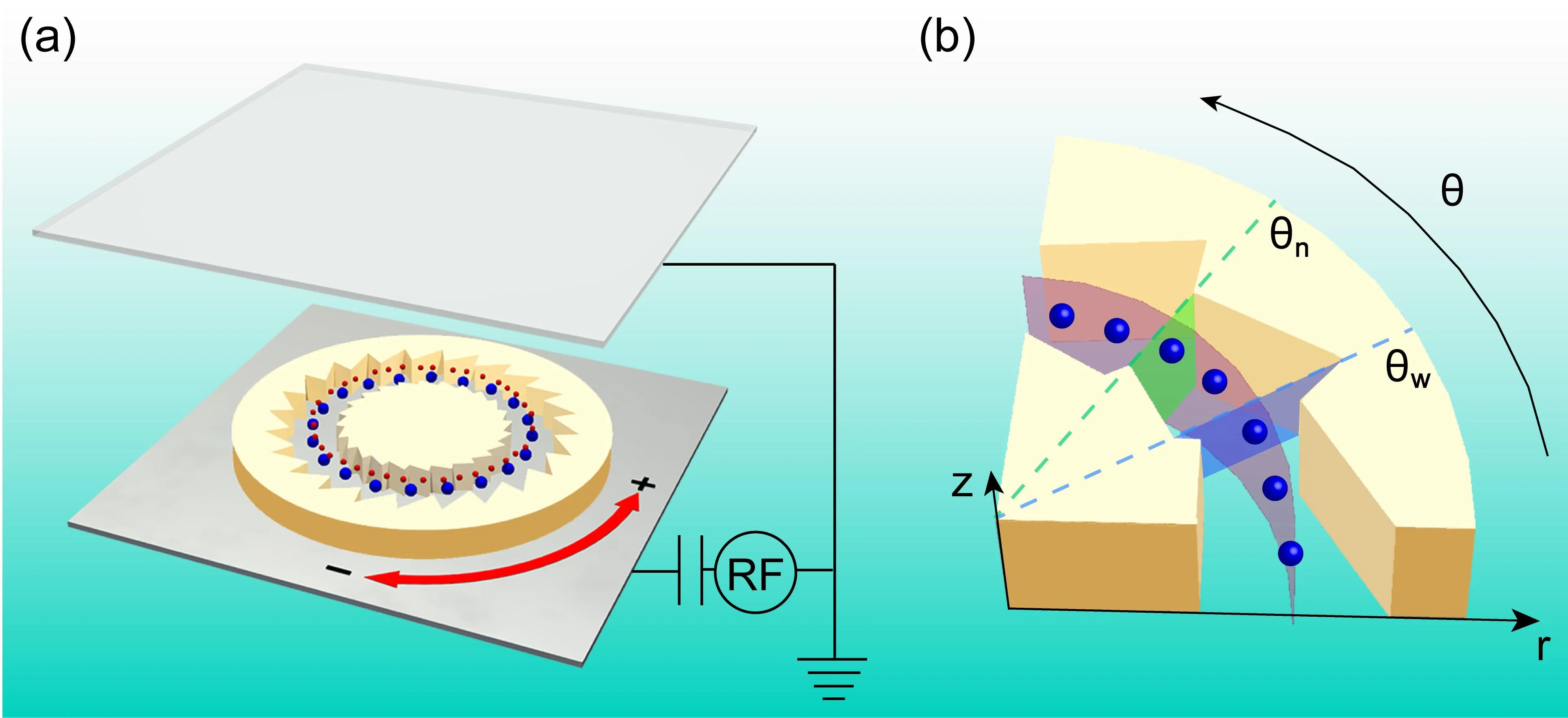
The researchers built a ring-shaped channel between two toothed rings in a chamber with argon plasma. Microspheres of two sizes, with radii of 8 and 14 micrometers, were introduced into the channel. The particles became charged in the plasma and levitated above the lower electrode. Their motion was recorded with a camera from above at 50 frames per second. Then, using numerical simulations in COMSOL, they calculated the electric field and potential distribution in the channel to understand at what height the particles levitate and what ratchet potential they experience.
Results
At a pressure of 25 Pa and a power of 20 W, particles with a radius of 8 micrometers moved in the positive direction, while those with 14 micrometers moved in the negative direction. At a power of 30 W, both groups moved in the positive direction, but the small particles had an angular speed of 0.038 rad/s and the large ones 0.013 rad/s, a threefold difference. At a power of 12 W, both groups moved in the negative direction but at different speeds. Simulations showed that particles of different sizes levitate at different heights and encounter ratchet potentials with different orientations or barrier heights.
Implications
This work differs from neighboring studies in that it demonstrates for the first time the separation of particles in dusty plasma using a ratchet potential. Previously, only rectification of the flow of identical particles was studied in dusty plasma; here it is shown that the motion of particles of different sizes can be controlled independently. This opens the way to creating plasma-based particle sorters that operate faster than their liquid counterparts.
Future development
The method can be extended to other particle sizes and other gases. The authors have already tested separation in air plasma and developed a straight-line design with two outlets. In the future, it may be possible to create devices for continuous sorting of microparticles on an industrial scale.
Impact
The technology could find applications in microfluidics, pharmaceuticals, and materials science for sorting microparticles.
Next steps
The influence of the ion wake on separation efficiency needs to be investigated, and the design optimized to increase throughput.
Key open problems
An open question remains how collective effects in strongly coupled dusty plasma affect particle transport at high density. It is also unclear how to avoid the influence of the ion wake when the size difference between particles is small.
The knowledge machine's view
This section is addressed to the author of the paper and their colleagues. Neighbouring works were found by meaning-based search across our archive, not by word overlap. We do not review: we show the field around the work.
What the work does
The study experimentally demonstrates the separation of microspheres with radii of 8 and 14 μm in dusty plasma using an asymmetric annular channel. By tuning the discharge power and gas pressure, the authors achieved motion of particles of different sizes in opposite directions or at different speeds. Numerical simulations in COMSOL showed that particles of different sizes levitate at different heights and experience different ratchet potentials.
Where its strength is
The main strength lies in using a ratchet mechanism to separate particles by size in dusty plasma, which had not been demonstrated before. This provides a fast (up to 1 cm/s) and tunable sorting method that could potentially outperform liquid-based counterparts.
Where it could go next
- A related paper in the archive shows how ultrasound scatters particles; combining acoustic fields with plasma ratchets might offer extra degrees of freedom for controlling separation.based on: How Ultrasound Scatters Particles arXiv:2601.13582
- It could be interesting to examine particle dynamics in more complex geometries, as in the study of particles getting stuck in a maze, to understand how channel inhomogeneities affect sorting efficiency.based on: How Particles Get Stuck in a Maze arXiv:2603.04048
- Since particles in dusty plasma can form ordered structures, it might be worth comparing with work on waves in inhomogeneous plasma to study collective effects during separation.based on: How Plasma Waves Learn to Live with Inhomogeneity arXiv:2607.16779
Worth trying
- Try adding an acoustic field, as in work 2601.13582, to modulate the levitation height of particles and broaden the range of separable sizes.
- Test how the ratchet potential behaves when local obstacles or channel bends are introduced, similar to the maze in 2603.04048.
- Investigate whether collective modes emerge in the particle flow at high concentrations, building on approaches from 2607.16779.
Why this may matter
The proposed method could underpin fast plasma-based sorters for microparticles, which are needed in purification technologies, materials science, and analytical chemistry, where speed and precision of separation are critical.
Nearby works in our archive
- What a Cosmic Hurricane Sounds Likesimilarity 0.54
- Laser Beam in a Plasma Channel: How to Measure Its Speedsimilarity 0.54
- How Particles Get Stuck in a Mazesimilarity 0.53
- Cosmic Blender: How Electrons Outrun Protonssimilarity 0.53
- Cosmic filaments pull in two directionssimilarity 0.52
- How Plasma Waves Learn to Live with Inhomogeneitysimilarity 0.52
- How Ultrasound Scatters Particlessimilarity 0.52
The archive is sparse around this work: the closest review is only 0.54, against a usual 0.64. It looks like few have drilled nearby.
The flow speed of dust particles in this experiment reached 1 cm/s, comparable to the speed of a snail.
The idea of separating particles with an asymmetric potential is reminiscent of Maxwell's demon, which sorts molecules by speed, but here everything works without violating the second law of thermodynamics.
Key numbers
- particle radii: 8 and 14 micrometers
- flow speed: up to 1 cm/s
- angular speed of small particles: 0.038 rad/s
- angular speed of large particles: 0.013 rad/s
- gas pressure: 15–40 Pa
- discharge power: 12–30 W