A translator who never misses a whisper ✛
A courtroom interpreter catches every word, every breath, every whisper in the corner. They have no right to miss a detail, because the meaning of the whole conversation depends on it. Quantum state tomography works in much the same way: it reconstructs the full quantum state of a system from a set of measurements, leaving no detail out.
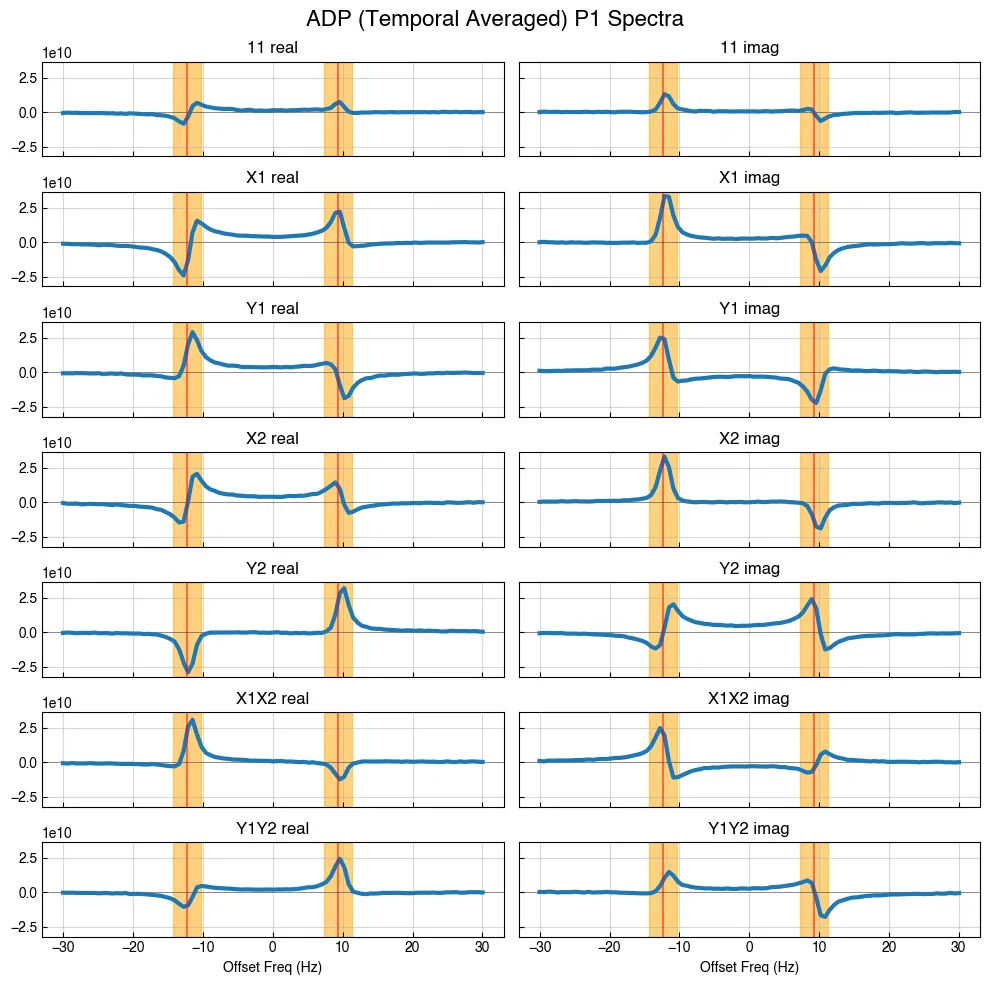
For a long time this "interpreter" was locked inside the black box of commercial software. Researchers saw only the result, never the process itself: how exactly raw data from the instrument turn into a density matrix, the mathematical description of a quantum state. The Tomography-NMR package opens that box. It takes the time-domain signal, applies a Fourier transform, corrects the phase, and then extracts peak intensities from the spectrum.
Every doublet, that is, a pair of peaks from coupled spins, encodes two numbers: the sum and the difference of the left and right peaks. These numbers are directly tied to the coefficients in the expansion of the state over the product operator basis. The resulting matrix is then subjected to physical constraints: it must be Hermitian, have a trace equal to one, and be positive semidefinite. That is how a correct quantum state is born from a spectrum.
A test on 20 experimental states prepared on two phosphorus-31 nuclei in an ADP molecule showed an average accuracy from 0.975 to 0.995. Basis states were reconstructed with an accuracy of 0.995, outputs of the Hadamard gate with 0.992, and Bell states with 0.980. Optimized integration for individual states reaches 0.998, whereas methods that do not know the target stay around 0.98.
In the past, checking someone else's result meant trusting closed-source code or reproducing it from scratch. Now anyone can download Tomography-NMR, run the same data through it, and compare the density matrices. For experimental quantum information science this means a shift in practice: transparency and reproducibility become the norm rather than the exception. Students get a hands-on teaching tool, and researchers get a common language for comparing results.
The interpreter no longer sits behind soundproof glass. They have stepped into the room, and anyone can hear exactly how they turn whispers into meaning.
The package is called Tomography-NMR and is distributed under the MIT license, which allows free use in academic and commercial projects. Validation was performed on the ADP molecule, where two phosphorus-31 nuclei are coupled through a J interaction of about 22 Hz.