Tomography of spin ensembles: turning a spectrum into a quantum state ✛
Context
The work sits off to the side: its closest neighbors in the archive deal with quantum algorithms, error correction, and quantum information, but do not touch practical state reconstruction from spectra. Tools for simulating spin dynamics (PULSEE) and general libraries (QuTiP, nmrglue) already exist, yet the link between raw spectrometer data and a validated density matrix was missing. Tomography-NMR fills this niche, setting itself the task of transparent and reproducible processing of NMR data for quantum tomography.
Methods
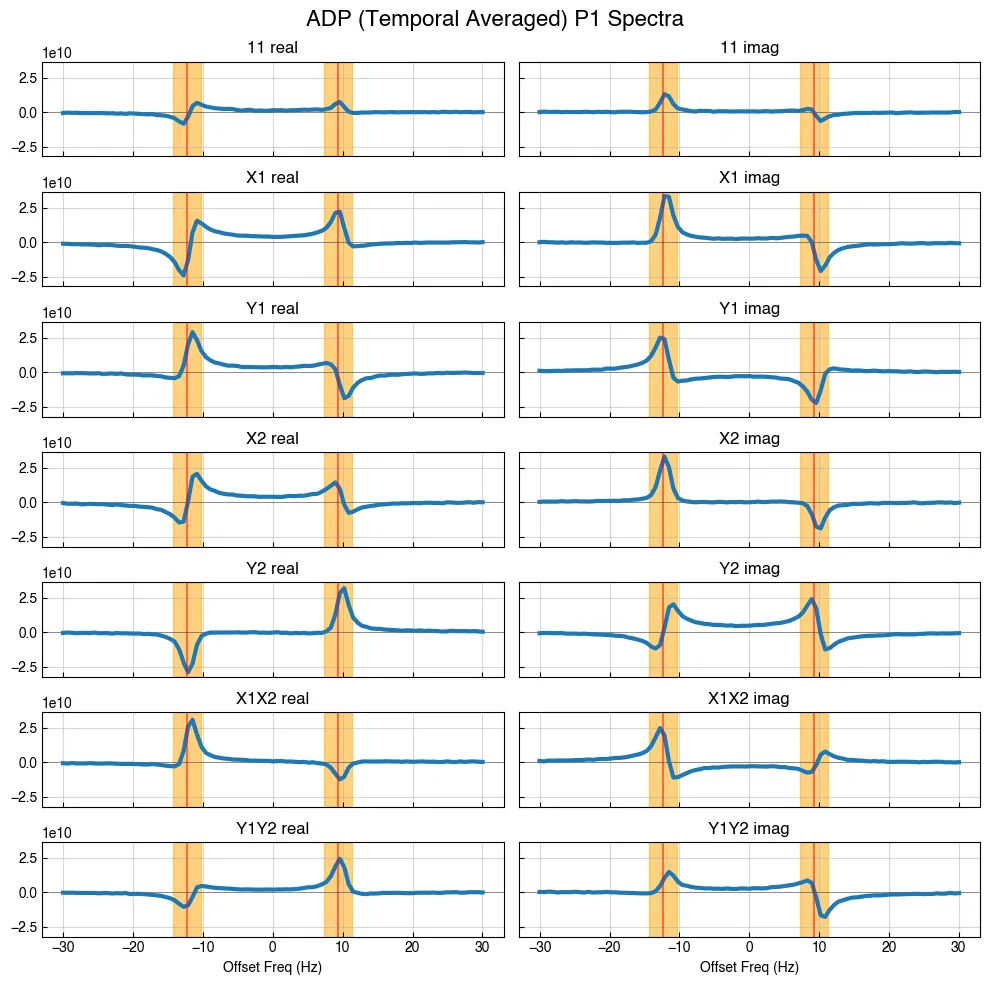
The package implements an analysis pipeline in Python 3.11+: raw time-domain signals undergo Fourier transformation with automatic or manual phase correction, after which the peak intensities of doublets are extracted in three ways. The first is direct measurement of the peak height at a single point; the second is numerical Simpson integration over a fixed window; the third is a systematic sweep of parameters (frequency shifts, window width, splitting correction) to maximize accuracy relative to a known theoretical state. The sum and difference of the left and right peaks of a doublet are mapped onto product operator coefficients via a lookup table, after which the density matrix is reconstructed subject to physical constraints (Hermiticity, trace normalization, positive semidefiniteness).
Results
On 20 experimental states prepared on two coupled phosphorus-31 nuclei in ADP, the average reconstruction fidelity by the Fortunato metric ranged from 0.975 to 0.995 depending on the state category. Basis states reached 0.995, outputs of the Hadamard gate 0.992, CNOT 0.983, Bell states 0.980, and the H+T combination 0.975. Optimized integration gives accuracy above 99% for individual states (up to 0.998 for |00⟩), whereas methods that do not know the target state stay around 98%. Density matrix element errors are estimated at the level of 10⁻³–10⁻⁴.
Implications
Unlike neighboring work focused on algorithms or simulation, this work solves the inverse problem: reconstructing a quantum state from real experimental spectra. It provides the first open and fully documented pipeline for NMR tomography, removing dependence on closed commercial software and enabling independent verification of published results. This changes the practice of experimental quantum information science, making it more transparent and reproducible.
Future development
Extending to systems with three or more qubits will require solving the problem of overlapping multiplets and the scalability of optimization. A prototype module for three spins is already included, but full support remains an open task. Also planned are Bayesian optimization instead of grid search, real-time analysis for adaptive protocols, and new validation metrics such as entanglement witnesses.
Impact
The work will influence experimental quantum information science, especially NMR quantum computing, by providing a standardized tool for state characterization. It will also speed up the training of new specialists and make it easier to compare results between groups.
Next steps
The immediate steps include implementing Bayesian optimization to speed up parameter search and developing spectral deconvolution methods for three-qubit systems. It is also important to expand support for data formats from other spectrometers.
Key open problems
For quantum information science, the problem of scalable state tomography remains unsolved: the number of measurements grows exponentially with the number of qubits. This work does not solve it, but it sets a benchmark of accuracy and transparency for the two-qubit case, which is necessary for testing future methods.
The knowledge machine's view
This section is addressed to the author of the paper and their colleagues. Neighbouring works were found by meaning-based search across our archive, not by word overlap. We do not review: we show the field around the work.
What the work does
The work describes Tomography-NMR, an open-source package that runs the entire pipeline from raw NMR signal to a validated density matrix, using the product operator formalism and three peak-integration methods. Across 20 experimental two-qubit states, it achieves an average accuracy of 0.975-0.995. The modular architecture makes it possible to adapt the package to other spectroscopic platforms.
Where its strength is
The package offers a transparent, reproducible tool for NMR tomography, removing the dependence on proprietary software and enabling independent verification of results. Its flexibility in integration methods (with and without a known target state) makes it applicable in a range of experimental scenarios.
Where it could go next
- It may be worth comparing the proposed approach with shadow tomography methods, which estimate state properties from fewer measurements. Our archive holds a related paper in which shadows are used to speed up reconstruction and improve its accuracy.based on: Shadows of Quantum States: How to Measure Faster and More Accurately arXiv:2603.28307
- It might be worth considering machine learning for automatic phase correction or peak classification, much as neural networks are used to analyze spectra in other fields. The archive includes an example of fast information extraction from spectral data using a trained model.based on: Neural Network Reads Stars' Chemical Passport in Seconds arXiv:2604.03082
- It would be interesting to explore how the package could be adapted to other spin systems or platforms, for instance electron spin resonance, drawing on work on recognizing topological phases from single-spin spectra.based on: Topology by Aroma: How One Spin Gives Away the Quantum Phase arXiv:2607.10656
Worth trying
- Test accuracy estimation for tomography based on randomized measurements (shadows) to cut down the number of experiments required.
- Check whether a neural network can be trained on synthetic spectra to automatically select optimal integration parameters.
- Apply the pipeline to electron spin resonance data to test how universal the approach is.
Why this may matter
An open, reproducible tool for NMR tomography could become a standard in experimental quantum information science, boosting transparency and comparability of results between laboratories. Extending it to other platforms and integrating it with modern reconstruction methods could speed up progress toward quantum devices.
Nearby works in our archive
- How Measurement Gives Rise to Quantum Noisesimilarity 0.51
- Neural Network Reads Stars' Chemical Passport in Secondssimilarity 0.51
- Hybrid Intelligence: Quantum Hearing Distinguishes Topological Phasessimilarity 0.51
- Shadows of Quantum States: How to Measure Faster and More Accuratelysimilarity 0.51
- Topology by Aroma: How One Spin Gives Away the Quantum Phasesimilarity 0.50
The archive is sparse around this work: the closest review is only 0.51, against a usual 0.64. It looks like few have drilled nearby.
The package is called Tomography-NMR and is distributed under the MIT license, which allows free use in academic and commercial projects. Validation was performed on the ADP molecule, where two phosphorus-31 nuclei are coupled through a J interaction of about 22 Hz.
Key numbers
- reconstruction accuracy (optimized): up to 0.998
- reconstruction accuracy (without knowing the target): about 0.980
- number of validated states: 20
- number of non-identity coefficients for two qubits: 15
- optimization time for one state: 2–5 minutes