How to Hear the Faintest Signal express
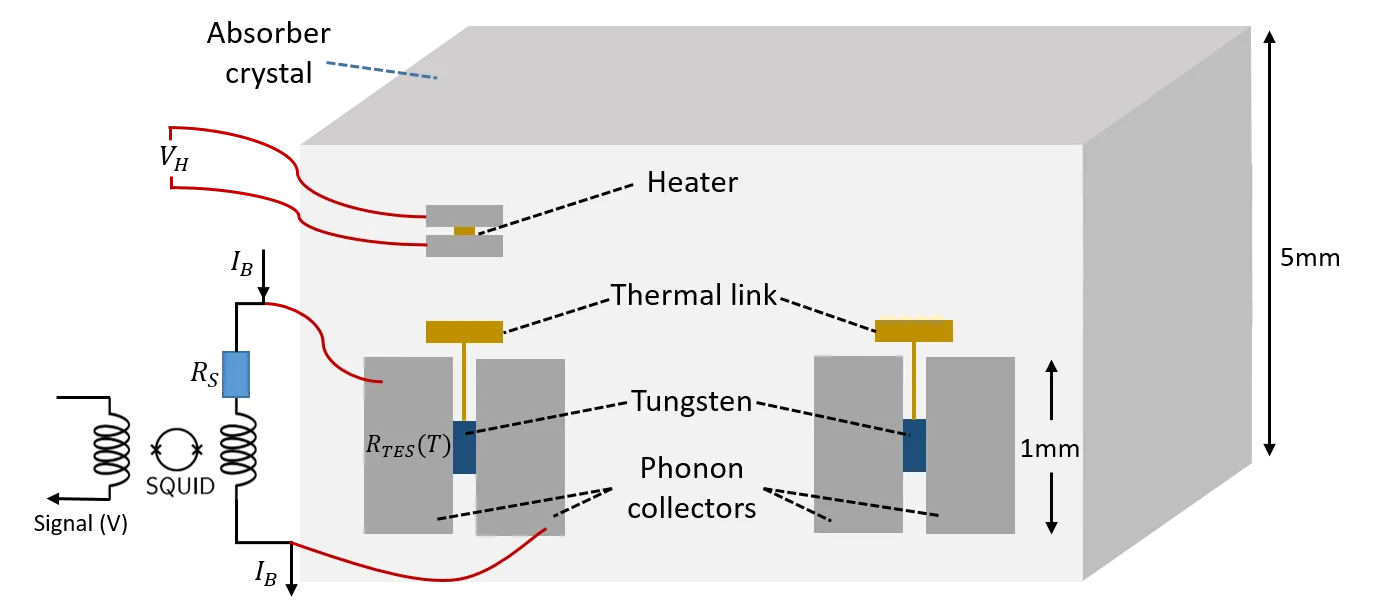
A detector that hunts for rare particles is like an ear trying to catch a whisper in a noisy room. The quieter the signal, the harder it is to tell apart from random noise. In the NUCLEUS experiment, such detectors, cryogenic calorimeters, are cooled to near absolute zero so they can pick up even a faint pulse of heat from a single particle.
To sharpen the instrument's hearing, the scientists used two tricks. First, they swept through many settings and found the one where the signal comes through most clearly. Then they combined readings from two different channels of the same detector, as if listening to a conversation with both ears instead of one. Processing the two signals together helps filter out noise and spot quieter events.
Such a low threshold is a record for detectors based on calcium tungstate. This means that the upcoming NUCLEUS run will be able to search for particles that were previously lost in the noise. Among them, there may be traces of dark matter — the invisible substance that makes up most of the universe.
Original abstract
as written by the authors arXiv:2603.28276
Phonon-mediated cryogenic calorimeters find application in rare event searches due to their intrinsically low energy threshold. Achieving the best sensitivity for this kind of detectors is crucial for signal identification, leading to various optimization techniques. In this work, we present two complementary methods to increase the sensitivity of cryogenic detectors read out by transition-edge sensors, developed and tested in the context of the NUCLEUS experiment. The first procedure maps the signal-to-noise ratio of the device across a wide range of operating points, to identify the configuration with maximal sensitivity to be used during data taking. The second method exploits the double readout of the detector, combining the information on different channels with a two-dimensional optimum filter analysis that effectively lowers the energy threshold. With both techniques at the same time, we obtained a baseline resolution of 2.94 $$\pm$$ 0.05 (stat) eV using a CaWO4 based detector, achieving a promising result in view of the first run of NUCLEUS at the experimental site.
The cryogenic detector operates at temperatures below -270°C — colder than the surface of Pluto.