Jeremy Mould

5 articles · 8 co-authors · latest: 2026-07-20
3 citations · h-index 1 · 9 papersData: Semantic Scholar

We have retold 5 papers by this author. 1 of them with a full read. most often about: primordial black hole, Hawking radiation, dark energy. 8 co-authors across our retellings.

Links in the knowledge graph
Cosmology2026-01-121 minarXiv:2601.07106express
Tiny black holes explain galaxy flows and the expansion of the Universe
Dark matter may not be particles but black holes from the Big Bang era. In the early Universe, which was like a swirling batter, they were like heavy lumps — barely moving, they gathered surrounding matter and spun it into the swift galaxy flows astronomers observe today.
Galaxies2026-03-052 minarXiv:2603.04784express
How black holes could have assembled galaxies
Dough rises faster when it already contains yeast. Similarly, galaxies may have assembled faster if they already had black holes inside. Astrophysicists considered a scenario where the universe contained primordial black holes from the very beginning — objects that could have formed in the first instants after the Big Bang.
Cosmology2026-05-192 minarXiv:2605.19375express
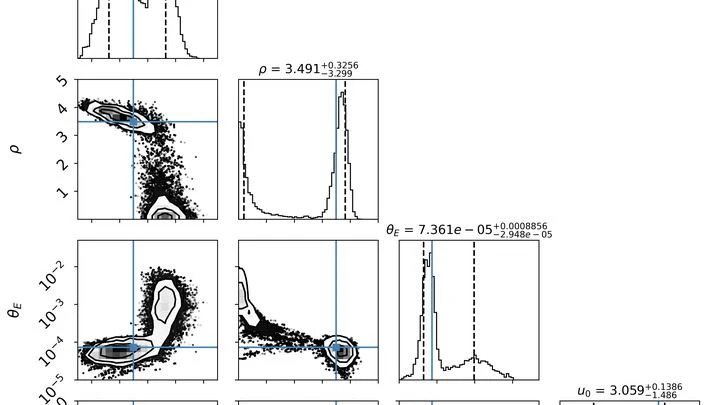
A Moon-Sized Shadow in the Milky Way's Halo
A spotlight shines through a dark hall. Between the lamp and the wall, an invisible lens drifts by, and the spot of light briefly brightens and shifts. That is exactly what the DECam telescope, aimed at the Large Magellanic Cloud, a satellite galaxy of our Milky Way, was watching for five consecutive nights.
Cosmology2026-06-181 minarXiv:2606.19837express
Where Does the Universe's Matter Go?
The universe is like a vast warehouse where a strict inventory was taken long ago. The cosmic microwave background is an ancient record of everything in stock 380,000 years after the big bang. According to it, the fraction of matter in the cosmic 'budget' (the parameter Omega_m) is known with high precision.
Cosmology2026-07-204 minarXiv:2607.18528
Cosmic Hot Tap: How Primordial Black Holes Rewrite the Speed of the Universe
The universe cooled like a giant bathtub after a hot start. At 400 000 years after the Big Bang, hydrogen was ready to recombine — protons capturing electrons to become neutral atoms. But somewhere in this dark water, a tap kept dripping.
