K. Park

4 articles · 30 co-authors · latest: 2026-08-12
127 citations · h-index 6 · 52 papersData: Semantic Scholar

We have retold 4 papers by this author. most often about: neutron star merger, lepton, Standard Model. 30 co-authors across our retellings.

Links in the knowledge graph
HEP Experiment2026-02-102 minarXiv:2602.09800express
Rare Meson Decay: Hunting for Neutrinos
Inside the accelerator, particles collide, and for a fleeting moment a B meson is born — a heavy particle that lives for less than a billionth of a second. Usually, it decays into a shower of debris, but sometimes it transforms into just two particles: a muon and a neutrino. This rare path is like a lottery where the winning ticket appears once in every two million draws.
HEP Experiment2026-02-141 minarXiv:2602.13569express
Hunting Ghost Particles: What Belle II Saw
At Japan's KEK laboratory, electrons and their antimatter counterparts, positrons, collide inside the Belle II detector. In such collisions, new particles are born for a fleeting moment. Among them is J/ψ, a bound state of a charm quark and its antiquark.
HEP Experiment2026-03-221 minarXiv:2603.21168express
Trapping Antimatter: How to Catch What You Can't Touch
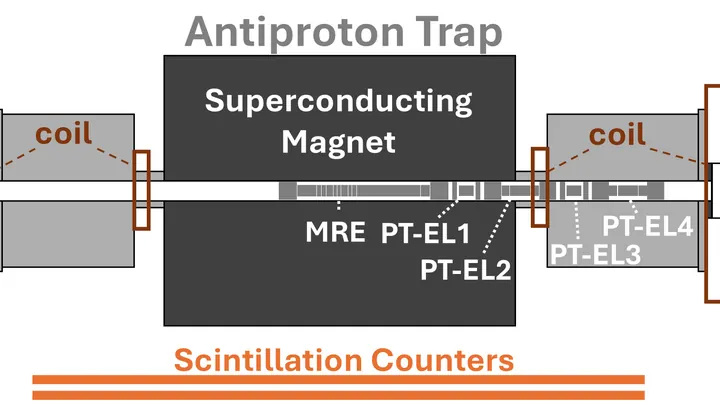
At CERN's antimatter factory, antiprotons are born with the energy of a bullet from a rifle. You can't just put them in a box: they instantly annihilate upon touching ordinary matter. So physicists devised a way to catch them in electromagnetic traps — invisible cages made of fields.
HEP Experiment2026-08-122 minarXiv:2608.11795express
Antiprotons: Bounce or Annihilate?
The antiproton is the mirror twin of the proton: same mass, but negative charge. When it hits matter, it usually annihilates instantly — disappearing in a burst of energy upon colliding with an atomic nucleus.