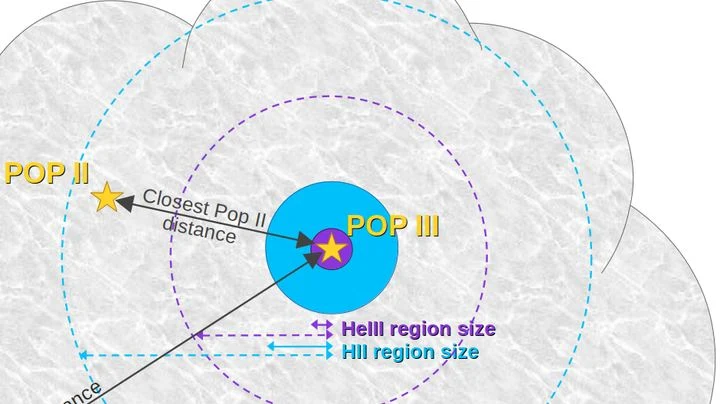
400 million years after the Big Bang, the James Webb Space Telescope noticed a bright spot near the galaxy GN-z11 — like a distant lighthouse whose light pushed through the primordial darkness.
Immediately after the Big Bang, an idea championed by Georges Lemaître, the cosmos was a dark broth of hydrogen and helium. Then the first stars ignited — enormous, dazzlingly bright and hot, like sparks from a cosmic bonfire.
A fisherman's net is stretched across the depths of space. When a massive star dies, it leaves behind a black hole — a sinker in this net. Usually, such sinkers weigh from a few to tens of suns.