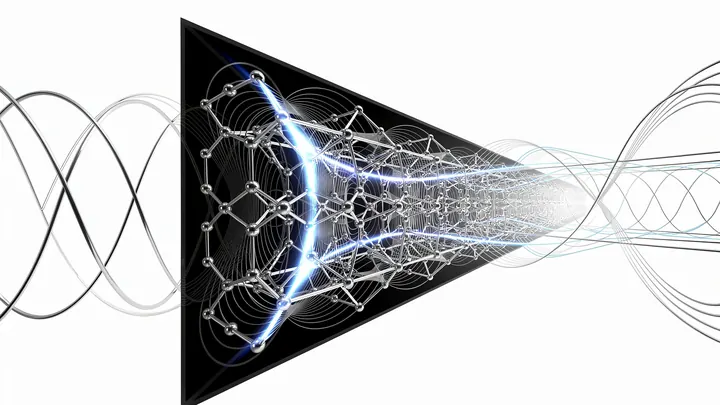
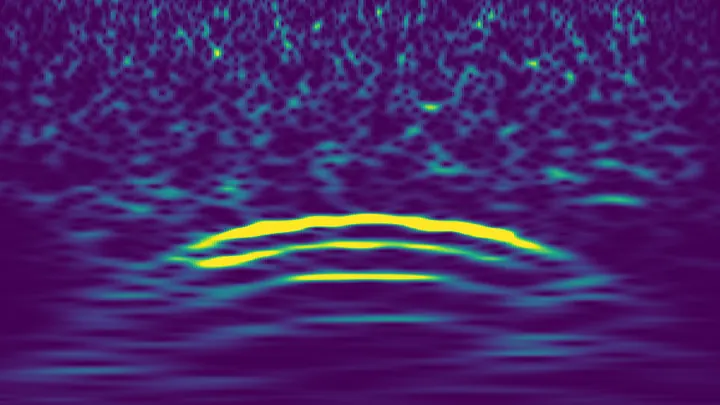
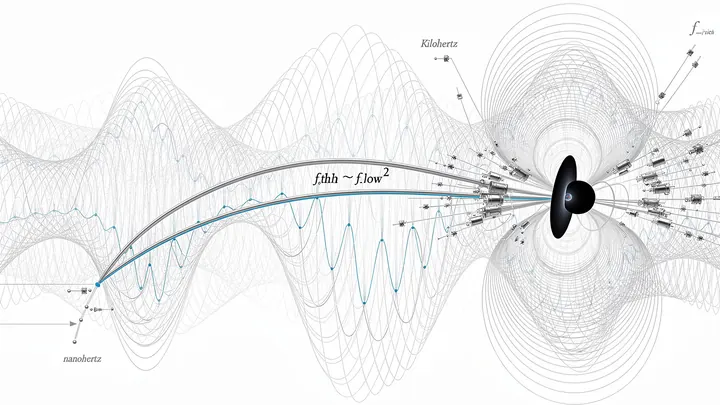
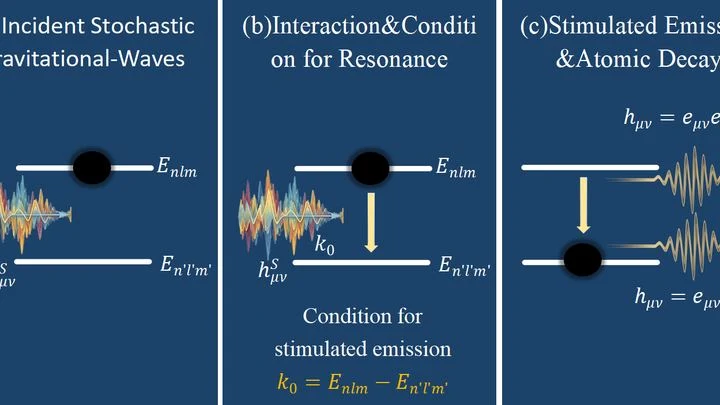
The gravitational wave background is a stochastic signal composed of gravitational waves from many independent sources, such as merging black holes, neutron stars, or processes in the early universe. Unlike individual events detected by LIGO or Virgo, this background is a continuous 'noise' that permeates spacetime. It can carry imprints of dark matter dynamics, cosmic phase transitions, or primordial processes that occurred shortly after the Big Bang.
History
The concept of a gravitational wave background was proposed in the 1960s, but it was only in 2015 that the first direct detection of gravitational waves from a binary black hole merger was made. Since then, pulsar timing arrays have been used to search for a low-frequency background, and in 2023, several collaborations reported evidence for a stochastic background likely originating from supermassive black hole mergers.
How it works
The background is formed by the superposition of gravitational waves from countless unresolved sources. Each source contributes a tiny ripple, but together they create a detectable signal that varies randomly in amplitude and phase. By analyzing the statistical properties of this background, such as its frequency spectrum and polarization, scientists can infer the properties of the sources that created it. For example, a background from primordial black holes would have a distinct spectral shape compared to one from cosmic strings.
In practice
The gravitational wave background is used to probe the early universe, test models of dark matter, and study the population of black holes and neutron stars. It also provides a way to observe phenomena that are otherwise invisible, such as cosmic strings or phase transitions in the early universe.
Fun fact
The gravitational wave background might be so loud that it could be detected by future space-based observatories like LISA, which would allow scientists to 'hear' the universe's earliest moments.
Imagine a lottery where instead of money, you win black holes. Each ticket is a random spot on the sky, and the prize is a gravitational wave from the merger of two giants. The chance of hitting the jackpot is minuscule, but if you do, the wave is heard across the entire universe.
When a star many times heavier than the Sun dies, it collapses and explodes as a supernova. This is not just a flash of light — the entire process, from core collapse to the ejection of the outer layers, makes space itself tremble. These ripples are called gravitational waves.
A noisy café. You're trying to make out two quiet conversations: one from the table by the window (black hole mergers), the other a barely audible whisper from the far corner (echoes of the universe's birth). But the hiss of the espresso machine and street noise (detector jitter) drown everything out. New work teaches a computer to separate these sounds.
A thrown stone sends ripples across water. A gravitational wave is the same kind of ripple, but in spacetime. It is produced, for example, by the merger of two black holes. In classical physics, this ripple is eternal: once created, it travels through the Universe without fading.
Space is full of invisible waves — ripples in the fabric of spacetime left behind by cataclysms like black hole mergers. An ordinary black hole swallows everything without a trace. But there are hypothetical exotic objects — ultradense clumps of matter without an event horizon (a surface from which not even light can escape).
In the first moments after the Big Bang, cosmic symmetry breaking divided the hot plasma into regions with different vacuums — the lowest energy states of a field.
13.8 billion years ago, the universe swirled in a waltz. The right turn was forbidden. Today, the echoes of that cosmic ball reach us as a barely perceptible ripple in spacetime — gravitational waves. Their existence was predicted by Albert Einstein.
The Universe is humming, but our ears catch only the bass. LIGO hears the rumble of black hole mergers — the infrasound of space. Higher up, in the gigahertz range, the flutes and violins of primordial gravity ring out.
For over a century, astronomers puzzled over the capricious behavior of RR Lyrae stars: their brightness periodically waxed and waned with unpredictable amplitude, like a lighthouse with a faulty mechanism. The Blazhko effect, discovered in 1907, taunted scientists for decades.
Picture the early Universe as an unimaginably large bell. Inflation — the era of rapid expansion, dreamed up by Alan Guth, strikes it, sending a wave rippling across the fabric of spacetime.
Gravitational-wave detectors are like sensitive microphones, listening for the whispers of distant cataclysms. But every now and then, a sharp crack bursts in — a brief noise spike known as a glitch.
A low rumble coming from underground could be the noise of a distant construction site, or it could be the echo of an ancient earthquake. Astronomers faced a similar puzzle in 2023 when they detected ultra-low-frequency gravitational waves — the trembling of spacetime itself, rippling across the universe.
The mystery of dark matter has puzzled physicists for nearly a century. Among the candidates for its role are primordial black holes (PBHs), born in the fiery embrace of the first moment after the Big Bang.
The early universe resembled an overcrowded hall where heavy particles collided and decayed at a deafening pace. Among them could have been scalar leptoquarks — particles that simultaneously latch onto a quark (a building block of matter) and a lepton (such as an electron).
Two dead suns circle in an eternal dance. Their orbit is a perfect metronome, keeping time with the accuracy of atomic clocks. But even dead stars can tremble.
LIGO and Virgo detectors catch ripples in spacetime, but some signals force us to rewrite the scripts of stellar death. GW190814 — the merger of a black hole of 23 solar masses with a compact object of 2.6 solar masses — is a discordant chord in the symphony of standard models.
Light passes through a crumpled film — and comes out slightly altered. In much the same way, gravitational waves born in the early universe feel the lumpy distribution of galaxies and dark matter.
At the heart of nearly every large galaxy lives a supermassive black hole — a silent giant around which stars, gas, and other, smaller black holes orbit. From time to time, one of these objects breaks free from its orbit and begins to fall toward the central monster in a tightening spiral.
A dead star with a magnetic field billions of times stronger than Earth's is a magnetar. Its crust cracks, sending a powerful X-ray burst into space. But some of that light doesn't reach us in its usual form. In an ultra-strong field, photons can turn into gravitational waves — the trembling of space itself.
Gravitational waves — the cosmic tremors from distant cataclysms — are so faint that detecting them is like trying to hear a whisper in a hurricane. But a black hole can amplify that whisper many times over.
The origin of the hot Big Bang is one of the greatest mysteries. The familiar picture: after inflation, the inflaton field transfers energy to ordinary particles, reheating the Universe. Yet dark matter and dark energy hint that nature has hidden sectors.
Astronomers listen to the cosmos like an old radio: they twist the knob not to find a particular station, but to catch any unusual noise. This approach breaks the mold: instead of hunting for gravitational waves using memorized patterns, they catch everything — without bias.
Gravitational waves are the trembling of spacetime itself. Usually we only catch their overall hum, but each wave also has a direction of oscillation – polarization. Old maps were built only from signal loudness, which led to errors. It's like trying to see the bottom of a pond through sun glare.
A giant drum has just taken a hit. Its membrane is still trembling, but besides the main boom, a fine ripple spreads across it — someone ran a finger over the taut skin. In much the same way, in the first moments after the Big Bang, spacetime vibrated not only with the "roar" of expansion but also with the tension of suddenly emerging magnetic fields.
A fundamental string plucked at the moment of the Big Bang doesn't just hum a single note — waves run along it, and occasionally tiny loops peel off. These loops, like tuning forks, begin to ring at their own frequency, producing a very high-pitched sound.
In the early Universe, primordial black holes emerged — objects no larger than an atom but with the mass of a mountain. They gradually evaporate and, before disappearing, should produce gravitational waves — ripples in spacetime. If they were all identical, they would pop simultaneously, like popcorn kernels: the roar would be deafening.
Usually, black holes inch closer gradually, circling in a tightening spiral. This dance births a long ripple of gravitational waves — a tremor in the very fabric of spacetime. Detectors LIGO and Virgo routinely catch such mergers.
But GW190521 is the exception.
Two ocean liners sail at night without lights. One was built in a shipyard from steel plates, the other seems to have grown by itself from foam and waves. By ear they are almost indistinguishable, but an experienced hydroacoustician will catch the difference in the hum of the propellers and the contours of the hull.
The mystery of dark matter, first glimpsed in the stellar whirlpools by Vera Rubin, has been tormenting physics for nearly a century. One of the boldest hypotheses: primordial black holes, born in the scalding broth of the early universe.
Two heavy balls orbit on the surface of a pond. Ripples spread from them: these are gravitational waves. As the balls spiral closer, the waves carry away energy, and the ripples become more frequent.
A pot of water sits on the stove. When the water boils, it suddenly turns into steam: that's a phase transition. In the first moments after the Big Bang, the Universe underwent something similar, but it wasn't liquid and gas that changed, but fundamental fields.
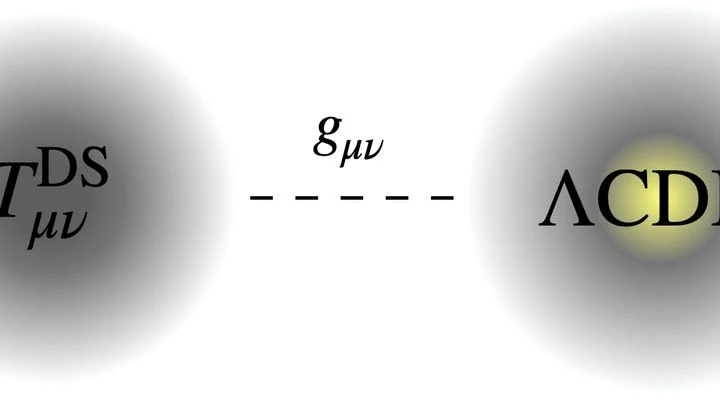
A pond with ripples spreading from a fallen stone. So it is on cosmic scales: a sudden burst of energy in the dark sector, an invisible substance that emits no light, creates ripples in the fabric of space. These ripples alter the path of light particles traveling to us from the very birth of the cosmos.
The authors of the new study built a mathematical framework to describe these distortions.
Gravitational wave detectors pick up a low-frequency hum, like the sound of a distant waterfall. The Webb telescope finds galaxies in the early universe with black holes that seem too massive for such a young age.
The trembling of space sounds like an orchestra. Gravitational waves caught by the LIGO and Virgo detectors tell of black hole collisions. Sometimes the music carries off-key notes — tiny deviations from Einstein's score. They might whisper of new physics or simply of dust on the bows.
Imagine a vast lake at night, perfectly still. You can't see waves, but you hear them lapping evenly on the shore from all sides. That's what astronomers call the gravitational-wave background — a constant hum from distant black hole mergers. But what if the splashing were slightly louder on one side?
A fisherman's net is stretched across the depths of space. When a massive star dies, it leaves behind a black hole — a sinker in this net. Usually, such sinkers weigh from a few to tens of suns.
In the first moments after the Big Bang, the cosmos resembled a giant cooling pond. Just as water, when freezing, becomes covered with a network of cracks, so the cooling universe could have cracked — not into ice, but into the thinnest filaments of pure energy. These filaments are called cosmic strings.
The universe wasn't born in silence. Primordial gravitational waves — ripples in spacetime — still carry the echo of that event. Scientists try to hear it in two ways. Low 'notes' are captured in the Big Bang's afterglow — light emitted 380,000 years later.
Toss a handful of pebbles into a pond, and the spreading ripples intersect, creating splashes and calms. That’s roughly how gravitational waves, predicted by Einstein, behave. Except it’s not water that’s oscillating, but spacetime itself.