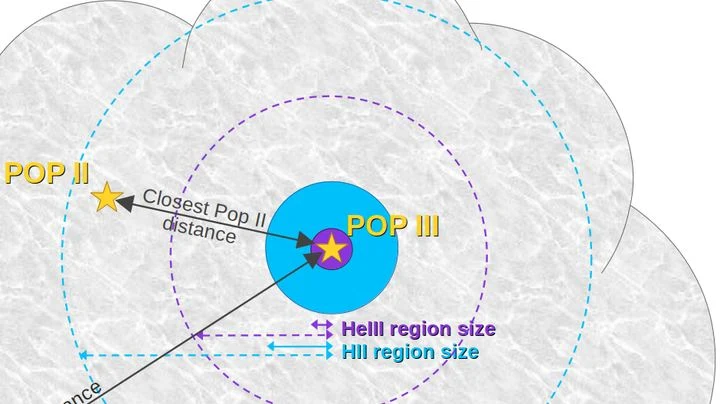
400 million years after the Big Bang, the James Webb Space Telescope noticed a bright spot near the galaxy GN-z11 — like a distant lighthouse whose light pushed through the primordial darkness.
Immediately after the Big Bang, an idea championed by Georges Lemaître, the cosmos was a dark broth of hydrogen and helium. Then the first stars ignited — enormous, dazzlingly bright and hot, like sparks from a cosmic bonfire.
When the universe was a couple of hundred million years old, it resembled a giant kitchen where the first galaxies were being shaped from primordial 'dough'—hydrogen and helium. At their centers, black holes ignited like ovens of varying power, from light 'camp stoves' to heavy 'hearths.' But how quickly did they gain mass by swallowing surrounding gas?
A fisherman's net is stretched across the depths of space. When a massive star dies, it leaves behind a black hole — a sinker in this net. Usually, such sinkers weigh from a few to tens of suns.