Philipp Podsiadlowski

4 articles · 30 co-authors · latest: 2026-08-12
2 citations · h-index 1 · 6 papersData: Semantic Scholar

We have retold 4 papers by this author. most often about: stellar evolution, star formation, supernova remnant. 30 co-authors across our retellings.

Links in the knowledge graph
A Star with a Secret: 70-Day Plateau Betrays a Supernova's Binary Past
70 days. That's exactly how long the plateau, the steady glow after the blast, lasted for supernova SN 2018gj. Usually, these plateaus stretch a hundred days or more. This short plateau was the first crack in the star's mask. Images from the Hubble Space Telescope pinpointed the progenitor: a red supergiant. Enormous. Cold.
High Energy2026-01-101 minarXiv:2601.06577express
Supernova Born from the Merger of Two Stars
Massive stars end their lives in a grand explosion — a supernova. Their cores collapse into a neutron star (a super-dense ball where a teaspoon of matter weighs a billion tons) or a black hole. For a long time, the most common type of such outbursts was thought to be the domain of solitary stars. However, supernova SN 2018gj broke the rule.
Stellar2026-02-181 minarXiv:2602.16394express
Stellar Ashes and Oxygen-18
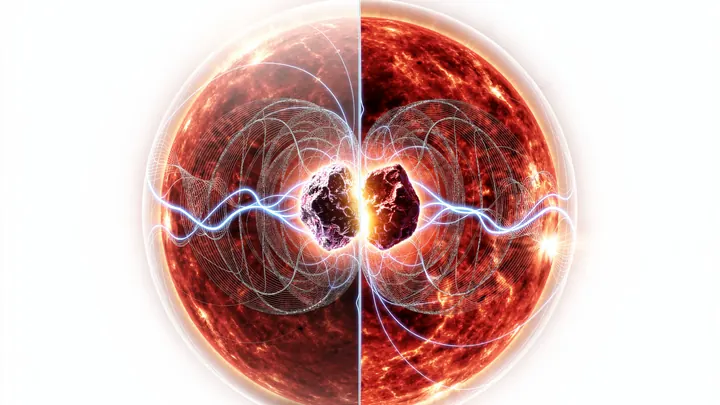
Two burned-out stellar cores collide and merge into one. That's how R Coronae Borealis stars are born — rare luminaries where oxygen-18 is hundreds of times more abundant than in the Sun. But exactly how this happens has remained a puzzle.
Stellar2026-08-122 minarXiv:2608.11557express
The Invisible Star and Its Heavy Companion
Two spinning tops whirl so close they nearly touch. One is scorching blue, the other dim white. Together they complete a full orbit in twenty hours. This is the pair Feige 64: a blue star with a mass of just a third of the Sun's, and a white dwarf, the cooled core of a former star, one and a half times heavier than our Sun. The blue star seems too hot for its mass.