Yi Yang

8 articles · 30 co-authors · latest: 2026-07-26
32 citations · h-index 3 · 13 papersData: Semantic Scholar

We have retold 8 papers by this author. most often about: stellar evolution, star formation, supernova remnant. 30 co-authors across our retellings.

Links in the knowledge graph
A Star with a Secret: 70-Day Plateau Betrays a Supernova's Binary Past
70 days. That's exactly how long the plateau, the steady glow after the blast, lasted for supernova SN 2018gj. Usually, these plateaus stretch a hundred days or more. This short plateau was the first crack in the star's mask. Images from the Hubble Space Telescope pinpointed the progenitor: a red supergiant. Enormous. Cold.
High Energy2026-01-101 minarXiv:2601.06577express
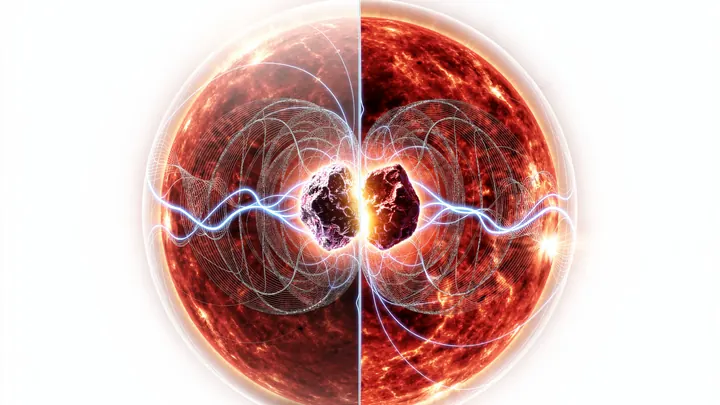
Supernova Born from the Merger of Two Stars
Massive stars end their lives in a grand explosion — a supernova. Their cores collapse into a neutron star (a super-dense ball where a teaspoon of matter weighs a billion tons) or a black hole. For a long time, the most common type of such outbursts was thought to be the domain of solitary stars. However, supernova SN 2018gj broke the rule.
Nuclear Theory2026-01-302 minarXiv:2601.22417express
The Thorium Pendulum: Catching the Atomic Echo
An atomic nucleus usually lives in a single energy state, like a ball resting on the floor. But thorium-229 has a rare exception: the nucleus can get stuck on a tiny step above the floor — the so-called isomeric state. This step is so low that it can be nudged by ordinary light, not just hard radiation.
HEP Phenomenology2026-03-272 minarXiv:2603.26824express
Cosmic Rays Hit a Single Note
When a heavy nucleus slams into interstellar gas at enormous speed, it shatters into pieces. Those pieces (lithium, beryllium, boron) then fly onward, and their abundance in the cosmic-ray flux depends on how the breakup unfolded. Conventionally, one expected the proportions to shift smoothly with energy, like the taste of soup when you keep adding water.
High Energy2026-05-152 minarXiv:2605.16487express
The Star That Exploded Twice
A light bulb that doesn't burn out but flares brighter and brighter until it blows the whole fixture apart. That's roughly how the most massive stars in the universe die. When a star's core heats up to billions of degrees, pairs of particles (electrons and their antimatter counterparts, positrons) begin to form.
High Energy2026-06-082 minarXiv:2606.10014express
General Relativity2026-07-221 minarXiv:2607.19814express
How to Catch a Mirror's Tremor
You're listening to the faint whisper of stars, and nearby someone keeps moving a chair. In gravitational wave telescopes, that role is played by scattered light: it reflects off trembling surfaces and creates false signals.
Strongly Correlated2026-07-262 minarXiv:2607.23695express
How to Tie a Quantum Knot from Two Bodies
The quantum world is tricky: sometimes particles confined to a flat layer and pierced by a strong magnetic field start behaving like a liquid made not of whole electrons but of their fractions — fractional charges. This is the fractional quantum Hall effect.