Jifeng Liu

5 articles · 30 co-authors · latest: 2026-09-13
26 citations · h-index 4 · 14 papersData: Semantic Scholar

We have retold 5 papers by this author. 1 of them with a full read. most often about: cosmic dust, interstellar medium, molecular cloud. 30 co-authors across our retellings.

Links in the knowledge graph
Galaxies2026-01-062 minarXiv:2601.02724express
The Milky Way's Dust Settles into Two Layers
Dust in space is not just grime: it's the raw material for future stars and planets. But how it is distributed in our galaxy has long been a puzzle: dust is hard to measure directly, and it blocks the light of distant stars. Now astronomers have peered through this veil using data on five million stars: their brightness, color, and precise positions in the sky.
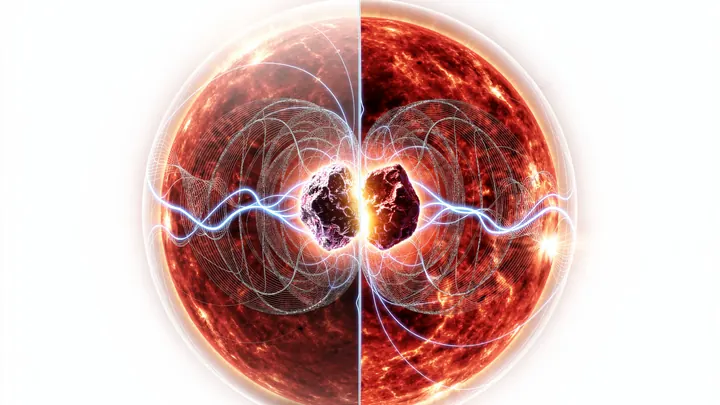
A Star with a Secret: 70-Day Plateau Betrays a Supernova's Binary Past
70 days. That's exactly how long the plateau, the steady glow after the blast, lasted for supernova SN 2018gj. Usually, these plateaus stretch a hundred days or more. This short plateau was the first crack in the star's mask. Images from the Hubble Space Telescope pinpointed the progenitor: a red supergiant. Enormous. Cold.
High Energy2026-01-101 minarXiv:2601.06577express
Supernova Born from the Merger of Two Stars
Massive stars end their lives in a grand explosion — a supernova. Their cores collapse into a neutron star (a super-dense ball where a teaspoon of matter weighs a billion tons) or a black hole. For a long time, the most common type of such outbursts was thought to be the domain of solitary stars. However, supernova SN 2018gj broke the rule.
Galaxies2026-08-212 minarXiv:2608.20781express
Flash in a Lens: Supernova on the Galaxy's Edge
In the dense galaxy cluster Abell 2744, where gravity bends light like a lens, the James Webb Space Telescope spotted a new point of light. It appeared in images from 2023 and then began to change brightness. It was a supernova, the explosion of a dying star, but not just any kind: a Type IIP.
Galaxies2026-09-133 minarXiv:2609.14342
A Neural Network Reads the Pulse of Variable Stars
An old lighthouse at the edge of the harbor blinks with the precision of a clockwork mechanism. Every few hours its lamp flares and dims, and sailors recognize that rhythm from afar, using the strength of the light to tell where the shore lies.