Planck's law explains why heated objects glow, from embers to stars. It tells how much light of each 'rainbow' band an ideal black body emits at a given temperature. The hotter it is, the more light there is and the bluer it gets.
History
In the late 19th century, the problem of thermal radiation was investigated by Gustav Kirchhoff, Josef Stefan, Ludwig Boltzmann, Wilhelm Wien. The classical Rayleigh-Jeans theory predicted infinite energy in the ultraviolet. Max Planck, trying to reconcile theory with experiment, reported a formula on October 19, 1900, and in December gave its theoretical justification, introducing the concept of the quantum of action h. Later, the law was experimentally confirmed and became a cornerstone of quantum mechanics. The cosmic microwave background radiation, discovered in 1965, matches the Planck spectrum with high precision.
How it works
It is applied in astrophysics to measure the temperature of stars and interstellar dust, in cosmology — to analyze the spectrum of the cosmic microwave background, in pyrometry, thermal imaging, and calibration of radiation sources. It is applicable to all bodies close to black bodies over a wide temperature range. It is generalized to gray bodies through the emissivity coefficient.
Fun fact
If our eyes could see microwaves, we would notice a faint glow across the entire sky — this is the cosmic microwave background radiation, the cooled light of the Big Bang, obeying Planck's law at a temperature of just 2.7 K.
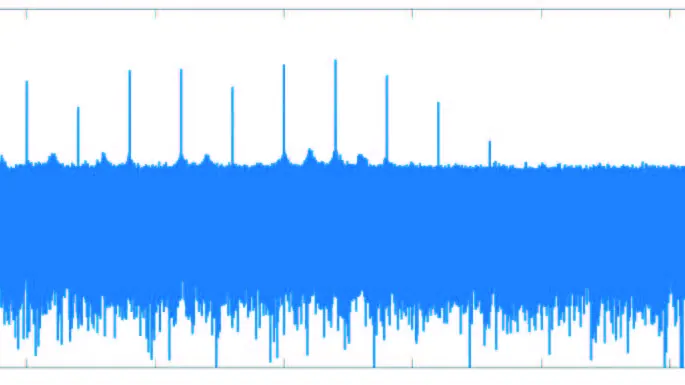
On March 26, 2026, the Chinese-European Einstein Probe observatory caught an X-ray flash that lasted a little over a quarter of an hour. A thousand seconds. The onboard WXT telescope registered a sharp rise in radiation, then a smooth decline, as if someone had screamed into silence, and the echo slowly faded.
In the deep field of JWST, among thousands of galaxies, astronomers zoomed in on the source JADES-GS 209777 – and saw a cosmic chick. Its "shell" is a thick cocoon of gas and cosmic dust that long hid the growing black hole at its center. But at a redshift of 3,711 (1,8 billion years after the Big Bang), the shell began to crack.
In 2008, the Spitzer telescope aimed at the star HD 15407A and detected a strong infrared excess. Fifteen years later, in 2023, JWST repeated the measurements. The light from the dust had dimmed by 14%. But the mineral composition of the dust remained the same, like a fingerprint taken in different years.
Through three minutes after the Big Bang, the Universe played its first symphony. It was the big bang nucleosynthesis — the formation of light nuclei, where each element sounded its own note, and the tempo was set by the expansion of space.
When a star ventures too close to a supermassive black hole, a cosmic requiem plays out — a tidal disruption event. Thanks to photometry and spectroscopy, astronomers discern every instrument in this orchestra.
The most abundant construction material on Earth, concrete, hides its deepest secrets at nanometer scales. Its strength and tendency to creep slowly under load are governed by a microscopic gel of calcium silicate hydrate (C-S-H), whose structure is as chaotic as a frozen vortex of atoms.
The cosmos is full of screams we can't hear. Every time a black hole tears a star apart, a blinding flash is born, and often — a narrow relativistic jet, shooting out thousands of light-years. But if that searchlight is aimed away from Earth, we see only a faint afterglow — a radio echo arriving with a delay.
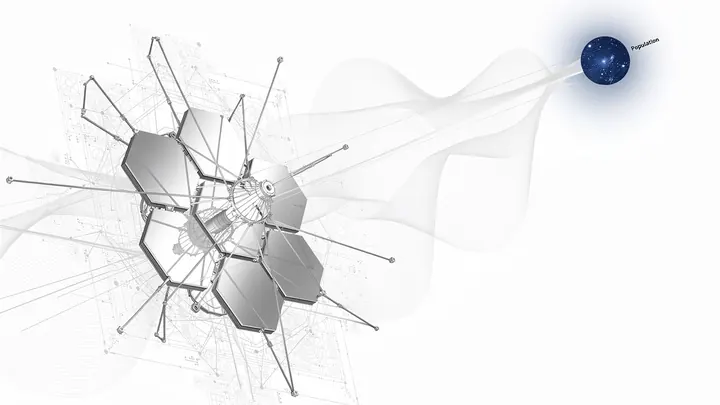
Right after the Big Bang, the Universe was a chemical desert — only hydrogen and helium, not a hint of metals. But moments passed (by cosmic standards), and the birth of the first stars — Population III — began.
Some 158 light-years away, around the dim star TOI-6894, a red dwarf, a planet moves leisurely. Its year lasts less than two Earth days, yet it is a cool world with an equilibrium temperature around 420 K, just a bit warmer than a sauna.
If you shrank an ordinary black hole to the size of a grain of sand, it would shine like a tiny star and quickly vanish in a flash. That's Stephen Hawking's prediction: the event horizon acts like a hot surface emitting particles.
A magnetic field in plasma resembles a stretched soap film: pressure from inside pushes it out, while surface tension pulls it in, giving it shape. Here too, magnetic pressure and tension forces balance each other.
Near black holes and neutron stars, plasma churns like water in a boiling kettle. But this 'kettle' has no walls — only magnetic fields that twist and tear. At the tears, thin sheets form where magnetic field lines reconnect, giving particles a kick like a surfer catching a wave.
When light knocks an electron out of an atom, it flies off like a ball thrown into a crowd. Scientists have long wanted to know the exact moment each electron leaves the atom, but direct measurement disturbed the very process. Now physicists have proposed a method that uses a second light pulse to 'photograph' the moment of the electron's birth.
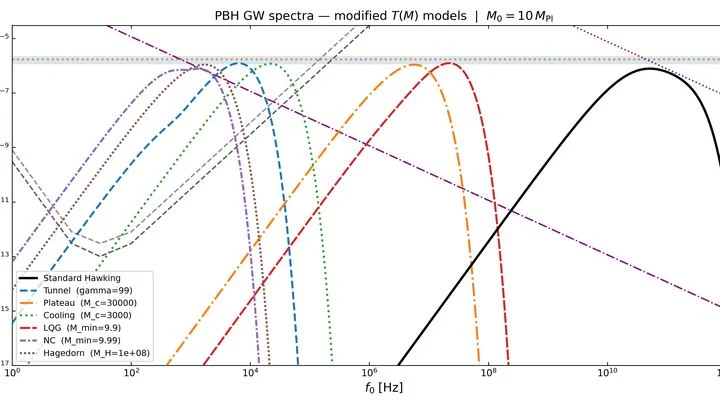
Primordial black holes behave like boiling kettles: as they evaporate, they whistle gravitational waves. The character of the whistle, its spectrum, depends on how the hole's temperature relates to its mass.
In the 19th century, James Clerk Maxwell imagined a tiny demon. It knows the speed of every gas molecule and opens a door: fast ones to the left, slow ones to the right. This creates a temperature difference without expending energy, seemingly violating the laws of physics.
Water always flows downhill, and heat from hot to cold. That's what энтропия dictates. But the quantum world finds loopholes.
Physicists made light particles interact with hot and cold environments in an uncertain sequence — like a flipped coin that hasn't landed yet.
Two great theories describe reality: one — how massive bodies cause curvature of space, the other — the Standard Model — governs elementary particles. Reconciling them remains elusive, like trying to describe an ocean storm in the language of a diamond lattice.
In 1976, Canadian physicist Bill Unruh asked a simple question: what does an observer see when accelerating through empty space? The answer turned out to be strange: emptiness ceases to be empty. An accelerating observer bathes in thermal radiation with a temperature proportional to the acceleration.