Amino Acid Relative Found in a Cosmic Cloud express
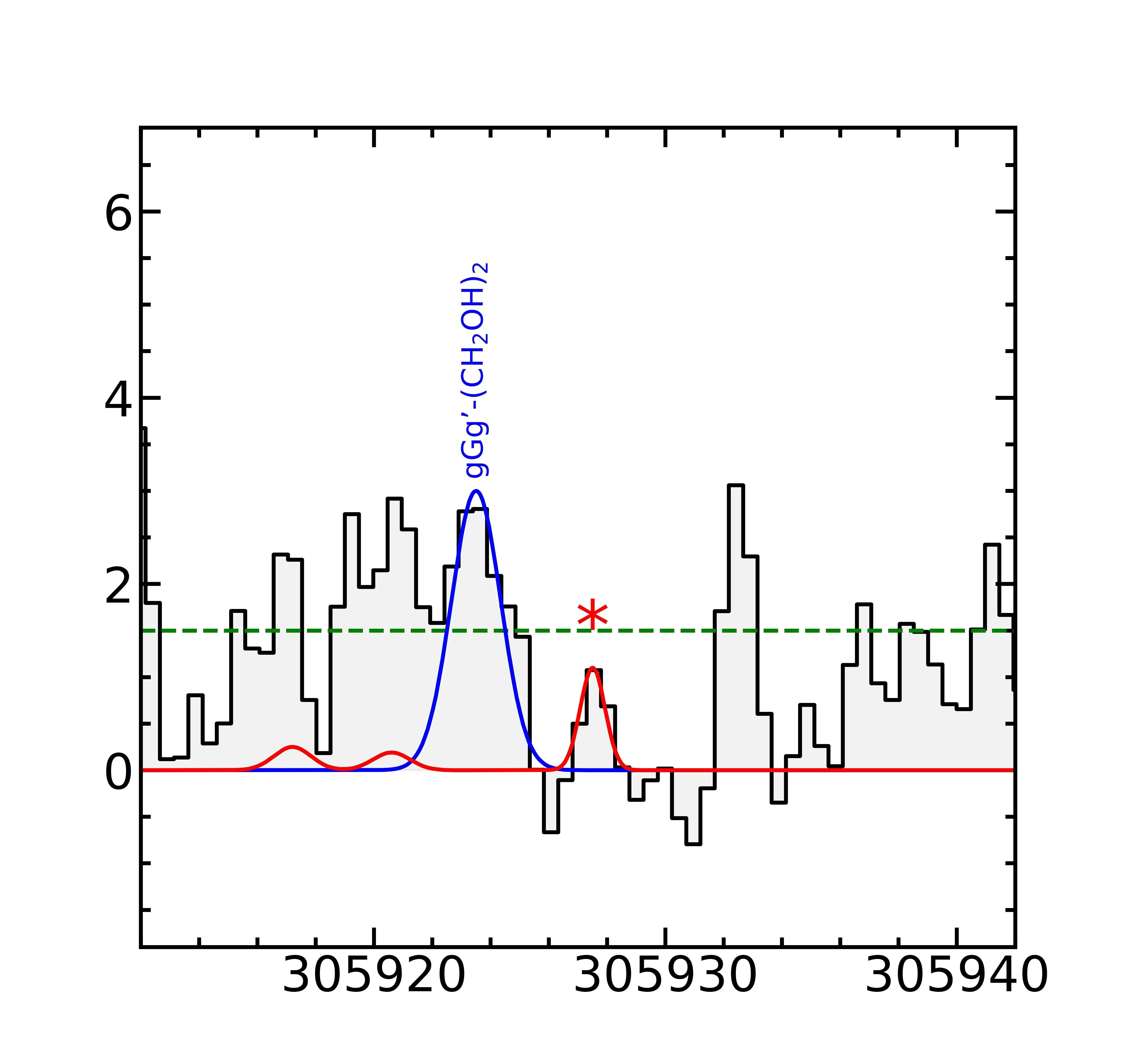
For nearly half a century, astronomers searched space for glycine, one of the simplest building blocks of proteins. Instead, in a cloud surrounding a newborn star, they found methyl carbamate, its isomer: the same atoms, but assembled differently, like two models from the same set of parts.
The ALMA antenna array captured the molecule's signal. Its radio fingerprint revealed that methyl carbamate is about a hundred times more abundant than expected in a stable equilibrium. It seems that in these cosmic nurseries, chemical reactions proceed not sedately, but briskly and rapidly.
Likely, the substance forms on the surface of dust grains from carbon-rich debris, like pieces of a construction set randomly gluing together in the dark. Now, by comparing the abundance of methyl carbamate and other building blocks across different parts of the Galaxy, scientists can trace the path from simple molecules to life’s complex bricks.
Original abstract
as written by the authors arXiv:2605.07159
Glycine-the simplest amino acid-has remained undetected in the interstellar medium despite decades of sensitive searches, motivating alternative approaches to constrain its astrochemical origin. A promising strategy is to investigate the broader $$\rm C_{2}H_{5}O_{2}N$$ isomer family and identify detectable members that can serve as observational anchors for glycine-related chemistry. Herein, we report the first robust interstellar detection of methyl carbamate toward the hot molecular core G358.93-0.03 MM1 using ALMA 1 mm observations. Ten unblended rotational transitions are identified, yielding a column density of (4.21$$\pm0.84)\times10^{15} \rm cm^{-2}$$ and an excitation temperature of $$204\pm10$$ K. We also searched for other $$\rm C_{2}H_{5}O_{2}N$$ isomers with available rotational spectroscopic data, including glycine, but none were detected, allowing us to derive upper limits on their column densities. The resulting abundance pattern deviates significantly from the Minimum Energy Principle predictions, highlighting that the $$\rm C_{2}H_{5}O_{2}N$$ family is shaped primarily by kinetic chemical process rather than thermodynamic equilibrium. The observed methyl carbamate abundance is consistent with a grain-surface formation scenario involving radical-radical recombination ($$\rm CH_{3}$$O + $$\rm NH_{2}$$CO), further supported by its correlated abundances with its proposed precursors, methanol and formamide, across diverse astrophysical environments. This detection establishes methyl carbamate as a new observational anchor for glycine chemistry, providing critical constraints on the formation pathways of amino-acid-related molecules in star-forming regions.
On Earth, the same methyl carbamate is a raw material for medicines and... insecticides. So the molecule that helps us understand the origins of life also underpins the creation of means to destroy it.
The idea of panspermia, that life can hitch a ride on comets, gains chemical support. Fred Hoyle already painted a similar scenario in his novel 'The Black Cloud'.