The Electron's Third Path in a Molecular Dance express
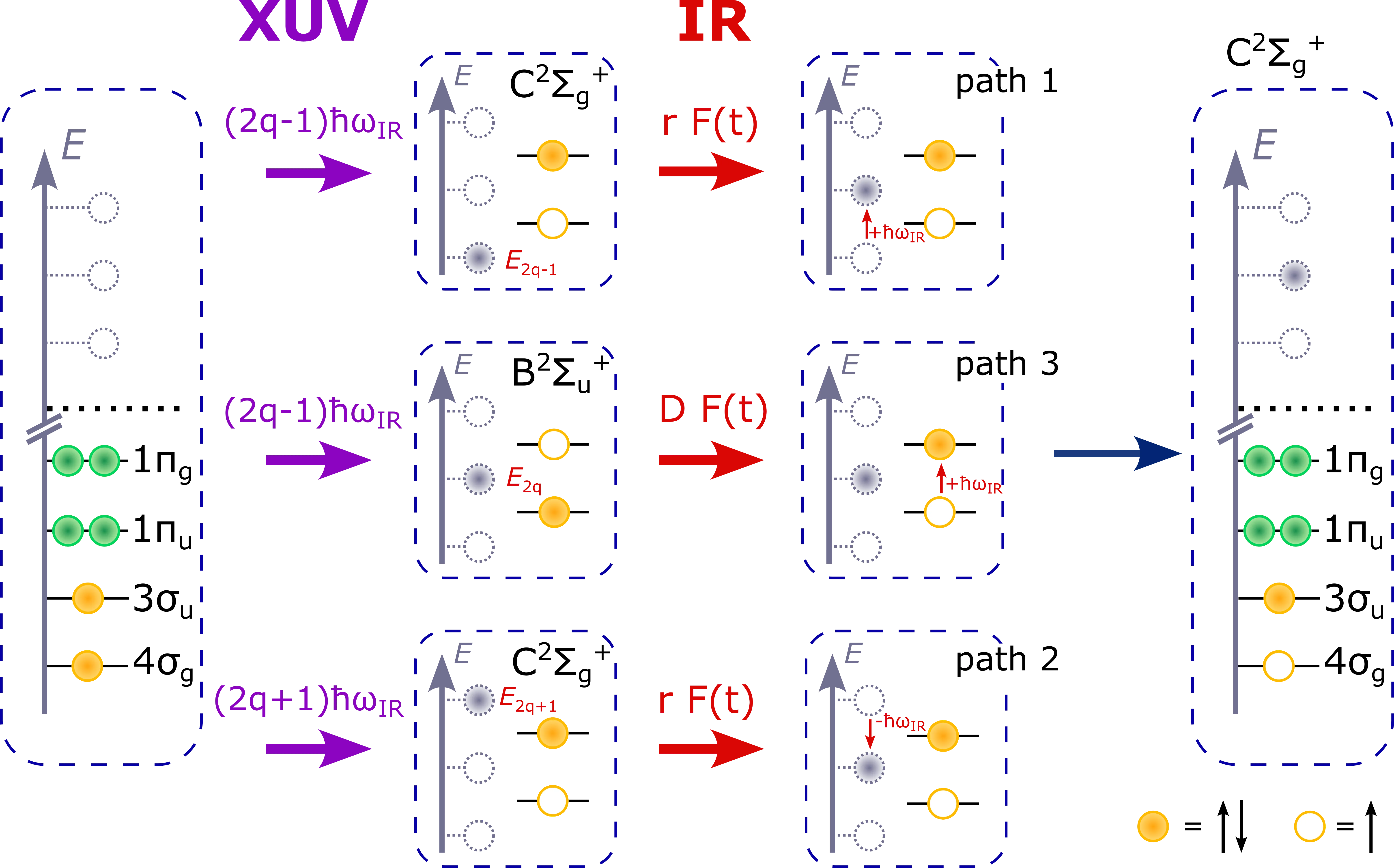
A high-speed camera capable of capturing the motion of electrons is an attosecond interferometer. It sends two laser pulses at a substance with a tiny delay. The first, ultraviolet, acts like a flash, knocking an electron out of the molecule. The second, infrared, like an invisible hand, gently nudges or slows this electron in flight. By observing how the electron's energy changes, scientists reconstruct events lasting billionths of a billionth of a second.
Until now, it was believed that the infrared pulse only interacts with the ejected electron, leaving the molecule itself as a static backdrop. But the authors of the new study decided to test this on carbon dioxide (CO₂). They found that infrared light can also shake the molecule left behind after the electron is removed. This shake opens a third, previously hidden route for the electron. Now the electron can leave the molecule via two distinct paths and also receive an extra kick from the excited molecule. All three trajectories overlap, like ripples on water from three thrown pebbles.
To unravel this tangle, physicists measured the energy and emission angle of the electrons. They found that when averaging over all angles, the clarity of the interference pattern drops in a certain energy range. This is like an orchestra where two musicians play in time, but a third occasionally comes in off-beat, making the overall sound quieter in places. By comparing experiment with theory, scientists could isolate the contribution of each of the three routes. The third path, linked to molecular excitation, turned out to be not just a nuisance but an essential part of the process that cannot be ignored.
This discovery changes the rules of the game for all of attosecond spectroscopy (a method for studying ultrafast processes). Previously, when studying simple atoms, one could neglect the effect on the ion itself. But for molecules and more complex systems, such an approach gives an incomplete picture. Now, knowing about the third quantum path, scientists will be able to more accurately decipher ultrafast processes — for example, how energy is redistributed during photosynthesis or how molecules are destroyed by radiation. Returning to our super-fast camera, one could say it has a new, more sensitive shooting mode that captures not only the main character but also the scenery, which suddenly comes to life.
Original abstract
as written by the authors arXiv:2604.23441
Attosecond interferometry in a two-color field is central to attosecond metrology and spectroscopy. In this technique, a photoelectron wave packet is released when a single photon from an extreme ultraviolet comb is absorbed. The wave packet then either emits or absorbs one or more near-infrared photons, leading to the formation of sidebands of the main photoelectron peaks. This picture applies well to atoms and assumes that the near-infrared laser pulse only acts on the photoelectron leaving the parent ion. The effect of the near-infrared pulse on the electronic structure of the cation is not considered, since the field usually cannot induce transitions between its electronic levels. Here, we demonstrate how dynamics induced by the near-infrared field in the cation can significantly impact the amplitude and phases of the sideband signal of the photoelectrons associated with specific dissociative channels of CO$$_2$$ molecules. This coupling of the near-infrared field with the molecular cation opens a third quantum pathway contributing to the signal measured in attosecond interferometry. Through angle- and energy-resolved characterization of the sideband oscillations, we observe reduction of interference amplitude over specific energy range upon angle integration. By comparison with theoretical predictions, we can isolate the contributions of specific interfering pathways to the two-color multi-pathway photoionization process. The scheme investigated in our work is general, and our observations highlight the importance of the additional pathway for accurately interpreting attosecond interferometry experiments involving molecules and more complex quantum systems.
Attosecond pulses are so short that if one second were stretched to the age of the universe, an attosecond would equal one second.
In Isaac Asimov's novel 'The Last Question,' a supercomputer learns to control processes at the level of elementary particles — with a time resolution similar to that provided by attosecond lasers.