The Avogadro constant is the number of atoms, molecules, or other particles in one mole of a substance. Its value is approximately 6.022 × 10^23 per mole. This constant bridges the microscopic world of individual particles and the macroscopic world of grams and liters, allowing chemists and physicists to count particles by weighingbulk material.
History
The concept was introduced by Amedeo Avogadro in 1811, though he did not determine the number itself. The first accurate estimate came from Johann Josef Loschmidt in 1865, and the constant was later named in Avogadro's honor. The modern value was precisely determined in the 20th century through X-ray crystallography and other techniques.
How it works
The constant is defined so that the mass of one mole of a substance in grams equals its atomic or molecular mass in atomic mass units. For example, one mole of carbon-12 atoms has a mass of exactly 12 grams and contains Avogadro's number of atoms. This works because the atomic mass unit is defined as one-twelfth the mass of a carbon-12 atom, and the mole is defined as the amount of substance containing as many elementary entities as there are atoms in 12 grams of carbon-12.
In practice
The Avogadro constant is essential in chemistry for stoichiometry, in physics for defining the mole and the kilogram (until 2019, when the kilogram was redefined using the Planck constant), and in biology for calculating concentrations of solutions.
Fun fact
If you had Avogadro's number of pennies, they would cover the entire Earth's surface to a depth of about 1.6 kilometers.
Molecules in an ultracold gas are like tiny magnets: they attract when far apart, but when they get close they can stick together for good. Such sticking destroys the gas: particles drop out of the game, and you never reach the quantum regime where all of them behave as one.
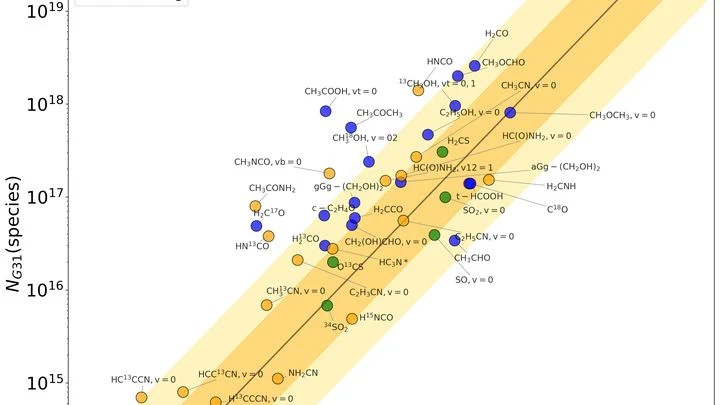
In an oven, a huge loaf of bread is baking. Inside the dough, there is a tiny, hottest spot: that's where the future loaf begins to rise. A hot molecular core (a region the size of the Solar System, where gas is heated to hundreds of degrees and compressed to billions of times the density of ordinary clouds) works in much the same way.
Cosmic rays are particles that arrive from deep space. When such a particle hits the atmosphere, it triggers a whole shower of new particles, like a billiard ball breaking a rack, sending balls scattering in all directions. To predict what such a shower will look like, we need to know how the primary particle interacts with the nuclei of air atoms.
Long before a star ignites in a gas cloud, chemical life is already bustling. In cold, dense clumps of gas, called starless cores, atoms stick together to form molecules, both simple and complex. To peer into this invisible kitchen, astronomers aimed a 40-meter radio telescope in Yebes at 23 such clouds in the Orion Nebula.
Two galaxies collided, and from their center an invisible fountain erupts. The ALMA and VLT telescopes peered into the heart of the IRAS20100-4156 system — where two stellar islands are merging. There, work is in full swing: hundreds of new suns are being born, and their heat drives a stream of cold gas outward.
This stream is like a giant's exhale.