Molecular Qubits: Long Memory at Room Temperature express
At the heart of a future quantum computer might lie a tiny organic molecule shaped like a triangle. It has two 'extra' electrons that don't pair up. Such molecules are called diradicals, and their electrons can store information in a special, quantum way.
The authors used precise first-principles calculations to study three variants: pristine triangulene, a nitrogen-containing derivative, and a more complex crystal. They found that if all magnetic nuclei are removed (by replacing hydrogen with deuterium and placing the molecule in a nuclear-free environment), the quantum coherence time of the molecule reaches 0.21 milliseconds at 10 K. That's like a fragile soap bubble lasting almost a quarter of a second in the air — very long for the quantum world.
But the real surprise came at room temperature. The relaxation time (T1), i.e., the lifetime of the excited spin state, for the nitrogen-containing molecule was 27 milliseconds. Information doesn't get lost almost instantly, as often happens, but lives long enough to be manipulated. Moreover, the scientists showed that the spin can be controlled with light — selectively transitioning electrons between states, thus enabling data read and write.
Original abstract
as written by the authors arXiv:2607.08634
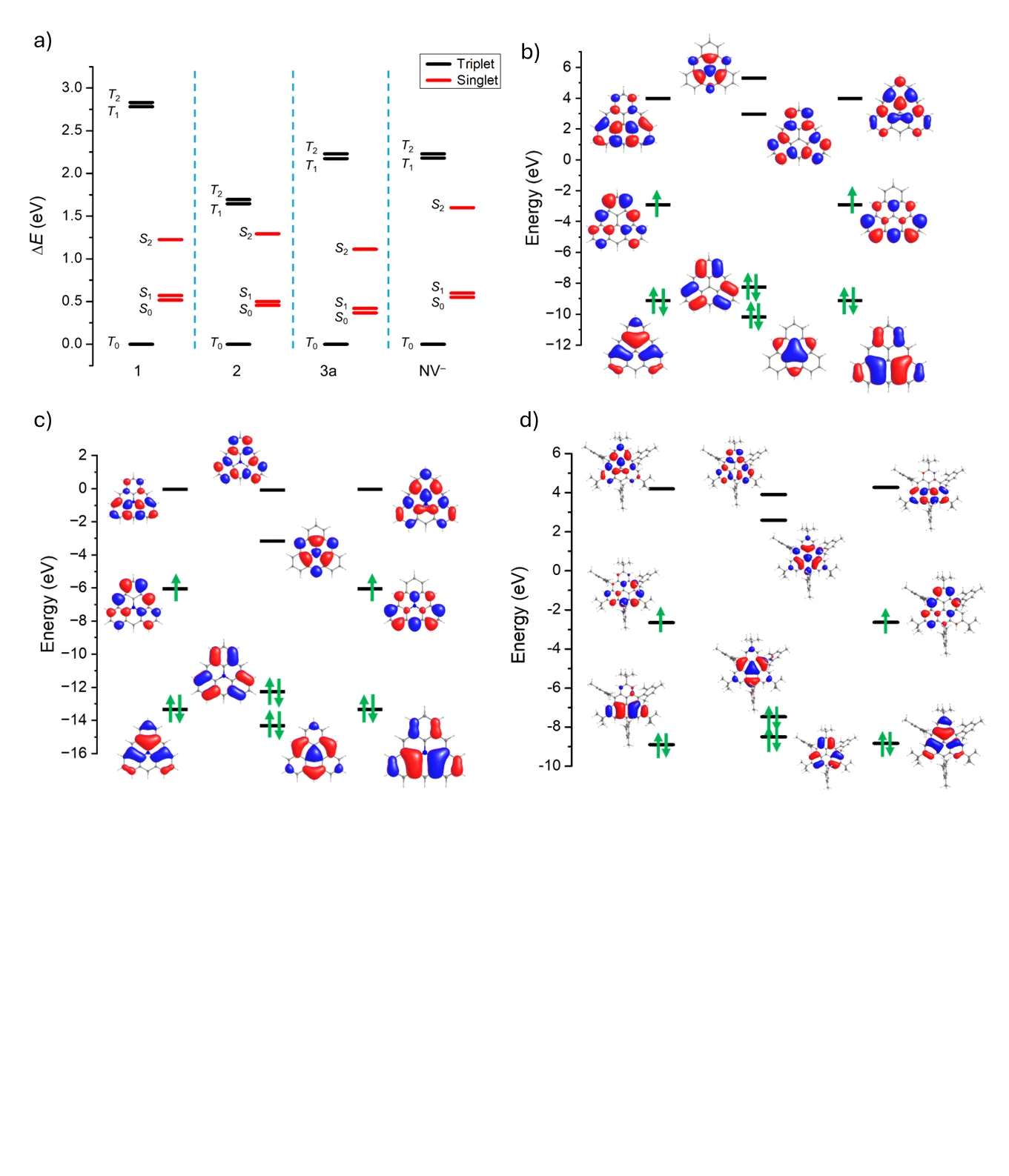
The identification of molecules that combine long spin coherence times and efficient spin-optical interfaces, ideally at room temperature, is pivotal towards the development of molecular quantum technology. By means of advanced first-principles methods, we here unravel the electronic structure for triangulene (1), its aza-cation derivative (2), and the crystal of 2,6,10-tri-tert-butyl-4,8,12-trimesityl-triangulene (3), and show that these organic diradicals possess a triplet ground state well separated from the first singlet excited state approaching 0.5 eV, closely resembling solid-state defects like nitrogen vacancy centers. In addition, we compute spin decoherence times due to the interaction with phonons and surrounding nuclear spins, showing that a deuterated molecule of 3 in a nuclear spin-free environment would support $$T_2 = 0.21$$ ms at 10 K. Importantly, we show that the engineering of specific low-energy vibrations could significantly improve $$T_2$$ toward the limit imposed by the molecular core spin relaxation, here estimated to be as long as $$T_1=27$$ ms at 300 K for 2. Finally, we compute two-phonon contributions to inter-system crossing at 300 K for2 as a luminescent prototype, and find that it is highly spin-selective, supporting the possibility to engineer optical read out and spin initialization. These results advance a unified first-principles theoretical foundation of spin decoherence and spin-selective excited-state processes and point to novel chemical design strategies for optically addressable, highly coherent molecular qubits.
A time of 0.21 ms at 10 K is roughly the duration of a single lightning flash. For a molecular qubit, that's an enormous span, during which hundreds of quantum operations can be performed.
The idea of molecular quantum computers echoes the 'quantum dots' in Greg Egan's novel 'Quarantine', where information is processed at the level of individual particles.