Nitrogen on the Brink of a Polymer: Two New Phases express
Nitrogen, the very gas we breathe, behaves like a finicky metal under a million atmospheres of pressure. In a diamond anvil cell, it is squeezed to 78–98 gigapascals and heated with a laser to 1800–2500 kelvin. Under these conditions, N₂ molecules rearrange into crystals that can store energy more densely than explosives.
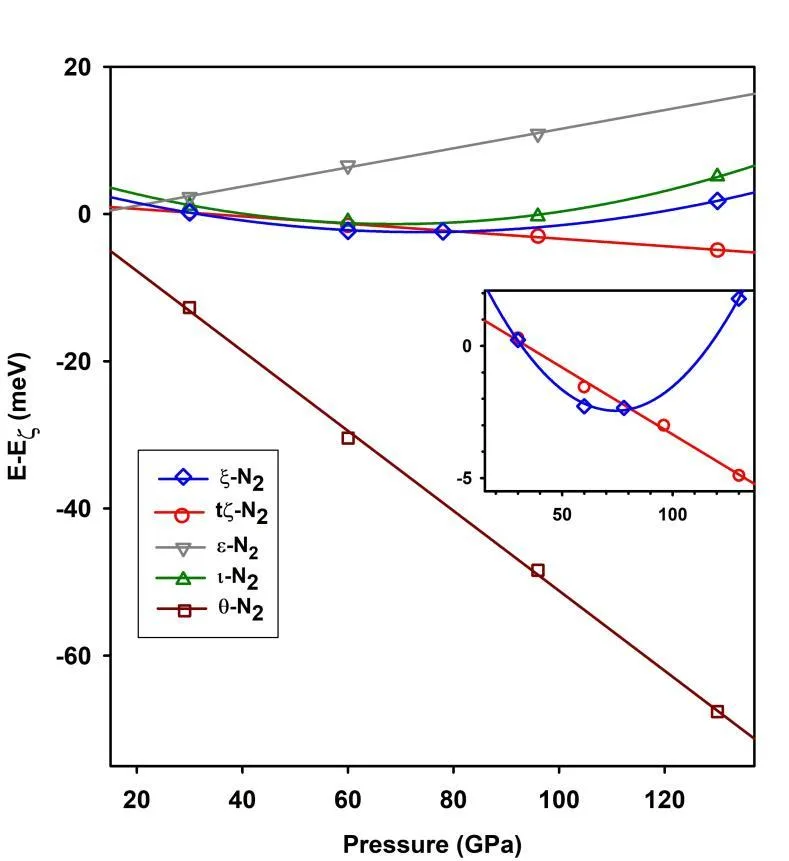
The research team found two such forms. The first, named tζ-N₂, is a "triple" variant of the already known ζ-phase: its crystal lattice repeats every three layers, and the unit cell holds 96 atoms. The second, ξ-N₂, is hexagonal, with 112 atoms per cell. Both phases were obtained by heating ζ-nitrogen with a laser in a diamond anvil cell, and their structures were determined using single-crystal X-ray diffraction. First-principles calculations confirmed the stability of the new forms.
These phases are stepping stones toward polymeric nitrogen, where atoms are linked by single bonds into a three-dimensional network. Such a substance could become the most energy-dense known, but so far it has only been produced in tiny amounts. The new structures help us understand how molecules rearrange under pressure, and may bring us closer to creating materials with record energy density.
Original abstract
as written by the authors arXiv:2604.16641
Molecular nitrogen exhibits remarkable structural diversity near the polymeric transition, where multiple phases are metastable. Here, we report two new molecular phases. The first, $$t\zeta$$-N$$_2$$, is a polytype of monoclinic $$C2/c$$ $$\zeta$$-N$$_2$$, characterized by a tripled $$c$$ axis and 96 atoms per unit cell. The second, $$\xi$$-N$$_2$$, is a previously unreported hexagonal phase ($$P6cc$$) containing 112 atoms per unit cell. Both phases were synthesized in a diamond anvil cell by laser heating $$\zeta$$-N$$_2$$ to 1800--2500~K at pressures of 78--98~GPa. Their crystal structures were determined using single-crystal X-ray diffraction, corroborated by Raman spectroscopy, and supported by first-principles calculations. The $$t\zeta$$-N$$_2$$ phase likely corresponds to the previously reported $$\kappa$$-N$$_2$$ phase.
At 78 gigapascals, the distance between nitrogen atoms in the crystal is smaller than that between carbon atoms in diamond.
In Kurt Vonnegut's novel Cat's Cradle, the fictional ice-nine causes water to crystallize at room temperature — the new nitrogen phases also exist only under extreme conditions, but they remind us how pressure transforms familiar substances.