Dark Matter Spins Black Holes express
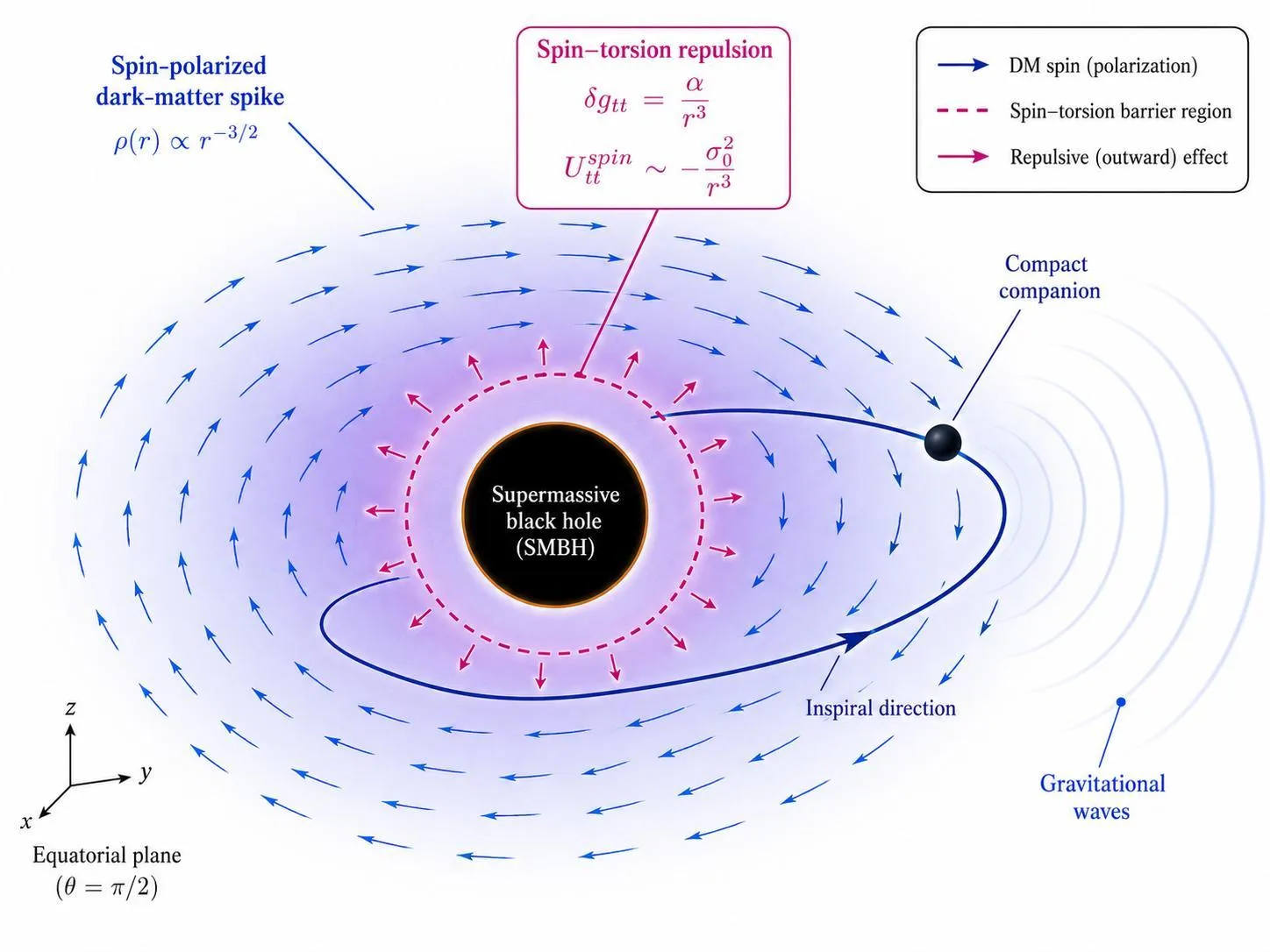
A supermassive black hole drifts through a cloud of dark matter. In the usual picture, this invisible substance just adds mass and barely interacts with ordinary matter. But dark matter particles could have intrinsic rotation — spin. In an extension of general relativity, the Einstein–Cartan theory, the spin of matter becomes a source of additional twisting in spacetime. The authors of a new study applied this idea to extreme systems: a small object (a black hole or neutron star) spirals into a giant black hole, emitting gravitational waves.
In their model, the spin of dark matter creates not just extra attraction around the big black hole, but a repulsive addition. It falls off with distance as a cube — very sharply, proportional to 1/r³. When the scientists solved the equations for a weak gravitational field, an interesting detail emerged: no global perturbation of the form 1/r³ appears. Instead, more complex corrections show up — a logarithmic tail and a term resembling the contribution of mass smeared over a radius. So the researchers propose treating their correction not as an exact solution but as an effective 'patch' potential. It works only near the black hole.
Next, the authors calculated how such a deformation of gravity would change the orbit and the gravitational wave signal. They used a simplified signal model, so-called analytic kludges. In an idealized scenario, the phase shift of the wave turned out to be large — tens and hundreds of radians. That means a future space detector like LISA or its Chinese counterpart Taiji could tell the difference between an ordinary black hole and one surrounded by spinning dark matter.
However, the scientists themselves urge caution. Their calculation ignores many subtleties: the spin of the black hole itself, orbital inclination, eccentricity, the back-reaction of radiation on the motion (self-force), and crucially, the real detector response and possible parameter degeneracies. So the result should be seen not as a prediction but as a way to probe constraints on dark matter properties. If a real system's signal shows no such shifts, then hypothetical spinning dark matter cannot be too dense around black holes.
Original abstract
as written by the authors arXiv:2606.15381
Extreme-mass-ratio inspirals (EMRIs) are sensitive probes of weak conservative perturbations in the strong-field region of massive black holes. We study a phenomenological EMRI model motivated by Einstein--Cartan gravity in which a spin-polarized dark-matter spike is described by a Weyssenhoff fluid. After torsion is eliminated algebraically, the local spin contribution contains a repulsive exterior source $$U_{tt}^{\rm spin}\propto-\sigma_0^2/r^3$$. Solving the corresponding static linearized field equation, however, does not produce a global $$1/r^3$$ metric perturbation; the response contains a mass renormalization, a logarithmic $$r^{-1}$$ tail, and an $$M/r^2$$ term. We therefore introduce $$g_{\mu u}^{\rm eff}=g_{\mu u}^{\rm Kerr}+\alpha h_{\mu u}^{\rm eff}$$ only as a local near-zone matching ansatz, not as a complete rotating Einstein--Cartan black-hole solution. Within this torsion-inspired deformation we compute circular equatorial inspirals and analytic-kludge waveforms. The fiducial model can produce large phase shifts in an idealized adiabatic calculation, but the forecast is optimistic and does not include a full LISA/Taiji response, Teukolsky/self-force fluxes, eccentricity, inclination, or high-dimensional parameter degeneracies. The results should be read as constraints on an effective near-zone operator rather than as a prediction of minimally coupled Einstein--Cartan dark matter.
Gravitational waves from a small object falling into a supermassive black hole will 'ring' through space for years — up to hundreds of thousands of cycles before merger. It's like a very slow but relentless crescendo of a violin string.