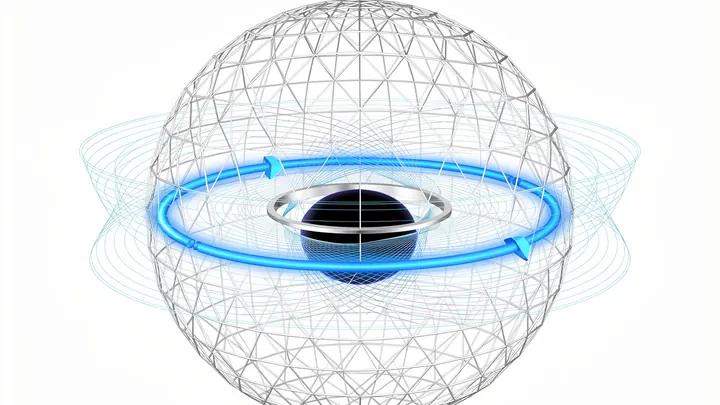
Black hole thermodynamics is a framework that treats black holes as thermodynamic systems with temperature, entropy, and energy, despite their classical description as objects that only absorb. The key results are that a black hole's entropy is proportional to its event horizon area (Bekenstein-Hawking entropy) and its temperature is inversely proportional to its mass (Hawking temperature). This theory bridges general relativity, quantum mechanics, and thermodynamics, revealing deep connections between gravity and statistical mechanics.
History
The framework was developed in the early 1970s by Jacob Bekenstein, who proposed entropy proportional to area, and Stephen Hawking, who derived black hole radiation in 1974, completing the thermodynamic picture.
How it works
The analogy works because black holes obey laws mathematically identical to the laws of thermodynamics: the zeroth law defines a constant surface gravity (temperature), the first law relates mass change to area change (energy and entropy), and the second law states that horizon area never decreases. Hawking's quantum calculation showed that black holes emit thermal radiation, giving the temperature a real physical meaning: smaller black holes are hotter and radiate more intensely.
In practice
It guides theoretical research in quantum gravity, holography (AdS/CFT correspondence), and cosmological models, and helps interpret observations of black hole mergers and shadows.
Fun fact
A black hole with the mass of the Moon would have a temperature of about 0.1 kelvin, while a solar-mass black hole is far colder than the cosmic microwave background at 60 nanokelvin.
At the center of nearly every large galaxy sits a supermassive black hole. It doesn't just devour infalling gas; it also blasts some of it back out in powerful jets. These jets act like giant pistons, shoving the surrounding gas and heating it. Astronomers have long suspected that this is how black holes keep galaxies from cooling into cold star factories.
A black hole is a maze with no way out. But what happens to the information inside? To test this, physicists didn't fly to the nearest hole; instead, they built a tiny replica on a quantum processor. The maze was played by a chain of 32 superconducting qubits, where each step leads only forward, like a one-way corridor.
Stare long enough into the night sky, and sooner or later your gaze hits a blackness beyond which nothing is visible. This is not just a distant fence: it is the edge of the universe accessible to us, the cosmic horizon. Light from more distant stars simply hasn't had time to reach us.
A black hole is not just a dark spot in space. It has a temperature, and it radiates. It has entropy — a measure of hidden information encoded on its horizon's surface, like a pattern on a soap bubble.
A boiling kettle on the stove eventually boils dry — and so, according to the classical picture, a black hole should gradually vanish in a hiss of radiation. But what if you add a special ingredient to the kettle?
A black hole has three laws, just like an ideal gas. The first: energy is conserved. The second: the horizon area never decreases. And the third, the most finicky, demands that at zero temperature the entropy (a measure of disorder) tend to zero or a universal constant.
A fussy thermometer shows different temperatures depending on who is looking at it. A black hole behaves much the same way: its thermal properties, entropy and temperature, depend on how we describe the information hidden inside.
A black hole devours everything, even light. Yet it obeys the laws of physics: it possesses entropy — a measure of the hidden information an object 'remembers.' In the 1970s, Jacob Bekenstein and Stephen Hawking discovered a strange pattern: a black hole's entropy grows not with its volume, but…
In 1973, Jacob Bekenstein proposed that black hole possess entropy — a measure of hidden disorder. Stephen Hawking later confirmed this by adding radiation, but the microscopic origin of entropy remained obscure.
A pot of boiling water is covered with two lids — an inner and an outer one. The thermometer under each shows its own temperature, but their harmonic mean (a special averaging method where you add the reciprocals) always remains unchanged. Heat seems to obey an invisible rule.
A black hole cooled to nearly absolute zero resembles a musical instrument with only a limited set of possible notes. Strike it, and it will respond not with any sound, but only with a strictly defined set of frequencies.
Imagine a pot of boiling water. Toss in a handful of pasta, and it quickly overcooks and clumps into a sticky mess. But in a huge restaurant kettle where the pasta floats freely, each piece stays separate.
At the centers of many galaxies lurk supermassive black holes. One of them, Sagittarius A* at the heart of the Milky Way, has become a testing ground for a new idea. The authors of the work took Einsteinian gravity and added an unusual electromagnetic field to it.
Imagine a steam engine where instead of a steel piston there is an event horizon, and the cylinder is curved space itself. This metaphor has gained mathematical flesh: physicists have for the first time constructed a complete set of reversible heat cycles with a Schwarzschild black hole confined in a spherical cavity.
Einstein’s cosmological constant — a blunder or a boomerang insight? The universe’s acceleration caught physicists off guard: ΛCDM works, but why is the vacuum energy so absurdly tiny? Imagine an ocean heaving with quantum fluctuations, yet on the surface only a microscopic ripple.
Black holes can emit heat. They have a temperature, entropy (a measure of disorder), and other thermodynamic properties. Usually, to compute these, you first have to construct the black hole itself — solve the complicated equations of curved spacetime.
At the center of many galaxies lurks an invisible halo of dark matter: it holds the stars at the edges, keeping them from flying apart. For a long time, it was described as a dilute gas of particles, but new work offers a different view: dark matter might gather into a quantum droplet.
A black hole is not just a cosmic vacuum cleaner. It is a region with such strong gravity that even light cannot escape it. But place it in a perfect fluid of dark matter and add a cloud of strings, thin filaments stretched across all of space, and the picture gets more complicated.
A black hole is like a spinning top: the faster it spins, the more noticeable its behavior. It has two boundaries — the outer and inner horizons, the edges beyond which even light cannot return. In the new work, physicists looked inside a rotating charged black hole and multiplied the areas of these two surfaces.
The merger of two black holes is the most powerful explosion in the Universe, yet we cannot see it. We only catch the shudder in spacetime — gravitational waves that carry information from the heart of the cataclysm. In December 2025, the LIGO detectors registered event GW250114.
Every quantum system (whether an atom, a crystal, or the entire Universe) has its own set of allowed energies, like the steps of a ladder. The hotter the system, the more readily particles climb to higher rungs.
A light ray skims along the horizon of a black hole: that invisible boundary from which nothing can escape. The closer the ray gets to the horizon, the slower its own 'time' stretches — a special measure of path called the affine parameter.
Spacetime is like a giant sheet of paper. Fold it, and distant corners come together. Poke a pencil through, and you get a wormhole, a short tunnel through the folds. But the paper wants to spring back flat, snapping the passage shut. To keep it open, you need a rare “gasket”—matter with negative energy.
An acoustic black hole is a fluid flow faster than sound, so sound waves can't escape. The boundary, the surface where the flow speed reaches the speed of sound, spawns pairs of phonons: sound quanta, one flying away, the other plunging inward.
When a massive star runs out of fuel, its core collapses under its own weight. A black hole forms — a region where gravity is so strong that even light can't escape. For a long time, it was thought that a point of infinite density, a singularity, lurks at the very center.
A black hole is like a perfect safe: anything that goes in seems lost forever. But at the microscopic level, it doesn't destroy information: it shuffles it with its internal degrees of freedom, much like a deck of cards after a thorough shuffle.
The event horizon of a black hole is often depicted as a one-way membrane: everything falls in, nothing comes out. But what if it's not an empty boundary but a cloud of the tiniest 'bits' of spacetime itself?
An ordinary kettle: you heat it up — temperature rises, molecular chaos grows, and steam shoots out. But in the lab, they've created a peculiar "kettle"—an analog black hole made from superconducting circuits cooled to the extreme.
Take a long thread, close it into a ring, and tie a knot in it. The knot slides along the thread until it hits something. Now imagine the thread is made of two different segments: one stiff and slippery, the other soft and sticky. When heated, the sticky segment softens, and the knot can slide off it, like a sled sliding off a melting hill.
A black hole is not a frozen sphere. It's more like a soap bubble, whose walls can expand and contract. It even has two layers: the outer horizon, beyond which light cannot return, and the inner one, hidden deeper. When the hole swallows matter or loses energy, both layers shift, like the film of a bubble changing size.
Black holes aren't faceless devourers. Sometimes they behave like water: they can 'freeze' or 'boil', changing their internal state. Scientists described this by modeling light near a black hole as a gas.
A stone falls into a pond, and ripples spread across the water. Similarly, a black hole resting in the void may encounter a gravitational wave or a cloud of gas. It does not remain indifferent: its surface (the event horizon) bends slightly, like a stretched membrane under the weight of a drop.
The quantum battery works like a sponge that absorbs light but won't release it without a forced squeeze. The inspiration came from bacteria's natural solar traps: capturing solar photons, they transfer energy almost losslessly, as proven by spectroscopy.
A hot chain of atoms lined up in a row behaves like a tiny black hole. Such a chain is a series of particles, each resembling a tiny magnet. At normal temperatures, the little magnets flip randomly, but when cooled, they align in a uniform order. Physicists have discovered that when heated, this simple system reproduces the strange properties of black holes.
A black hole isn't completely black. From its horizon, a faint thermal glow constantly seeps out, like steam rising from a cooling cup of tea. The temperature of this glow depends on the strength of gravity at the surface.
Scientists applied an unusual mathematical approach in the equations of искривления пространства-времени and obtained a new type of charged чёрных дыр. Their behavior turned out to be surprisingly familiar: this is how вода in a pot behaves when it starts to boil.
Time is a one-way road: events race forward with no U-turn allowed. The arrow of direction is governed by entropy — a measure of disorder, which only grows in the Universe, like a traffic jam at rush hour. You can clear one intersection, but the overall congestion only gets worse.