Quantum Corrections to Van der Waals Black Holes: Universality and Topology ✛
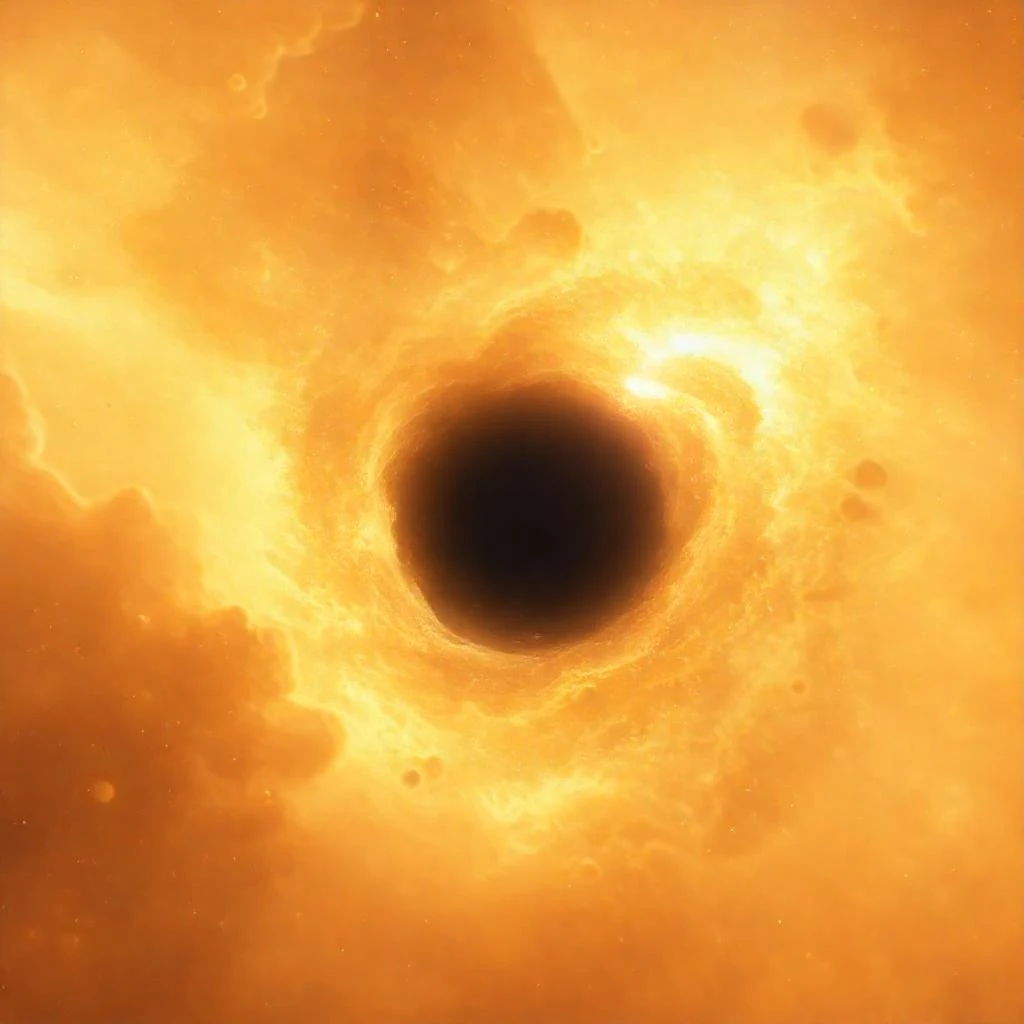
A black hole in anti-de Sitter space is not a void but rather a pot of boiling liquid. This liquid has two phases: small and large black holes, like steam and water. At a certain pressure, they merge at a critical point, just as water at 374 °C and 218 atmospheres loses the distinction between liquid and gas. Physicists have known this picture for a long time: the equation of state of a black hole in a space with negative curvature reproduces the Van der Waals equation, where quantum fluctuations of the horizon play the role of molecules. But what happens if you toss a pinch of quantum gravity into this pot?
Three pinches, to be precise. The first is the generalized uncertainty principle (GUP), which forbids particles from having arbitrarily small wavelengths: a minimum length emerges, like a grain on photographic film. The second is the extended uncertainty principle (EUP), which introduces a minimum momentum for particles in a confined volume, as if echoing the walls of the pot. The third is rainbow gravity, where the geometry of space itself depends on the energy of a passing particle, so each particle sees the world in its own color. The authors ran the Van der Waals black hole through all three corrections and examined what remained of the beautiful regularities.
The topological classification proved more capricious. If you construct a vector field from the generalized free energy and compute the winding numbers around its zeros, the classical black hole has two topological charges (+1 and −1) for a small parameter b, and one (+1) for a large b. GUP corrections make the classification stable: always two charges with a total of zero. EUP splits it into two distinct classes: for some parameters, three charges (−1, +1, −1) summing to −1; for others, two or four charges summing to zero. Rainbow gravity again yields a stable two charges with a total of zero. The photon sphere, a ring where light travels in circles, always has a topological charge of −1 for the classical model, while for quantum-corrected models the roots of the vector field lie below the horizon and are invisible to an external observer.
This work is not just another black hole but a testing ground for comparing predictions. The universal extremality relation, a connection between the change in mass and entropy for a nearly extremal hole, turns out to be a structural feature of black hole thermodynamics that survives quantum deformations. This bolsters confidence in generalized relations as a tool for testing quantum gravity theories. Topological invariants, in contrast, are sensitive to the type of correction: GUP and rainbow gravity preserve one class, while EUP splits it into two. Thus, topology can serve as a filter to distinguish quantum gravity models by their thermodynamic signatures.
Where does this lead? The next steps are to test the generalized universal extremality relation for rotating and charged black holes with the same three corrections, and to build a topological classification at nonzero chemical potential. If different topological classes yield distinct signatures in the black hole shadow, quasinormal modes, or gravitational waves, topology will become not an abstract classification but a working tool for astrophysics. For now, the Van der Waals black hole continues to behave like a gas that does not lose its habits even after a quantum shake-up.
The Van der Waals black hole has a critical point like water: below the critical pressure there are two phases, a small and a large black hole, and at the critical pressure they merge. The parameter b in the Van der Waals equation, which for an ordinary gas accounts for the finite size of molecules, here governs the topological transition: for b < 0.5 there are two charges, for b > 0.5 there is one.
In Greg Egan's novel "Schild's Ladder," the physics of different universes depends on vacuum states, and transitions between them resemble phase transitions. Here, black holes with different quantum corrections are like different vacua, and the topological charge is like an invariant that does not change under small perturbations.