A Black Hole's Shadow Betrays Its Spin express

Original: "Ring Asymmetry and Spin in M87*"
· Vadim Bernshteyn, Nicholas S. Conroy, Michi Bauböck, Paul Tiede, Abhishek V. Joshi, Ben S. Prather, Charles F. Gammie, the Event Horizon Telescope Collaboration, :, Kazunori Akiyama, Ezequiel Albentosa-Ruíz, Antxon Alberdi, Walter Alef, Juan Carlos Algaba, Richard Anantua, Keiichi Asada, Rebecca Azulay, Anne-Kathrin Baczko, David Ball, Bidisha Bandyopadhyay, John Barrett, Bradford A. Benson, Dan Bintley, Lindy Blackburn, Raymond Blundell, Katherine L. Bouman, Geoffrey C. Bower, Michael Bremer, Roger Brissenden, Silke Britzen, Avery E. Broderick, Dominique Broguiere, Thomas Bronzwaer, Sandra Bustamante, Douglas F. Carlos, John E. Carlstrom, Andrew Chael, Chi-kwan Chan, Dominic O. Chang, Koushik Chatterjee, Ming-Tang Chen, Yongjun Chen, Xiaopeng Cheng, Paul Chichura, Ilje Cho, John E. Conway, Thomas M. Crawford, Geoffrey B. Crew, Alejandro Cruz-Osorio, Yuzhu Cui, Brandon Curd, Rohan Dahale, Jordy Davelaar, Mariafelicia De Laurentis, Roger Deane, Jason Dexter, Vedant Dhruv, Indu K. Dihingia, Sheperd S. Doeleman, Sergio A. Dzib, Razieh Emami, Heino Falcke, Joseph Farah, Vincent L. Fish, Edward Fomalont, H. Alyson Ford, Marianna Foschi, Raquel Fraga-Encinas, William T. Freeman, Per Friberg, Christian M. Fromm, Antonio Fuentes, Peter Galison, Roberto García, Olivier Gentaz, Boris Georgiev, Ciriaco Goddi, Roman Gold, Arturo I. Gómez-Ruiz, José L. Gómez, Minfeng Gu, Mark Gurwell, Kazuhiro Hada, Daryl Haggard, Ronald Hesper, Dirk Heumann, Luis C. Ho, Paul Ho, Mareki Honma, Chih-Wei L. Huang, Lei Huang, David H. Hughes, Shiro Ikeda, C. M. Violette Impellizzeri, Makoto Inoue, Sara Issaoun, David J. James, Buell T. Jannuzi, Michael Janssen, Britton Jeter, Wu Jiang, Alejandra Jiménez-Rosales, Michael D. Johnson, Svetlana Jorstad, Adam C. Jones, Taehyun Jung, Tomohisa Kawashima, Garrett K. Keating, Mark Kettenis, Dong-Jin Kim, Jae-Young Kim, Jongsoo Kim, Junhan Kim, Motoki Kino, Jun Yi Koay, Prashant Kocherlakota, Yutaro Kofuji, Patrick M. Koch, Shoko Koyama, Carsten Kramer, Joana A. Kramer, Michael Kramer, Thomas P. Krichbaum, Cheng-Yu Kuo, Noemi La Bella, Deokhyeong Lee, Sang-Sung Lee, Aviad Levis, Shaoliang Li, Zhiyuan Li, Rocco Lico, Greg Lindahl, Michael Lindqvist, Mikhail Lisakov, Jun Liu, Kuo Liu, Elisabetta Liuzzo, Wen-Ping Lo, Andrei P. Lobanov, Laurent Loinard, Colin J. Lonsdale, Amy E. Lowitz, Ru-Sen Lu, Nicholas R. MacDonald, Jirong Mao, Nicola Marchili, Sera Markoff, Daniel P. Marrone, Alan P. Marscher, Iván Martí-Vidal, Satoki Matsushita, Lynn D. Matthews, Lia Medeiros, Karl M. Menten, Hugo Messias, Izumi Mizuno, Yosuke Mizuno, Joshua Montgomery, Kotaro Moriyama, Monika Moscibrodzka, Wanga Mulaudzi, Cornelia Müller, Hendrik Müller, Alejandro Mus, Gibwa Musoke, Ioannis Myserlis, Hiroshi Nagai, Neil M. Nagar, Dhanya G. Nair, Masanori Nakamura, Gopal Narayanan, Iniyan Natarajan, Antonios Nathanail, Santiago Navarro Fuentes, Joey Neilsen, Chunchong Ni, Michael A. Nowak, Hiroki Okino, Héctor Raúl Olivares Sánchez, Feryal Özel, Daniel C. M. Palumbo, Georgios Filippos Paraschos, Jongho Park, Harriet Parsons, Nimesh Patel, Ue-Li Pen, Dominic W. Pesce, Vincent Piétu, Alexander Plavin, Aleksandar PopStefanija, Oliver Porth, Giacomo Principe, Dimitrios Psaltis, Hung-Yi Pu, Alexandra Rahlin, Venkatessh Ramakrishnan, Ramprasad Rao, Mark G. Rawlings, Luciano Rezzolla, Angelo Ricarte, Luca Ricci, Bart Ripperda, Jan Röder, Freek Roelofs, Cristina Romero-Cañizales, Eduardo Ros, Arash Roshanineshat, Helge Rottmann, Alan L. Roy, Ignacio Ruiz, Chet Ruszczyk, Kazi L. J. Rygl, León D. S. Salas, Salvador Sánchez, David Sánchez-Argüelles, Miguel Sánchez-Portal, Mahito Sasada, Kaushik Satapathy, Saurabh, Tuomas Savolainen, Karl-Friedrich Schuster, Zhiqiang Shen, Sasikumar Silpa, Randall Smith, Bong Won Sohn, Jason SooHoo, Kamal Souccar, Joshua S. Stanway, He Sun, Alexandra J. Tetarenko, Remo P. J. Tilanus, Michael Titus, Kenji Toma, Pablo Torne, Teresa Toscano, Efthalia Traianou, Sascha Trippe, Matthew Turk, Ilse van Bemmel, Huib Jan van Langevelde, Daniel R. van Rossum, Sebastiano D. von Fellenberg, Jesse Vos, Jan Wagner, Derek Ward-Thompson, John Wardle, Jasmin E. Washington, Jonathan Weintroub, Maciek Wielgus, Kaj Wiik, Michael F. Wondrak, George N. Wong, Jompoj Wongphexhauxsorn, Qingwen Wu, Paul Yamaguchi, Aristomenis Yfantis, Doosoo Yoon, André Young, Ziri Younsi, Wei Yu, Feng Yuan, Ye-Fei Yuan, Ai-Ling Zeng, J. Anton Zensus, Shuo Zhang, Guang-Yao Zhao
arXiv:2601.00394 · 2026-01-01 · CC BY 4.0 · 2 min
The ring of light around the black hole M87* flickers unevenly, and that flicker reveals how fast the hole is spinning.

📄 Showing the "Simple" version — "Advanced" is not ready yet. Add it to favorites to help prioritize it.

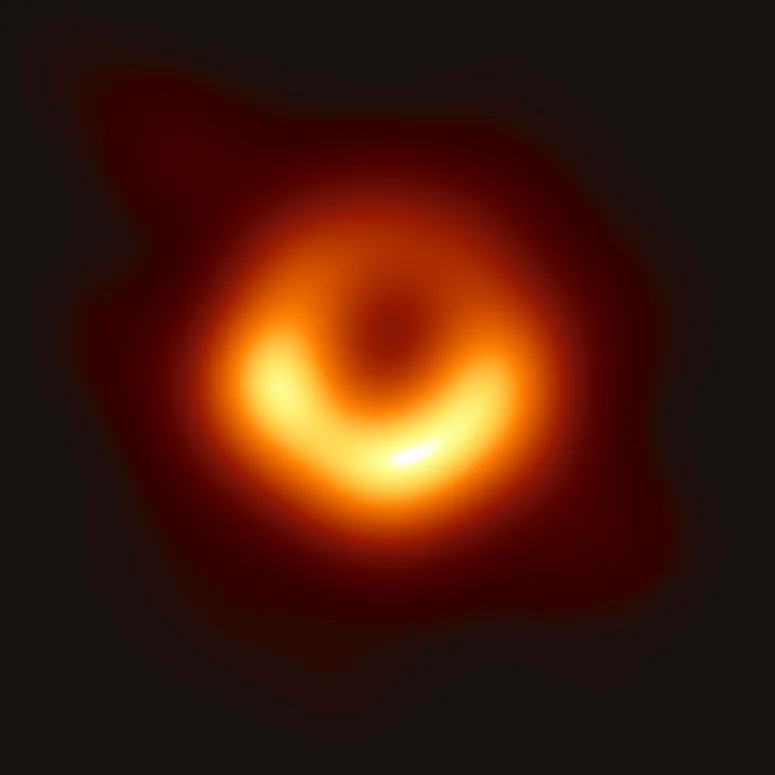
In 2019, astronomers unveiled the first-ever image of a black hole's shadow — a dark void encircled by a lopsided orange ring. This is the supermassive black hole at the heart of galaxy M87, 55 million light-years away. The ring isn't just glowing: one side is noticeably brighter than the other, like a campfire burning unevenly, with flames leaping higher on one side.

That asymmetry isn't a random flaw in the image. The light comes from superheated gas swirling around the hole before falling in. The gas moves at tremendous speed, and the part moving toward us appears brighter. But the brightness shifts from image to image — the gas churns like water in a boiling pot. Scientists took three images of M87*, taken in different years, and compared them with thousands of computer models. In the models, they varied one parameter: the spin rate of the black hole itself.

Black hole M87* weighs as much as 6.5 billion Suns, and its shadow on the sky is the size of a tennis ball as seen from Earth on the Moon.

It turned out that a very slow spin poorly explains what we see. A too-weak black hole couldn't accelerate the gas so strongly or make one side of the ring consistently brighter. The images best match models where the hole spins fast. This aligns with the fact that M87 shoots out a giant plasma jet thousands of light-years long, such jets, according to calculations, are launched by the hole's rotation.

Future observations will pin down exactly how fast it's spinning. That matters not just for astrophysics: the spin rate reveals how the black hole grew — whether it gulped matter chaotically or neatly along a spiral. The black hole's shadow, like a speedometer needle, reveals the hidden mechanics.

Original abstract

as written by the authors arXiv:2601.00394

Event Horizon Telescope (EHT) images of the supermassive black hole M87* depict an asymmetric ring of emission. General relativistic magnetohydrodynamic (GRMHD) models of M87* and its accretion disk predict that the amplitude and location of the ring's peak brightness asymmetry should fluctuate due to turbulence in the source plasma. We compare the observed distribution of brightness asymmetry amplitudes to the simulated distribution in GRMHD models, across varying black hole spin $$a_{*}$$. We show that, for strongly magnetized (MAD) models, three epochs of EHT data marginally disfavor $$|a_{*}| \lesssim 0.2$$. This is consistent with the Blandford-Znajek model for M87's jet, which predicts that M87* should have nonzero spin. We show quantitatively how future observations could improve spin constraints, and discuss how improved spin constraints could distinguish between differing jet-launching mechanisms and black hole growth scenarios.

Black hole M87* is so massive that its shadow is visible from Earth, even though the hole itself is 55 million light-years away, like spotting a coin on the Moon.

In the movie Interstellar, the black hole Gargantua is shown with a bright ring, lopsided due to rotation — exactly what we see at M87*.
Scientists
Stephen HawkingJacob BekensteinFritz ZwickyBernhard RiemannJoseph WeberKarl Schwarzschild
Concepts
m87 black hole spin black hole variability hawking radiation anomalies EHT spin parameter event horizon event horizon stability ringdown schwarzschild radius Bekenstein-Hawking entropy mass inflation relativistic jets iron line photon sphere wormhole resonance asymmetry Hawking radiation extremal black hole effective spin