Jian Wang

5 articles · 30 co-authors · latest: 2026-05-15
7 citations · h-index 2 · 6 papersData: Semantic Scholar

We have retold 5 papers by this author. most often about: topological insulator, quantum tunneling, superconductivity. 30 co-authors across our retellings.

Links in the knowledge graph
Mesoscale2026-03-041 minarXiv:2603.03927express
Indestructible current: how quantum edges bypass obstacles
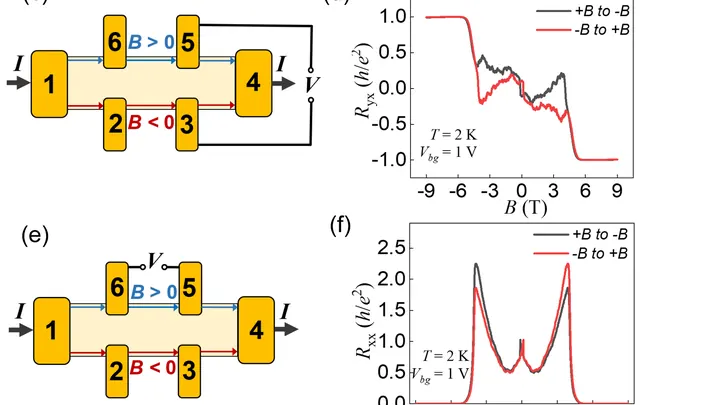
Certain materials, when placed in a strong magnetic field at low temperatures, exhibit a surprising property: their interior stops conducting, becoming an insulator, while along the very edge of the sample electricity runs like a river along a channel, always in one direction.
Superconductivity2026-03-051 minarXiv:2603.04717express
The Disorder That Gives Birth to an Insulator
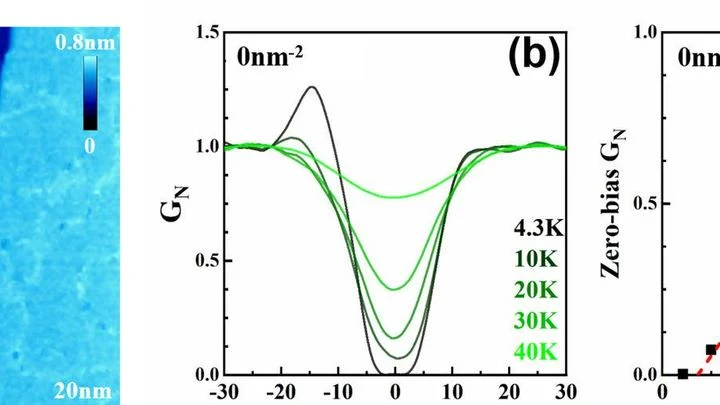
A superconductor carries current without loss, like a perfectly smooth road where cars glide with no friction. But what if you scatter rocks and potholes across that road? Scientists decided to find out by adding disorder to a superconducting material just one atom thick.
Quantum Physics2026-03-261 minarXiv:2603.25341express
A Quantum Dot That Entangles Light
A quantum dot is like a tiny lamp that turns on and off at the command of a laser, emitting exactly one photon at a time. But this light has a quirk: the photons don't interact with each other; they fly independently, like random drops from a faucet.
Materials2026-04-031 minarXiv:2604.02630express
When Electrons Collapse to a Point
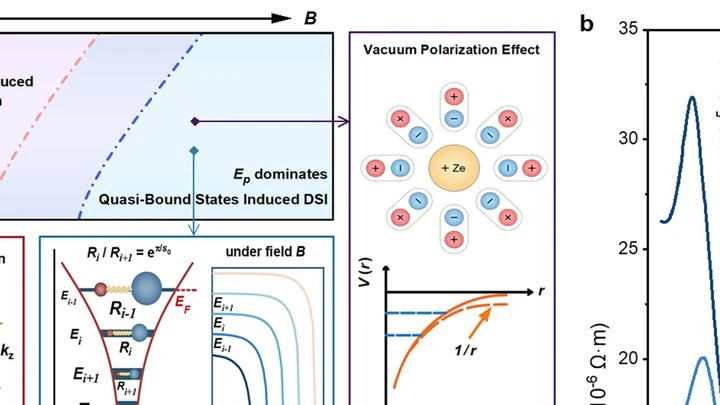
In the crystal HfTe5, electrons behave almost like light: their mass is so small that they obey the laws of relativity. If you place such a crystal in a strong magnetic field, the electrons start to circle in tiny orbits. Their energy then changes not smoothly but in steps, like floors in a building.
Superconductivity2026-05-152 minarXiv:2605.15703express
Superconductivity without pressure: nickelates caught the gap
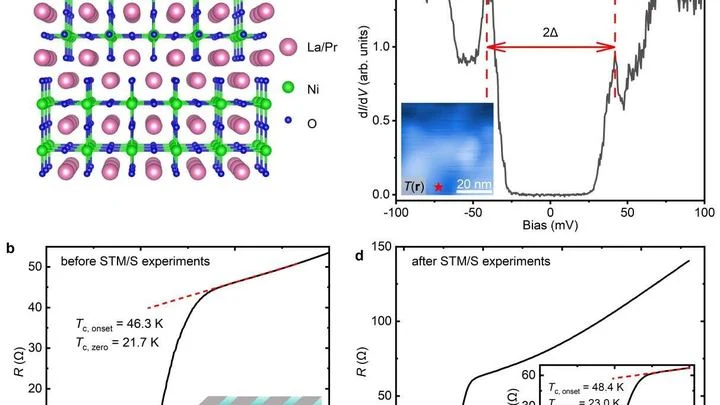
A packed stadium: fans mill about chaotically, creating jostling and resistance. That's how electrons behave in an ordinary conductor. In superconductivity, they pair up and move in sync, like spectators holding hands and calmly leaving the stands, without losing energy.