When Electrons Collapse to a Point express
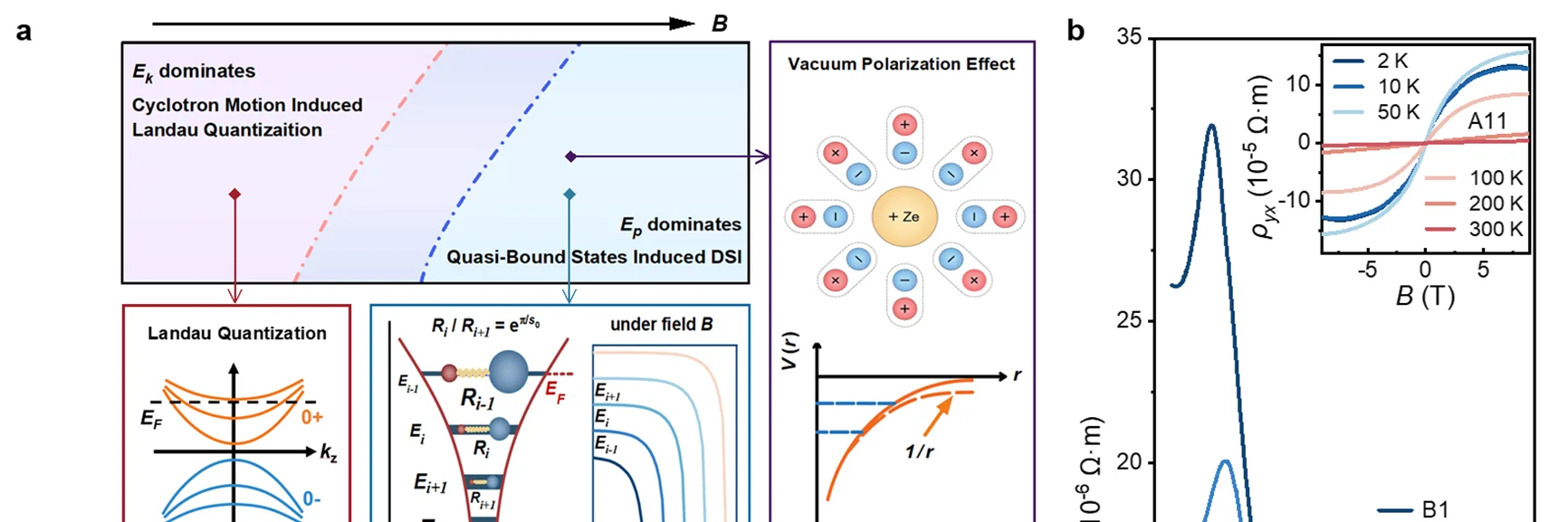
In the crystal HfTe5, electrons behave almost like light: their mass is so small that they obey the laws of relativity. If you place such a crystal in a strong magnetic field, the electrons start to circle in tiny orbits. Their energy then changes not smoothly but in steps, like floors in a building. In a weak field, you see one pattern of these steps, and in a strong field, another, with a special rhythm.
The transition between these patterns is like a change of music: first a steady metronome, then a rhythm where each successive beat lags by the same factor. Such a rhythm is a sign that states appear in the material resembling an electron falling onto a very heavy nucleus. In ordinary atoms, this does not happen, but here an impurity with a large charge creates the conditions for 'collapse.'
But the most interesting part is that this process depends on the electron density in the crystal. By changing it, you can control how strongly the vacuum 'eats' the impurity's charge. This means that a solid acts as a tiny laboratory for testing ideas about how the vacuum behaves near superheavy nuclei. And all of this — at temperatures available in an ordinary lab.
Log-periodic oscillations are a rare guest in solid-state physics. They arise when a system possesses discrete scale symmetry: if you change the scale by a certain factor, the pattern does not change. Such behavior occurs, for example, in turbulence and in finance.
In Stanisław Lem's novel 'Solaris,' the ocean exhibits structures that repeat themselves at different scales: this resembles the discrete scale symmetry seen in HfTe5.