How the Universe Got Magnetized Before the First Stars express
Right after the Big Bang, space was a hot plasma — a mix of charged particles and light. In such a medium, electric currents couldn't flow on their own: a 'potential difference' was needed to push electrons relative to photons. That's exactly what theories of cosmological magnetogenesis seek — the birth of the first magnetic fields.
The authors built a complete chain of equations, from particle collisions to the familiar Ohm's law, and tested three mechanisms. The first, discovered in 2005, works like a comb: the velocity difference between electrons and photons twists currents. The second was found only now: where photon density varies in space, an extra push on electrons arises. The third is a 'tailwind' from large-scale matter flows.
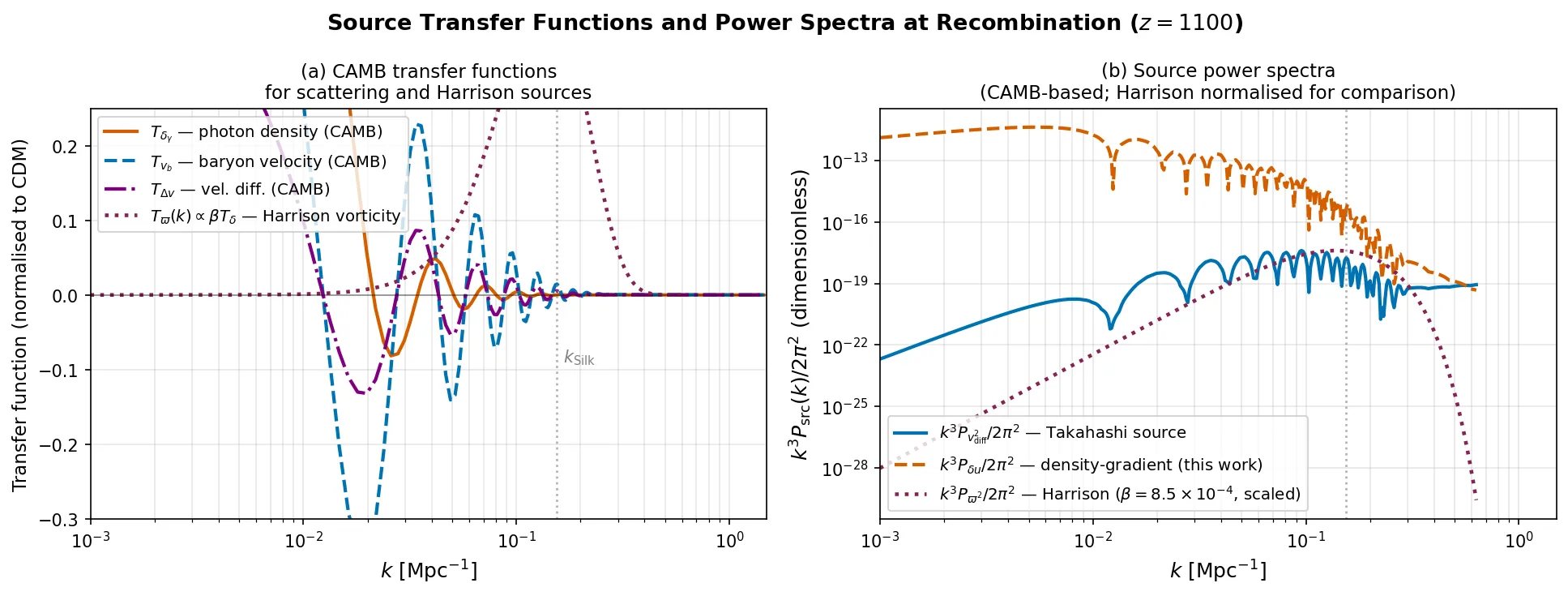
Numerical cosmological simulations (CAMB) at the epoch of recombination, when the Universe was 380,000 years old, showed that the new term adds nearly as much field as the old mechanism. Together, they boost the result by a factor of 1.5. And if large-scale matter flows circulated in the Universe, even at the limit allowed by Planck satellite data, a field of ten billionths of a gauss emerges on megaparsec scales. That's millions of times above the threshold where the galactic dynamo amplifies weak 'seeds' into the magnetic fields of stars and nebulae.
Thus, the cosmic plasma, which had never known a single star, was already weaving an invisible magnetic web, the scaffold for future galaxies.
The magnetic field born in the early Universe's plasma may be older than the oldest light we see today, the cosmic microwave background.