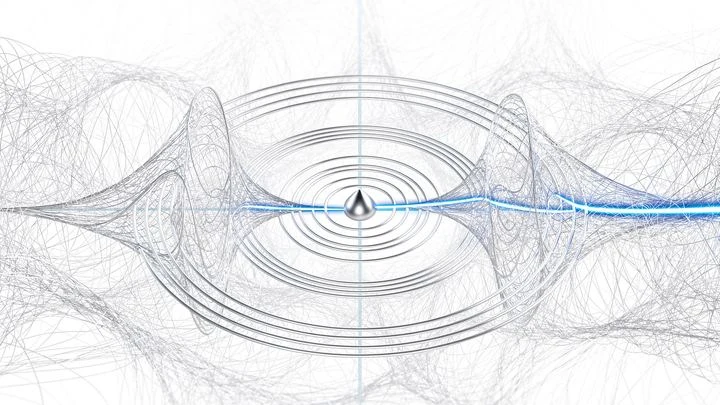
Quantum vacuumfluctuations are transient, random changes in the energy of empty space, arising from the Heisenberg uncertainty principle. Even in a perfect vacuum, pairs of particles and antiparticles can spontaneously appear, exist for a fleeting moment, and then annihilate, borrowing energy from the vacuum in the process. These fluctuations are not just a mathematical curiosity — they have measurable physical consequences, such as the Casimir effect, where two closely spaced metal plates are pushed together by the pressure of virtual particles. They also play a role in explaining phenomena like Hawking radiation from black holes and the spontaneous emission of light from excited atoms.
History
The concept was formalized in the late 1940s with the development of quantum electrodynamics, particularly through the work of Hendrik Casimir, who predicted the Casimir effect in 1948, and later by Stephen Hawking in 1974, who applied vacuumfluctuations to black holes.
How it works
The Heisenberg uncertainty principle allows a temporary violation of energy conservation, as long as the product of the energy fluctuation and its duration is small enough (ΔE·Δt ≈ ħ). This permits the creation of a particle-antiparticle pair from nothing, which then annihilates within a time scale set by their energy. In the presence of strong gravitational fields, such as near a black hole's event horizon, one member of the pair can escape while the other falls in, leading to Hawking radiation. In quantum electrodynamics, these fluctuations also 'dress' electrons, slightly altering their properties like charge and mass.
In practice
Quantum vacuumfluctuations are harnessed in technologies like the Casimir effect, which is studied for micro-electromechanical systems (MEMS), and they are essential for understanding the stability of matter and the emission of light in semiconductor devices.
Fun fact
The vacuum is not empty — it contains so much energy density that, if converted to mass, it would be enough to create a black hole the size of a proton in every cubic centimeter of space.
Inside a supercomputer, fifteen stable wave clumps — solitons — collide to form a halo of dark matter. These waves obey an equation that Erwin Schrödinger derived for electrons at the beginning of the 20th century, but now they paint a portrait of a giant galactic cocoon.
At temperatures billionths of a degree above absolute zero, a Bose–Einstein condensate emerges — a state where thousands of atoms march in a single quantum key.
A bonfire doesn't burn out all at once. If you glance at the flames at a random moment, all you see is a jumble of fire tongues, and you can never tell what exactly burned: a wet branch, an old magazine, or an armful of dry grass. But if you watch the fire hour after hour, rhythms emerge in its dance: a burst of heat, a lull, a change in color. These rhythms tell the story of what was thrown into the flames.
Normally, by rapidly oscillating a mirror in a vacuum, you can conjure real particles from nothing: this is the dynamical Casimir effect. But near a black hole, things are different. The spacetime curvature itself stifles any attempt to create something.
A black hole is not just a void but a massive object that warps the space around it. If it finds itself in a cloud of invisible dark matter, matter that emits no light but makes itself known through gravity, its behavior changes.
In the first instants after the Big Bang, the Universe expanded faster than light could cross it. This rapid growth, inflation, stretched tiny quantum jitters to the size of entire galaxies. But from what state did these jitters begin?
In the standard cosmological model ΛCDM, galaxies recede under the pressure of dark energy — an invisible spring. However, different methods of measuring the expansion rate give different numbers, as if the ruler's scale is off.
In the first moments after the Big Bang, the Universe underwent rapid expansion: inflation. But perhaps it was contracting before that, and then bounced. Both scenarios leave nearly identical imprints on the cosmic microwave background, and cosmologists have debated for decades which one is correct.