physics.gen-ph physics.gen-ph

7 articles

articles

Climate Networks: How El Niño Snaps Invisible Threads
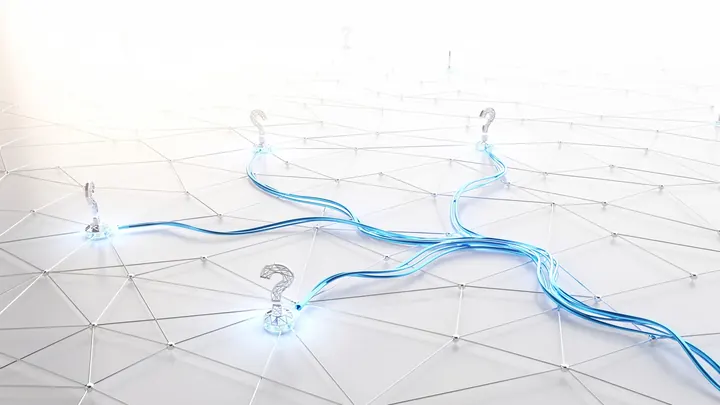
A hammock woven from thousands of cords is stretched between continents. Each cord is a link between two points on the planet: when it warms in one place, it cools in another, day after day. As long as the hammock holds, it keeps the climate in its familiar rhythm. But every few years El Niño arrives, a warm current off the coast of Peru, and the cords begin to snap.
An Ocean Thermometer Instead of a Barometer: A New Take on Climate Indices
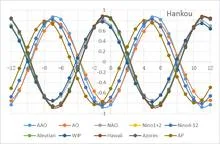
For a century, climatologists have measured the ocean's pulse with a barometer. Indices like El Niño or the North Atlantic Oscillation are built on atmospheric pressure differences between two points, and then we wonder why rivers don't obey.
A Telegraph Through a Hidden Tunnel in Time
Two couriers leave the same city in opposite directions. An hour later, each opens an envelope: one contains a slip marked “plus,” the other “minus.” How did they know who would get which?
Five Questions Physics Asks Philosophy
At night, an astronomer points a telescope at the edge of the visible universe and sees not stars but ripples — the imprint of the first moments. He knows these ripples should obey statistics, like the heights of people in a crowd. But he has only one crowd, and nothing to compare it with. This is cosmic variance.
physics.gen-ph2026-02-081 minarXiv:2602.17702express
Black Holes Are Born When the Universe Bounces
The universe can behave like a spring: compressing to microscopic sizes and then expanding again. In this cycle of contraction and bounce, black holes and dark matter are born.
physics.gen-ph2026-04-051 minarXiv:2604.03916express
Life from Mars: How Realistic Is It?
A rock knocked off one planet by an asteroid impact hurtles through space and lands on another. If microbial spores are hiding inside, they might survive the cold, the radiation, and the rough landing. That's panspermia — the idea that life travels between worlds. But imagining such a journey is one thing; calculating every step is quite another.
Quantum Entanglement as Geometry: Extra Time Instead of Instantaneous Communication
Two particles separated by kilometers change their states in concert, as if there were no distance between them. This is called quantum entanglement, and since its discovery it has baffled physicists: no known carrier can travel faster than light, yet correlations appear instantaneously.