A Hybrid Quantum Algorithm for the Unit Commitment Problem ✛
Context
Power plant scheduling is a daily trade-off between reliability and cost. Classical computers handle this task, but as the number of generators grows and uncertainties (such as load fluctuations) are considered, the complexity increases exponentially. Alongside this work, there are studies that reformulate the UC problem as quadratic binary optimization (QUBO) and solve it on quantum annealers or with variational algorithms, but accuracy or scalability remain limited. This work fits into that line of research but bets on a hybrid approach: the quantum processor does not solve the entire problem but merely "sieves" the solution space, leaving a small set of candidates for the classical computer to refine precisely.
Methods
The authors split the UC problem into two parts: first, they decide which generators to turn on (binary variables), then how much power each should produce (continuous variables). To select the commitment combinations, they construct a QUBO function that penalizes unmet demand and rewards low minimum costs. This function is encoded into a Hamiltonian, and a variational quantum algorithm (VQA) searches for its ground state, that is, the combination with the lowest cost. They use a layered ansatz that alternates entangling blocks (in a "butterfly" style) and mixing blocks with a warm start from a semidefinite relaxation. After VQA converges, the quantum state is sampled, and up to 128 of the cheapest feasible combinations are passed to the classical SLSQP solver, which finds the optimal power levels for each. The final solution is the combination with the minimum total cost.
Results
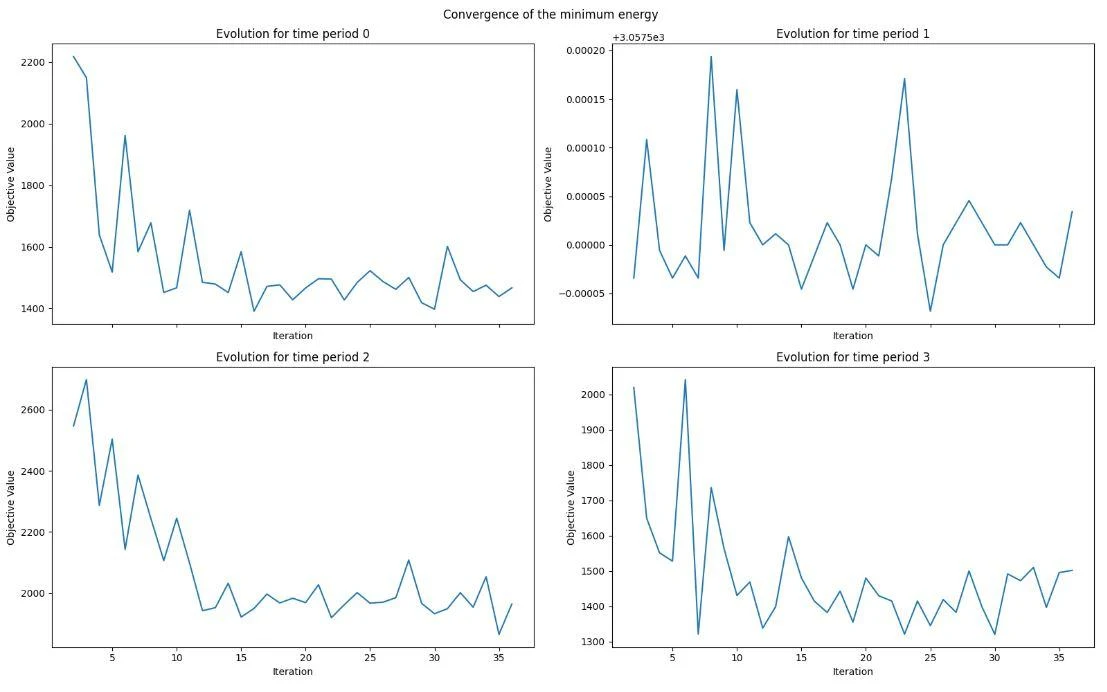
On a simulator for a system with 10 generators and 24 hours, the average approximation error drops from 1.78% (one ansatz layer) to 0.55% (nine layers). For 26 generators, the error stabilizes around 2.5% as the number of layers increases. The number of optimization iterations grows linearly with the number of parameters: on average, 8.63 iterations per additional parameter. On the IonQ Forte quantum processor for the 26-generator problem, the average inference error was 3.088% versus 3.201% on the simulator, indicating good agreement. VQA convergence on real hardware was demonstrated for individual hourly problems.
Implications
This work differs from neighboring studies in that it does not attempt to solve the entire UC problem on a quantum computer but uses it as a "sieve" to select candidates, leaving the precise optimization to a classical method. This achieves an error below 3% for systems with 26 generators, a level not previously demonstrated for variational quantum algorithms in this area. Such a hybrid approach reduces the requirements on the number of qubits and circuit depth, making it more practical for current quantum processors.
Future development
A promising direction is replacing VQE with variational quantum imaginary time evolution (varQITE), which could accelerate convergence. This would require adapting varQITE to constrained problems: exploring efficient ways to encode constraints into QUBO, developing a decomposition of the quantum objective function, and considering other QITE implementations. Another direction is creating specialized ansatze that better model the ground state of the UC Hamiltonian, reducing the number of optimization iterations.
Impact
The method could be useful for power system operators in short-term planning, especially with the growing share of renewable sources and load uncertainty. It also demonstrates a general principle of hybrid quantum-classical computing for mixed-integer optimization problems.
Next steps
Immediate plans include adapting varQITE to the UC problem and developing problem-specific ansatze. A deeper understanding of the relationship between the number of ansatz layers and approximation error is also needed as the number of generators scales to industrial sizes.
Key open problems
For the energy sector, the open question remains scaling quantum and hybrid algorithms to real power system sizes (hundreds and thousands of generators). Also unresolved is the problem of accounting for load and renewable generation uncertainties in quantum formulations. This work is a step toward answering the first question, but the second remains untouched.
The knowledge machine's view
This section is addressed to the author of the paper and their colleagues. Neighbouring works were found by meaning-based search across our archive, not by word overlap. We do not review: we show the field around the work.
What the work does
The authors propose a three-stage hybrid quantum-classical algorithm for the unit commitment problem: a variational quantum algorithm selects promising combinations of committed generators, a classical SLSQP optimizer refines power levels, and then the best combination is chosen. The method is tested on systems with 3, 10, and 26 generators over a horizon of up to 24 hours; for 10 generators, the average error drops to 0.55%, and for 26, to 2.53%. Experiments on the IonQ Forte quantum processor confirm convergence and agree with simulations.
Where its strength is
A key strength is the separation of the problem into a binary part (combination selection) and a continuous part (power optimization), which allows the quantum computer to act as a filter to reduce the candidate space while preserving the accuracy of classical optimization.
Where it could go next
- It might be interesting to see how the quantum error mitigation methods described in the paper could be applied to reduce VQA error in combination selection, especially on real hardware.based on: A Robot Traffic Cop for Quantum Gates arXiv:2504.10938
- A related work applies quantum algorithms to power grid problems; perhaps their approach to formulating the UC problem or handling uncertainties could be integrated into your hybrid scheme.based on: Quantum First Aid for Power Grids arXiv:2607.29582v1
Worth trying
- Test warm-starting the ansatz not only from semidefinite relaxation but also from solutions obtained by classical heuristics.
- Investigate how changing the number of sampled combinations (e.g., 64 or 256) affects the trade-off between accuracy and computational cost.
- Explore the possibility of applying error suppression techniques from [2504.10938] to real quantum runs to improve the quality of selection.
Why this may matter
This hybrid approach, where a quantum computer narrows the search space and a classical computer performs precise optimization, could offer a practical route to applying quantum computing in energy systems on current hardware, as it does not require full quantum advantage.
Nearby works in our archive
- Three Emitters Instead of a Laser Batterysimilarity 0.55
- A Quantum Compass for Your Batterysimilarity 0.55
- Body Heat as a Clue: A Quantum Look at Breast Cancersimilarity 0.55
- Quantum Calculator Cuts Molecular Costs in Halfsimilarity 0.54
- A Robot Traffic Cop for Quantum Gatessimilarity 0.54
- Iceberg Quantum Codes: How Errors Make Computers Smartersimilarity 0.54
- Quantum First Aid for Power Gridssimilarity 0.54
The archive is sparse around this work: the closest review is only 0.55, against a usual 0.64. It looks like few have drilled nearby.
For a system with 15 generators and 24 hours, the number of possible on/off combinations exceeds 2.3×$10^{108}$, which is more than the number of atoms in the observable universe (about $10^{80}$).
Key numbers
- Average error for 10 generators (9 layers): 0.55%
- Average error for 26 generators (best result): 2.53%
- Number of candidates passed to the classical solver: up to 128
- Number of possible combinations for 15 generators and 24 hours: 2.3×10108
- Average increase in iterations per parameter: 8.63