A Quantum Sieve for the Power Grid ✛
Every day, the power grid faces a puzzle: which power plants should be switched on to reliably meet demand without breaking the bank? For 15 generators and 24 hours, the number of possible schedules exceeds 2.3×$10^{108}$, more than the number of atoms in the visible universe. No classical supercomputer can sift through all of them, so dispatchers settle for a compromise. Researchers from the University of Toronto and IonQ have proposed a division of labor: the quantum processor filters out the junk, and the classical computer polishes the result.
The quantum sieve works like this. First, the unit commitment problem is cast as quadratic binary optimization, a mathematical form where each combination of active generators gets a cost score plus a penalty for unmet demand. Then a variational quantum algorithm with tunable parameters searches for combinations with the lowest score. Its quantum circuit consists of layers that entangle qubits and mix probabilities, starting from a "warm start," an approximation obtained from classical relaxation. After convergence, the algorithm outputs up to 128 of the cheapest feasible combinations. Next, the classical sequential quadratic programming method takes over: it takes each combination and precisely calculates how much power each generator should produce each hour to meet the load at minimal cost. The result is the combination with the lowest total price.
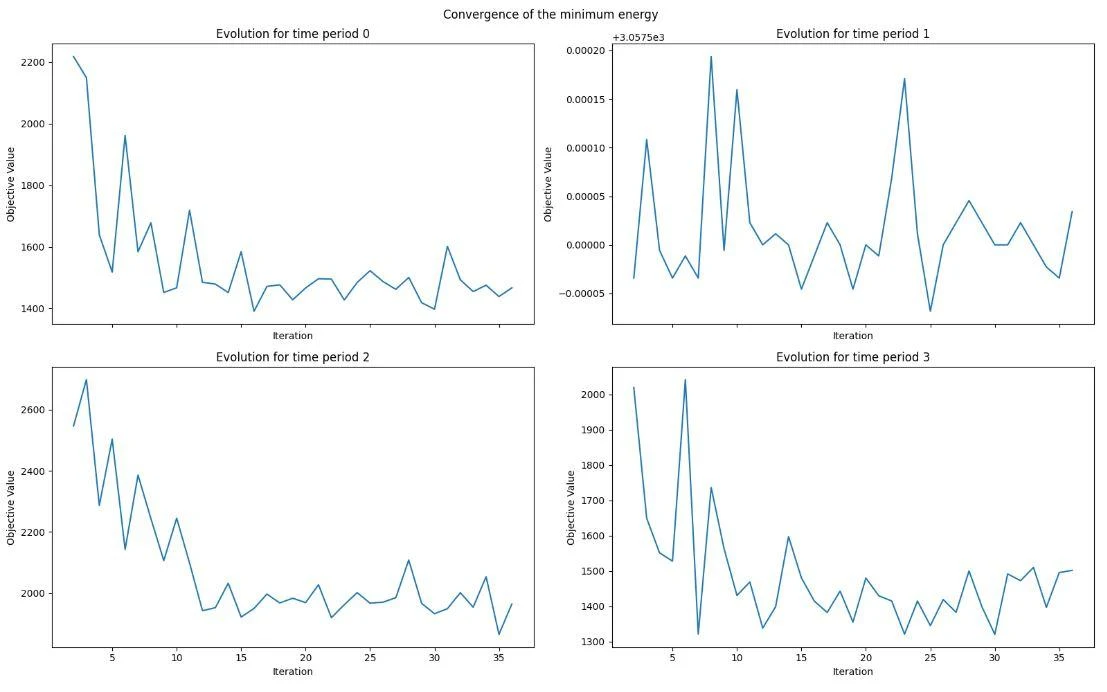
The results are encouraging. On a simulator for a system with 10 generators and 24 hours, the average approximation error drops from 1.78% with one circuit layer to 0.55% with nine layers. For 26 generators, the error stabilizes around 2.5%. Importantly, the number of optimization iterations grows linearly with the number of parameters: on average, 8.63 iterations per additional parameter. The real IonQ Forte quantum processor showed an average error of 3.088% versus 3.201% on the simulator, qualitative agreement that confirms the approach works on actual hardware.
Before this work, variational quantum algorithms for unit commitment either produced large errors, for example 8% for QAOA, or failed to scale beyond 20 generators. Now it has been shown that a hybrid approach with quantum candidate selection and classical refinement achieves an error below 3% for 26 generators. This division of roles reduces the demands on qubit count and circuit depth, making the method practical for today's quantum processors. Grid operators can already use it in short-term planning, especially with the growing share of renewables and load uncertainty.
The outlook goes further. The authors plan to replace the variational quantum algorithm with variational quantum imaginary time evolution, which may accelerate convergence. This requires adapting the method to constrained problems and designing specialized quantum circuits that better model the ground state of the problem Hamiltonian. Scaling to hundreds and thousands of generators remains an open question, as does incorporating uncertainties in quantum formulations. But already, the quantum sieve filters out the chaos of combinatorial explosion, leaving the classical computer just a handful of promising solutions, a step toward a grid that plans itself.
For a system with 15 generators and 24 hours, the number of possible on/off combinations exceeds 2.3×$10^{108}$, which is more than the number of atoms in the observable universe (about $10^{80}$).