A Kilometer-Long Bridge Between Cold Islands ✛
Two dilution cryostats, each the size of a barrel, stand at opposite ends of the laboratory. Inside are superconducting circuits cooled to 50 millikelvin, a hundred times colder than interstellar space. Between them runs an ordinary optical fiber, a kilometer of glass thread carrying light. For the first time, a coherent microwave pulse crossed this bridge without losing its quantum nature.
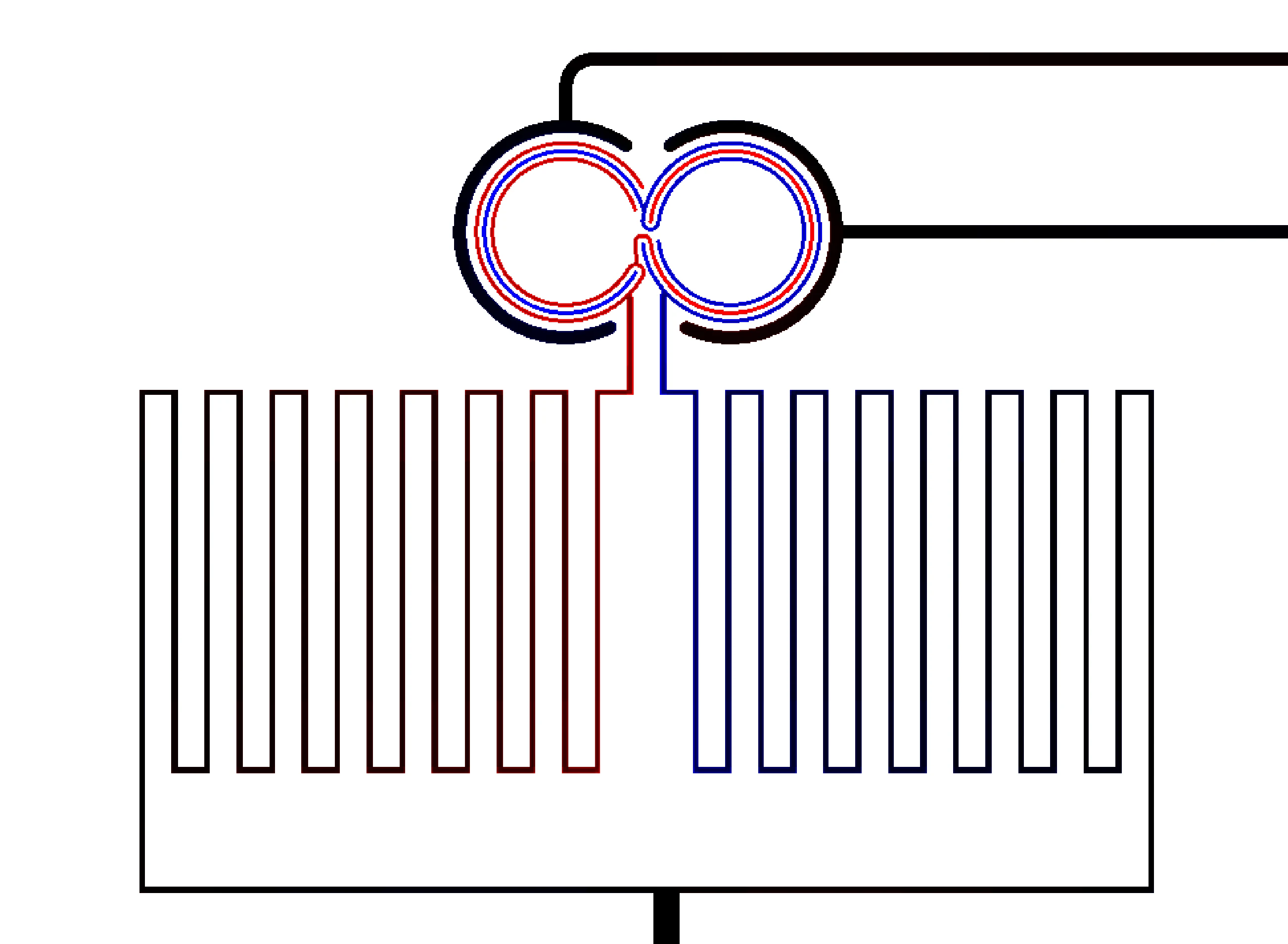
Superconducting quantum computers are like cities on an archipelago. Each island is a separate cryostat, and there are no roads between them. Electro-optic converters based on aluminum nitride act as ferries: they turn a microwave signal at 9.960 GHz into a photon with a wavelength of 1550 nanometers, send it through the fiber, and on the other shore convert it back to microwaves, but at 4.606 GHz. The frequencies are tuned by a DC voltage up to 160 volts, and the pair is matched using the Vernier effect, where the teeth of two slightly different combs align.
The on-chip conversion efficiency exceeded 0.1% at an optical power of about 4 milliwatts. The total microwave-optics-microwave link efficiency reached -60 dB on chip, which is 80 dB better than a pair of commercial modulators. Coherence was confirmed by measuring the phase of the scattering matrix and by interference with a local oscillator. The channel even carried data in QPSK format, quadrature phase modulation with four states, at a microwave power below -30 dBm.
Before this work, coherent transfer between separate cryostats was considered technically unattainable, because matching the frequencies of a pair of converters is extremely difficult. Now the cold islands can be connected by bridges. The next step is to generate entanglement between microwave photons in two cryostats using heralded schemes. This would bypass the 50% efficiency threshold for quantum communication. In parallel, one can increase the conversion efficiency by reducing the mode volume and improving the resonator quality factor. Increasing the gap between the electrodes and the optical ring will reduce added noise without sacrificing efficiency.
The kilometer-long photonic bridge is a ready-made building block for distributed superconducting processors. The archipelago gets roads.
A kilometer of coaxial cable would attenuate the microwave signal 1000 times more than the optical fiber used. A commercial electro-optic modulator for this task would require about a watt of modulation power, whereas in the experiment less than a microwatt sufficed.