Simple

How Atomic Noise Builds a Perfect Connection

Original: "Generation of entanglement between bright light fields via incoherent spontaneous emission"
arXiv:2505.00919v1 · 2025-05-01 · CC BY 4.0 · ⏱ 1 min · Quantum Physics
The random glow of atoms, usually a nuisance, can create almost perfect quantum communication.
Abstract

Spontaneous emission (uncontrolled light emission by atoms) usually destroys quantum entanglement. But in this work, it does the opposite, creating an almost perfect link between two bright light beams. Through quantum interference—similar to how colliding waves can cancel each other out—noise is suppressed, and entanglement emerges. What could this mean for quantum technology?

Links in the knowledge graph 1

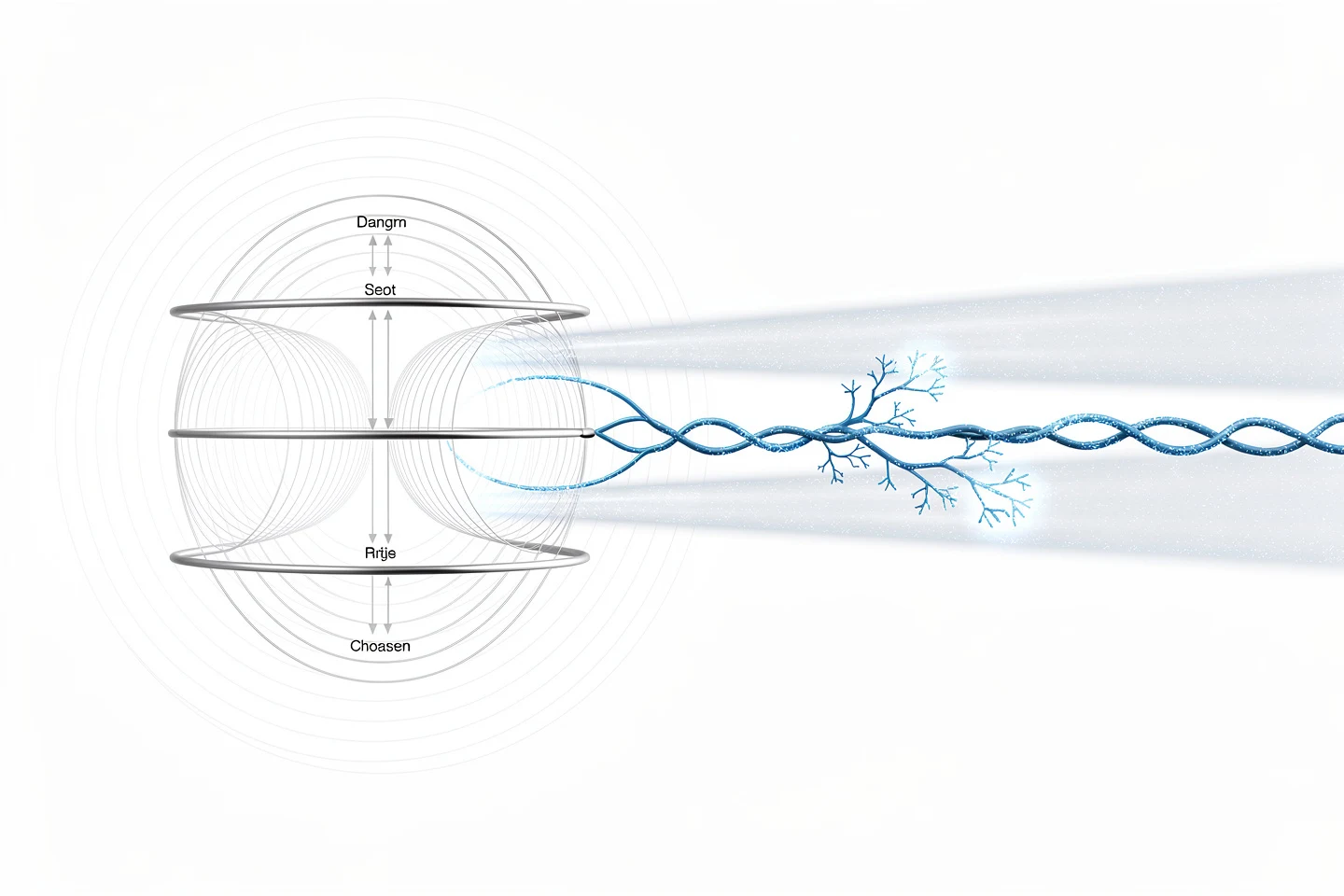
The random glow of atoms typically destroys entanglement (a concept introduced by Schrödinger), but physicists turned this noise to their advantage. Two emission channels cancel each other out, like opposing waves—crest meets trough.

In the experiment, atoms with two energy levels were illuminated by a laser at an intermediate frequency. The resulting two pathways for photon emission, through superposition, completely eliminated the noise. Then electromagnetic amplification kicked in, and the laser beams became entangled: measuring one instantly determines the properties of the other, no matter the distance—confirming the ideas of Bell and the experiments of Aspect.

When the noise is fully canceled, the atoms stop emitting light while staying excited—like a lit but invisible lamp.

This method is valuable for quantum communication and quantum computers, where reliable sources are essential. Quantum noise turns out to be not a foe but a builder. The future holds a quantum internet, built on precise measurements and quantum optics.

🎯 With fine-tuning, atoms can enter a ‘dark state’—they remain excited but don't emit light.

V_{12} = \langle (\delta X_1 + \delta X_2)^2 + (\delta P_1 - \delta P_2)^2 \rangle < 4
Correlator of amplitude and phase quadratures, where δX and δP are the fluctuations of the respective quadratures.
Scientists
Erwin SchrödingerHugh Everett IIINiels BohrPascual JordanWerner HeisenbergStephen Hawking
Tags
quantum entanglement superposition quantum optics quantum information quantum decoherence electromagnetism quantum measurement quantum computer
Laws
Schrödinger equationHeisenberg uncertainty principleHawking radiationPlanck–Einstein relationsuperposition principlePoynting's theorem
Original: arXiv:2505.00919v1 · CC BY 4.0 · bridge42worlds