Light-by-light scattering is a quantum electrodynamic process in which two photons interact and scatter off each other, producing two photons with changed directions. In classical electromagnetism, Maxwell's equations are linear, meaning light passes through light without any interaction; this process is therefore a purely quantum effect. It is a direct consequence of the vacuum not being truly empty but filled with virtual particle-antiparticle pairs, which can mediate the interaction.
History
The possibility was first predicted by Werner Heisenberg and Hans Euler in 1936, and independently by Victor Weisskopf, based on Dirac's theory of the electron. It remained unobserved for decades due to its rarity.
How it works
The mechanism involves a virtual electron-positron pair: one photon momentarily transforms into a pair, and the second photon interacts with one of these virtual particles, after which the pair annihilates back into two real photons. This is a fourth-order process in perturbation theory, making it extremely rare. The probability scales with the fine-structure constant squared, and it becomes observable only with very intense photon beams or strong electromagnetic fields.
In practice
It is a key background process in high-energy particle physics experiments, such as at the LHC, and is used to test quantum electrodynamics at high precision. It also plays a role in astrophysical environments like neutron stars and gamma-ray bursts.
Fun fact
The first direct observation of light-by-light scattering was achieved in 2017 by the ATLAS experiment at CERN, using ultra-peripheral collisions of lead ions.
An electron and its antiparticle — the positron, predicted by Дираком, — upon meeting, momentarily form позитроний: a tiny pair circling each other, like in an atom but without a nucleus. Almost instantly it decays, emitting two photons that turn out to be mysteriously linked.
In the scorching core of a star, two helium nuclei approach each other like two dancers on a crowded stage. Their dance is alpha scattering, the basis of stellar helium burning. How smoothly they twirl determines how quickly the star burns its fuel.
Previously, this dance was described in simplified terms.
Spacetime can be imagined as a tightly stretched fabric. A massive body dents it, guiding light. Rotation twists the fabric into a spiral. Such a gravitational funnel can entangle a passing photon with the very source of rotation — say, a tiny mirror. Quantum entanglement springs up: an invisible thread binding their fates.
A detector filled with superfluid helium-4 is like a perfectly still lake. The liquid doesn't slosh or bubble: it's frozen in a single quantum state. An invisible guest, a dark matter particle, flies through it. It doesn't shine or leave a track. But sometimes it nudges a helium nucleus.
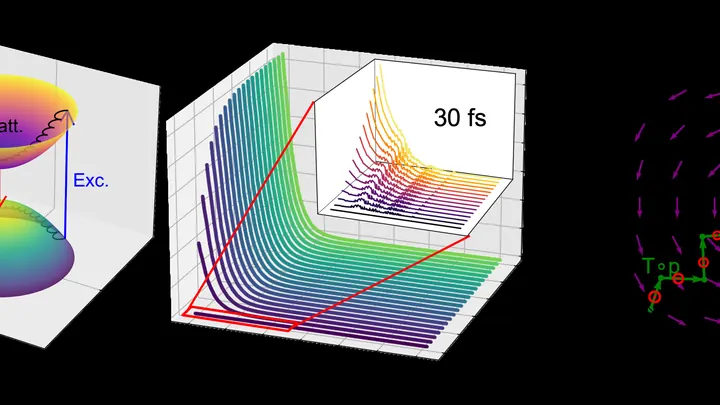
A light carousel spins not people but electrons. Instead of wooden horses, there are invisible blades of light. This is exactly the kind of 'carousel' physicists built to give electrons a spin.
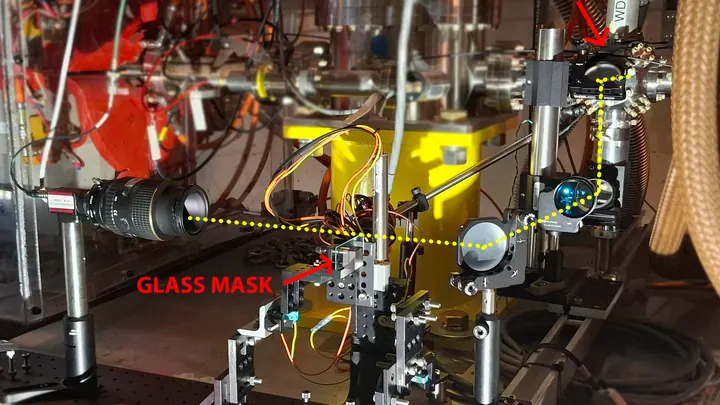
Usually, to twist an electron beam into a vortex, you need a tiny mask — a stencil with slits carved on the atomic scale. Fabricating it is extremely challenging.
A deuterium molecule, two atoms of heavy hydrogen, falls apart under a laser pulse. One electron is ripped away, leaving an ion behind. At that moment, they are still linked: the direction of one immediately tells you which way the other went. This link is called quantum entanglement.
A quantum dot the size of a virus, squeezed between mirrors, gives birth to two photons in a short flash of light. These photons fly out as a pair, and their polarizations, the directions of wave oscillation, are linked such that knowing one instantly tells you the other.
Two tiny emitters, each about the size of an atom, can together do what neither can do alone. We're talking about light scattering — when light hits particles and bounces off in all directions. Usually, a pair of particles scatters light only slightly more than a single one.
Light from many tiny emitters — atoms or artificial "quantum dots"—usually scatters in all directions, like a crowd where everyone shouts on their own. But if you make them "sing in chorus," the flash becomes many times brighter.
In giant particle accelerators, particles fly at nearly the speed of light and smash head-on. But sometimes one beam is slightly denser than the other, like someone stepping onto a packed escalator the wrong way. Then collisions become uneven, and detectors start 'flickering,' throwing off measurements.
An ordinary laser emits photons one by one, like a faucet dripping water. But what if you need several particles of light born at the same instant? Physicists have made a cloud of cold rubidium atoms emit quadruples of photons — as if the faucet suddenly released four drops at once, each falling into its own test tube.
A crystal without a center of symmetry is like a staircase where all the steps are tilted in the same direction: electrons, given a kick by light, roll predominantly in one direction. This is how a direct current is born — the photogalvanic effect.
When light passes through biological tissue or frosted glass, it scatters and loses the image. Researchers at the Paris Institute of Nanosciences have shown that a scattering medium can be tuned to transmit images encoded in the correlations of entangled photons while remaining opaque to classical light.
In an accelerator, two Higgs particles collide. For a fleeting moment, their fates intertwine, then separate, carrying away information about the encounter.
Spontaneous emission, the very process that lights up lamps and stars, has long been considered a pesky noise in quantum physics. This cacophony of random photons ruthlessly destroys fragile quantum entanglement, like radio static drowning out a distant melody.