Generating Quantum Entanglement of Bright Light Fields via Spontaneous Emission ✛ ✦
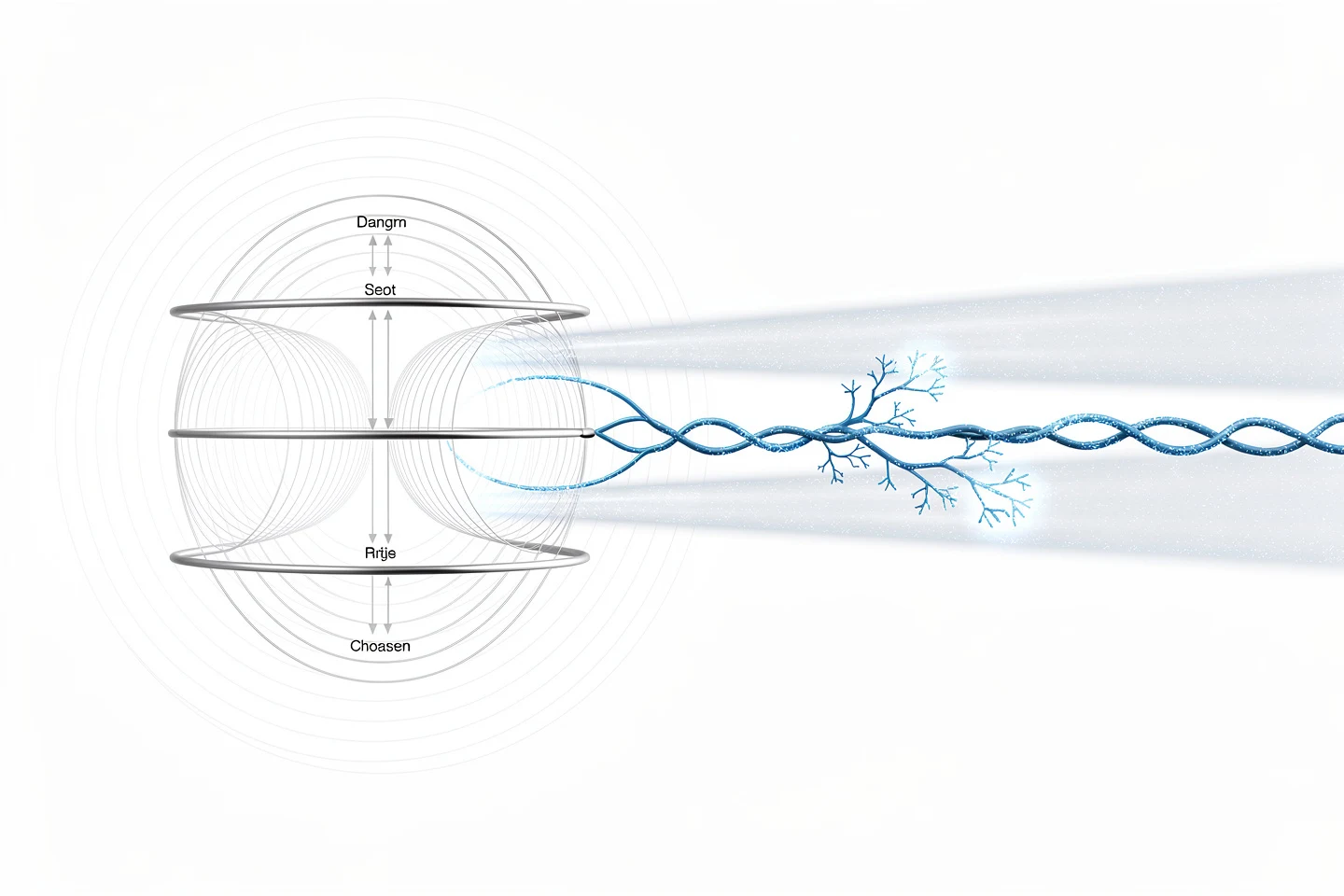
Context
Quantum entanglement, introduced into the debate by Schrödinger, is a key resource for quantum communication and quantum computing. Traditional methods for generating entangled light fields, such as parametric down-conversion in nonlinear crystals, suffer from broad bandwidth and short correlation times. An alternative are schemes based on four-wave mixing in atomic systems, but spontaneous emission noise usually limits the degree of entanglement. This work flips the paradigm: the incoherent process is used not as a foe but as a creator of quantum correlations. The interaction of atoms with electromagnetic fields in a configuration with coherent population trapping allows a radical enhancement of the medium's nonlinear response.
Methods
The theoretical work employs a four-level system (two closely-spaced excited levels and two lower ones) interacting with two strong coherent pump fields. Using the Heisenberg-Langevin formalism with account for quantum fluctuations and the Weisskopf-Wigner approximation, a system of operator equations is derived describing the evolution of atomic and field variables. Linearization is then applied: each operator is represented as a sum of a mean value and a fluctuation part. Entanglement is quantitatively assessed via the V₁₂ correlator of amplitude and phase quadratures according to the Duan–Giedke–Cirac–Zoller criterion. The scheme's key feature is precise tuning of the laser detunings to the midpoint between the excited levels, leading to destructive interference of two spontaneous decay channels and almost complete suppression of incoherent noise.
Results
Numerical solution showed that with parallel orientation of transition dipole moments (p₁ = p₂ = 1) and precise tuning to the midpoint, the V₁₂ correlator drops virtually to zero, corresponding to near-perfect bipartite entanglement. For instance, with pump field intensities comparable to spontaneous decay rates, V₁₂ ≈ 0.01, whereas under usual conditions V₁₂ = 4 (no entanglement). This occurs due to complete suppression of spontaneous emission through destructive quantum interference and dominance of the coherent four-wave process. Violation of the inequality V₁₂ < 4 is direct evidence of nonlocal correlations, as studied in Bell's theorem and Aspect's experiments. The dependence on lower-level decoherence (γ₁₃) turns out to be critical: at zero transition rate between the lower states there is no entanglement, but as γ₁₃ increases up to a certain limit, correlations strengthen. The optimal value of γ₁₃ is around 0.1γ₁, where γ₁ is the decay rate of the excited levels. Further increase breaks the weak-field-depletion approximation.
Implications
The results show that processes traditionally considered purely destructive for quantum coherence—such as spontaneous emission and collisions—can be harnessed to generate entanglement. This opens up a new class of methods in quantum optics and quantum information science, especially for creating bright non-degenerate entangled beams with narrow bandwidth and long correlation times, sought after in quantum repeaters and networks. Conceptually, the work deepens understanding of the role of decoherence and superposition in open quantum systems.
Future development
The topic could evolve towards experimental implementation using Rydberg states in sodium dimers, where spin interactions create closely spaced energy levels, or by using additional laser fields to engineer an effective four-level system. Furthermore, combining the scheme with quantum memory techniques and non-demolition measurements for building distributed quantum networks is of interest. In the future, similar principles could be applied to other platforms, including solid-state and optomechanical systems.
Impact
Will impact the development of quantum communications (quantum repeaters), quantum computing (generation of entangled resource states), and precision spectroscopy.
Next steps
Experimental verification in atomic systems with suitable level structure (e.g., sodium dimers) and optimization of parameters to maximize the degree of entanglement.
Key open problems
Connection to fundamental problems: the nature of quantum measurement and decoherence; the boundary between coherent and incoherent processes in open quantum systems; the search for resource-efficient methods to generate entanglement for scalable quantum technologies.
The knowledge machine's view
This section is addressed to the author of the paper and their colleagues. Neighbouring works were found by meaning-based search across our archive, not by word overlap. We do not review: we show the field around the work.
What the work does
The paper proposes a theoretical scheme for generating bipartite entanglement of bright light fields, leveraging destructive interference between two spontaneous decay channels in a four-level atomic system. Using the Heisenberg–Langevin formalism and linearization, conditions for almost complete suppression of incoherent noise are derived, and numerical analysis demonstrates achieving a correlator V₁₂ ≈ 0.01, corresponding to nearly perfect entanglement.
Where its strength is
The strength of the work lies in flipping the paradigm: spontaneous emission, which usually destroys quantum correlations, becomes a resource here thanks to precise tuning to destructive interference of decay channels. This paves the way for creating robust entangled states without the need to suppress noise by external means.
Where it could go next
- Nearby lies a work where entanglement is generated by sunlight rather than lasers, which might be interesting for extending the proposed scheme to incoherent pump sources and testing the stability of interference noise suppression under such conditions.based on: Sunlight Creates Quantum Entanglement arXiv:2602.15655
- In our archive, there is a study showing how losses can breed order in quantum systems; perhaps comparing their approach could deepen understanding of the role of dissipation in your scheme and find regimes where inevitable losses do not destroy but rather enhance entanglement.based on: Loss Creates Order: The Quantum Dance of Photons arXiv:2604.05422
- Another direction is studying the influence of turbid media on entangled photons, described in a neighboring article; this could hint at how your scheme behaves in realistic conditions with scattering and inhomogeneous broadening, and how to preserve the advantages of interference.based on: Entangled Photons vs. Murky Media arXiv:2508.14616
Worth trying
- Test whether destructive interference persists when coherent pump fields are replaced by thermal or solar sources, using the model from the paper on solar entanglement.
- Investigate whether intentionally introducing controlled losses into one of the decay channels can stabilize entanglement, drawing on the concept of 'losses breed order'.
- Assess the scheme's robustness to phase and amplitude noise of the pump, typical for propagation in turbid media, using methods developed for entangled photons in scattering media.
Why this may matter
The proposed mechanism of using spontaneous emission as a constructive element could become the foundation for a new class of entangled light sources that are noise-resistant and suitable for quantum communications in real-world conditions.
Nearby works in our archive
- Sunlight Creates Quantum Entanglementsimilarity 0.67
- Loss Creates Order: The Quantum Dance of Photonssimilarity 0.65
- Entangled Photons vs. Murky Mediasimilarity 0.65
- How a Beam of Light Turns into Schrödinger's Catsimilarity 0.64
- Gravity Entangles Particles with a Delaysimilarity 0.63
- Sunlight replaces lasers: quantum imaging without complex opticssimilarity 0.63
The closest work in the archive sits at 0.67 by meaning — the usual level for our corpus.
Original abstract
as written by the authors arXiv:2505.00919v1
In contrast to the general argument that the spontaneous decay is intrinsically incoherent in nature and detrimental to quantum entanglement, here, we show that nearly perfect entanglement between two bright pump fields can be realized via spontaneous decay-induced destructive quantum interference in a closed double Lambda-type four-level atomic system with the energy separation of the excited doublet comparable to their decay rates. The high degree of bipartite entanglement results from the cancellation of spontaneous emission and subsequent elimination of the associated noise due to the destructive quantum interference between the two spontaneous emission pathways from the upper doublet to each of the two lower levels when the two strong pump fields are tuned to the particular frequencies where quantum interference takes place. This scheme is particularly suitable for the generation of entanglement between two bright light fields, and may find potential applications in realistic quantum information processing.
Interestingly, complete destructive interference of two spontaneous emission channels can completely "trap" the population in the excited levels — the atoms stop emitting even though decay is formally allowed. This resembles the "dark state" effect in coherent population trapping, but it occurs purely due to quantum interference of vacuum modes.
Key numbers
- V₁₂ at optimal parameters: ≈0.01 (near-perfect entanglement)
- γ₁₃ / γ₁ (optimal ratio): 0.1
- Number of atomic levels: 4
- Interference parameter p: 1 (complete destructive interference)
- Pump intensity (in units of γ₁): on the order of 1–10