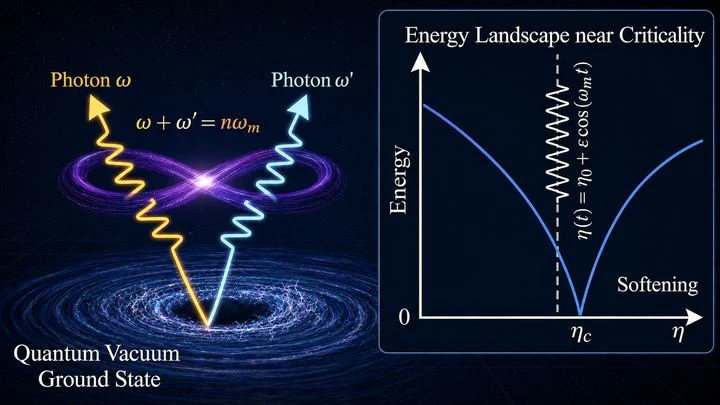
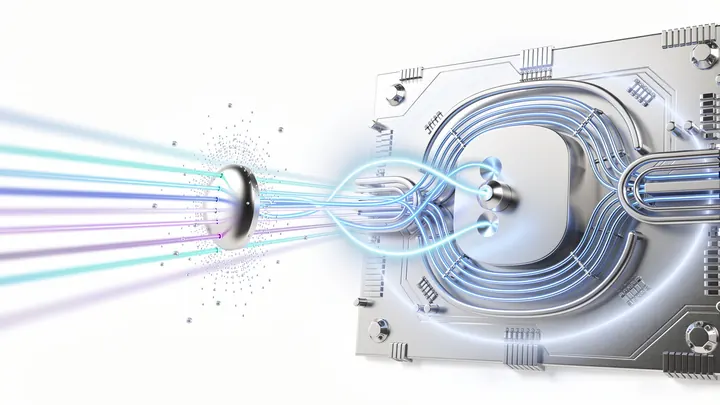
The dynamical Casimir effect is the quantum phenomenon where photons are created out of the vacuum by rapidly moving boundaries or time-varying electromagnetic conditions. Unlike the static Casimir effect, which produces an attractive force between two stationary plates, the dynamical version converts mechanical energy into real photons. It is a direct demonstration that the quantum vacuum is not empty but seething with virtual particles that can be 'shaken' into existence.
History
The effect was predicted by Gerald Moore in 1970 and later developed by Julian Schwinger, who proposed it as a mechanism for sonoluminescence. The first experimental observation was reported in 2011 by a group at Chalmers University of Technology, using a superconducting quantum interference device (SQUID) as a tunable mirror.
How it works
In quantum field theory, the vacuum is filled with virtual photon pairs that constantly appear and disappear. When a conducting mirror moves at speeds comparable to the speed of light, or when the electromagnetic properties of a cavity change rapidly in time, these virtual pairs can be separated before they annihilate, becoming real photons. The effect is extremely weak: the mirror must accelerate violently, and the photons emerge in pairs with correlated frequencies. In practice, researchers mimic the moving mirror using superconducting circuits whose electrical properties are modulated at gigahertz rates.
In practice
The dynamical Casimir effect is studied in superconducting circuits to generate entangled photon pairs, which are useful for quantum information processing and tests of fundamental quantum optics.
Fun fact
The photons created by the dynamical Casimir effect emerge in pairs that are quantum-mechanically entangled, meaning measuring one instantly influences the other, regardless of distance.
In a pot of water carefully heated above its boiling point, the liquid remains calm. But the slightest disturbance, and it violently turns to steam. Physicists call this a metastable state: it seems stable, but in reality it's ready to break apart at the slightest nudge.
In the first moments after the Big Bang, the universe underwent a rapid expansion — inflation. Space stretched faster than light, and quantum jitters of the vacuum turned into real particles. This is how dark matter, the invisible substance that holds galaxies together, could have been born.
In the first moments, the Universe expanded at an enormous rate. This process is called inflation, and its driving force is the inflaton field. Its energy pushed space apart, like yeast raising dough. But physicists suspect that the dough might have left 'bubbles'—superheavy particles born from the expansion itself.
A thrown stone sends ripples across water. A gravitational wave is the same kind of ripple, but in spacetime. It is produced, for example, by the merger of two black holes. In classical physics, this ripple is eternal: once created, it travels through the Universe without fading.
Inside a supercomputer, fifteen stable wave clumps — solitons — collide to form a halo of dark matter. These waves obey an equation that Erwin Schrödinger derived for electrons at the beginning of the 20th century, but now they paint a portrait of a giant galactic cocoon.
The quantum vacuum is not a dead void but a boiling cauldron of probabilities. In some theories, our Universe is frozen in a metastable state: like superheated water, it's ready to explode into steam at the slightest nudge.
Space is threaded with magnetic fields. They exist around galaxies, stars, and even in nearly empty voids — the vast empty spaces between galaxy clusters. It's usually thought that fields are amplified from weak 'seed' fields by turbulence, much like a dynamo. But the origin of the seed fields themselves has remained a puzzle.
In 1905, Einstein showed that the chaotic motion of pollen in water results from the jostling of invisible molecules. A century later, physicists have learned not only to observe but also to control motion at the quantum level.
In the microscopic world of the strong interaction, nature's most powerful glue, quarks never wander alone. Over large distances, they stick together into the protons and neutrons we know. But under extreme compression, like in the depths of a neutron star, this glue creates far more exotic forms of matter.
A surfer glides across the ocean surface until a big wave comes, and then they're flying forward. Similarly, a free electron interacts with light: usually the energy exchange is barely noticeable, but if the surrounding medium begins to oscillate rhythmically, each wave crest pushes the particle harder and harder.
The universe is expanding at an accelerating rate, like dough that keeps rising faster even though the yeast ran out long ago. For twenty years, astronomers have been searching for the cause and call it dark energy. But what it is remains a mystery.
New work proposes an unexpected source: the vacuum inside the atomic nucleus.
Spacetime can be imagined as a tightly stretched fabric. A massive body dents it, guiding light. Rotation twists the fabric into a spiral. Such a gravitational funnel can entangle a passing photon with the very source of rotation — say, a tiny mirror. Quantum entanglement springs up: an invisible thread binding their fates.
When an electric charge moves with acceleration, it emits electromagnetic radiation, i.e., light — a familiar phenomenon in physics. However, researchers have found that when moving along a specially chosen trajectory, the radiation acquires unusual properties.
A time crystal resembles an eternal clock: its atoms spontaneously perform rhythmic movements. In ordinary clocks, a pendulum is driven by a spring or battery, but here the motion arises without an energy supply — the system simply returns to its initial state at regular intervals. This idea was proposed by Frank Wilczek in 2012.
Two quantum particles are linked by an invisible thread: one loses energy, the other gains it, but the total remains unchanged. If you watch only the first, its oscillations don't fade — the rhythm is steady, like that of a cosmic pulsar, even though it seems that entropy and chaos are increasing.
In the quantum world, light and matter constantly exchange energy. Previously, they were described statically, like frozen poses. The new approach follows the dance itself: the transitions between states, like a continuous sequence of movements.
Normally, by rapidly oscillating a mirror in a vacuum, you can conjure real particles from nothing: this is the dynamical Casimir effect. But near a black hole, things are different. The spacetime curvature itself stifles any attempt to create something.
On the surface of a tiny sphere live two invisible fields, like two kinds of ripples on a soap bubble. These fields don't just oscillate on their own: they constantly influence each other, like musicians playing in unison. In a new study, physicists derived exact equations that describe how this ripple changes over time, heats up, and descends into chaos.
A handful of rice grains falls onto a hot skillet, and they start jumping. Each grain pushes its neighbors, and the whole pile stirs without any external hand. That's active matter: a multitude of particles that draw energy on their own and convert it into motion.
Light from a bulb or even a regular laser resembles a crowd at a subway exit: people move haphazardly, sometimes dense, sometimes sparse. Physicists call this behavior shot noise — random fluctuations in the number of particles arriving per second.
Vacuum is not silent emptiness, but a boiling cauldron of quantum fluctuations, born from nothing and vanishing in billionths of a second. This invisible symphony acts like a constant wind, pressing an atom against a wall — as if a powerful bass note pushes a light ball.
The quantum vacuum is not emptiness, but a tautly stretched string, where particles constantly appear and vanish. Abruptly changing conditions, like shifting the mirrors of a microcavity, causes the 'string' to emit real photons.
A laser beam holds a single ion in a vacuum, and that ion behaves like a ball trapped between two cups. The cups aren't pits in the ground but regions where the ion energetically prefers to be. In the classical world, a ball would roll into one cup and stay there.
On a lab bench sits a laser trap — an invisible hand that holds a glass bead the size of a bacterium in midair. Next to it is a mirrored cavity where light bounces between two reflective walls. Scientists made the bead and the light exchange quantum entanglement: their states are now linked so that measuring one instantly reveals the other.
A pot on a stove receives heat, but not work: the gas under the lid just heats up. But what if the stove is not ordinary, but quantum? Then heat and work can arrive simultaneously, like from an engine that also heats.
In a new study, exactly this case is described: a classical system (say, a pendulum or a small mirror) bathes in a quantum environment.
Two metal plates in a perfect vacuum attract each other. Even Richard Feynman compared emptiness to a boiling foam: particle pairs are born and immediately vanish, creating the Casimir effect. If the plates are asymmetric, they also start to twist — that's a vacuum motor.
But rotation doesn't require oddly shaped parts.
In a glass of salty water, even if it sits perfectly still, something is always happening. Tiny salt particles, ions, float and collide, sending ripples through the water. These ripples are invisible, but they create a force that attracts or repels nearby objects.
Previously, it was thought that this force only acts over very short distances, as if it quickly fades out.
An ordinary laser emits photons one by one, like a faucet dripping water. But what if you need several particles of light born at the same instant? Physicists have made a cloud of cold rubidium atoms emit quadruples of photons — as if the faucet suddenly released four drops at once, each falling into its own test tube.
Our Universe may have arisen from a highly unstable state that physicists call the false vacuum. Imagine a glass of water cooled below its freezing point: the liquid remains liquid only until the first jolt, which instantly triggers crystallization into ice.
The expansion of the universe is like a dance floor stretching wider. For decades, physicists assumed that more stretching would spawn more particles, like the floor spontaneously generating new dancers. But those models ignored an obvious fact: dancers sometimes link arms. When particles interact, new simulations reveal, they actually suppress creation.
A crystal without a center of symmetry is like a staircase where all the steps are tilted in the same direction: electrons, given a kick by light, roll predominantly in one direction. This is how a direct current is born — the photogalvanic effect.
The Wigner function is a kind of topographic map of probabilities: hills correspond to regions where a particle is most likely to be found, and valleys to where its appearance is practically ruled out.
Two voices in a molecular duet can sound in unison or cancel each other into silence. In physics, such silence is called a dark state: a quantum excitation that does not interact with light and therefore lives unusually long.
In a superconducting circuit cooled to below 10 millikelvin, a mechanical oscillator vibrates at 5.33 megahertz. Usually in such systems, the mechanics outlives the light, but here the roles are reversed: the oscillator decays faster than the photons in the resonator.
The hall is silent, but the conductor has already raised the baton. The orchestra is quiet, yet the score is changing. So it is in an optical resonator: there is no light, but the quantum vacuum—that emptiness filled with short-lived field fluctuations—is already conducting the…
Spontaneous emission was long considered fickle: a quantum dot emits a photon, obeying only probability. The Purcell effect allowed amplifying it by placing the emitter in a resonator, but that only changed the rate, not the spectral shape.