An exceptional point is a specialdegeneracy in a non-Hermitian system where not only the eigenvalues (energies or frequencies) but also the eigenvectors (states) of the system coalesce. Unlike a standard degeneracy, where two states share the same energy but remain distinct, at an exceptional point the two states become identical, leading to a breakdown of the usual mathematical description. This concept arises in systems that are open, meaning they exchange energy or particles with their environment, and it has profound implications for how such systems behave.
History
Exceptional points were first studied in the context of non-Hermitian quantum mechanics in the 1960s, but they gained prominence in the 2000s with experiments in optics and photonics, where gain and loss can be precisely engineered. The term 'exceptional point' was coined by T. Kato in his 1966 book on perturbation theory.
How it works
In a non-Hermitian system, such as one with gain or loss, the eigenvalues are complex, with the imaginary part representing decay or growth. An exceptional point occurs when two eigenvalues and their corresponding eigenvectors merge, which requires both the real and imaginary parts to match. Near this point, the system's response to perturbations is highly sensitive, and the behavior of the system changes dramatically — for example, the usual rules of quantum mechanics, like the orthogonality of states, break down. This sensitivity can be exploited for enhanced sensing and control.
In practice
Exceptional points are used to design ultra-sensitive sensors, where a small perturbation near the exceptional point causes a large response, and to control light propagation in photonic devices, such as lasers and waveguides.
Fun fact
At an exceptional point, the system's eigenvectors become parallel, meaning the two states are indistinguishable — a phenomenon that has no analogue in closed, Hermitian systems and can lead to effects like unidirectional invisibility.
A laser beam can do more than heat things up: it can also calm motion. When light enters a mirror trap, it exerts pressure on the mirrors, and if you tune the beam's color just right, that pressure becomes a gentle braking force. This is how tiny mechanical vibrations are cooled to nearly absolute zero.
An ordinary network of four optical waveguides is like an intersection without traffic lights: the signal wanders in all directions and mixes. But if you look only at some of the outputs, the picture changes. An illusion arises that the system has losses — though in reality energy doesn't disappear; it just goes into unobserved ports.
An orchestra without a conductor. Each musician hears not only their neighbor but also echoes from across the stage. That's roughly how the idea of a nonlocal Higgs field works: a particle 'feels' what's happening not at a single point but across an entire region of space.
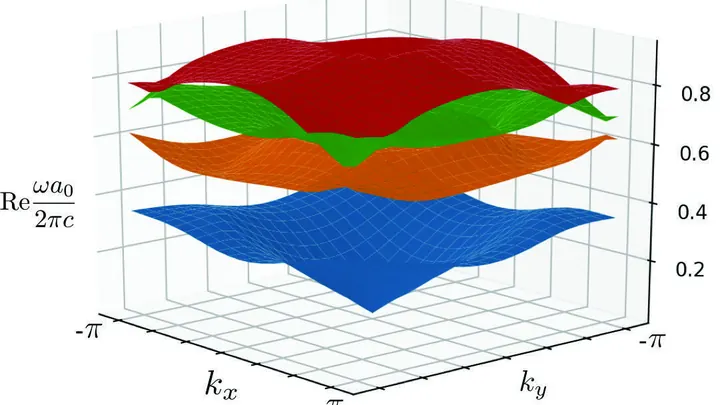
Light, discovered by Maxwell, behaves differently in different media. In a new study, researchers simulated a two-dimensional crystal that absorbs light and has magnetic properties. In it, light waves behave like passengers on a one-way escalator: they relentlessly move toward edges and corners, where they accumulate.
Two musicians play a duet. In a perfect hall, they hear each other perfectly and gradually fall into resonance. But try playing in a room where someone keeps slamming the door. You'd think the rhythm would be thrown off. But no: sometimes that very random slam makes both of them sync up instantly.
Classical black holes, regions of spacetime with gravity so strong that even light cannot escape, according to general relativity, hide a singularity at their center: a point of infinite density and curvature where the known laws of physics break down.
In two mirrored rooms, set at right angles, lives a cloud of atoms. Each atom is like a singer in a choir: on its own, it may stay silent, but when neighbors start to sing, it joins in. Here, the conductor's role is played by geometry itself: one room helps the atoms emit light together, while the other gently nudges them toward that — not directly, but through a clever detour.
Light from a quantum system is like a singer's voice: by the tremor, you can tell something's off with the vocal cords. Physicists have found that in the emission spectrum of a collective spin (a group of atoms behaving like a single magnet), peculiar distortions appear when the system passes through so-called exceptional points.
Light is trapped in a tiny cavity and circles around like a ball in a groove. If you slightly change the material inside, the light notices immediately, and gives a signal. Usually, such sensors work like spring scales: the harder you press, the more noticeable the shift. But there's another, trickier approach: make even a weak perturbation produce a disproportionately large response.
Two pendulums hanging from the same crossbar gradually begin to swing in sync. But if you give one of them a slight nudge, the shared rhythm changes, and from that change, you can detect even the lightest touch. This is roughly how sensors based on coupled oscillating systems work.
In the new study, the researchers considered two coupled circuits, like two pendulums connected by a spring.
Hot water sometimes freezes faster than cold — that's the classic Mpemba effect. In the quantum world, its counterpart is even more astonishing: tiny particles can reach equilibrium many times faster than expected, and what helps them is not forgetfulness, but memory.
Open systems exchange energy with their surroundings, like a guitar string fading into the air. Scientists built such a system out of light, twisting the beams into corkscrews and forming an artificial lattice — a maze where losses can be controlled at every step. Light in this maze always moves at the maximum possible speed, but its energy can fade or grow.
In a chain of cold spins stretched along a single line, order and disorder can intertwine into a pattern that defies the usual rules. Two states of matter, two kinds of "order," are separated by a crossroads where the roads do not converge but diverge.
Spontaneous emission was long considered fickle: a quantum dot emits a photon, obeying only probability. The Purcell effect allowed amplifying it by placing the emitter in a resonator, but that only changed the rate, not the spectral shape.
At the hilltop of classical physics, a particle is frozen in unstable equilibrium. The slightest nudge — and it rolls down with increasing speed. In the quantum universe, no nudge is needed: the uncertainty principle itself acts as an all-pervading wind, blowing the particle off the peak.