Melody of Disorder: What a Black Hole's Light Says About Chaos ✛
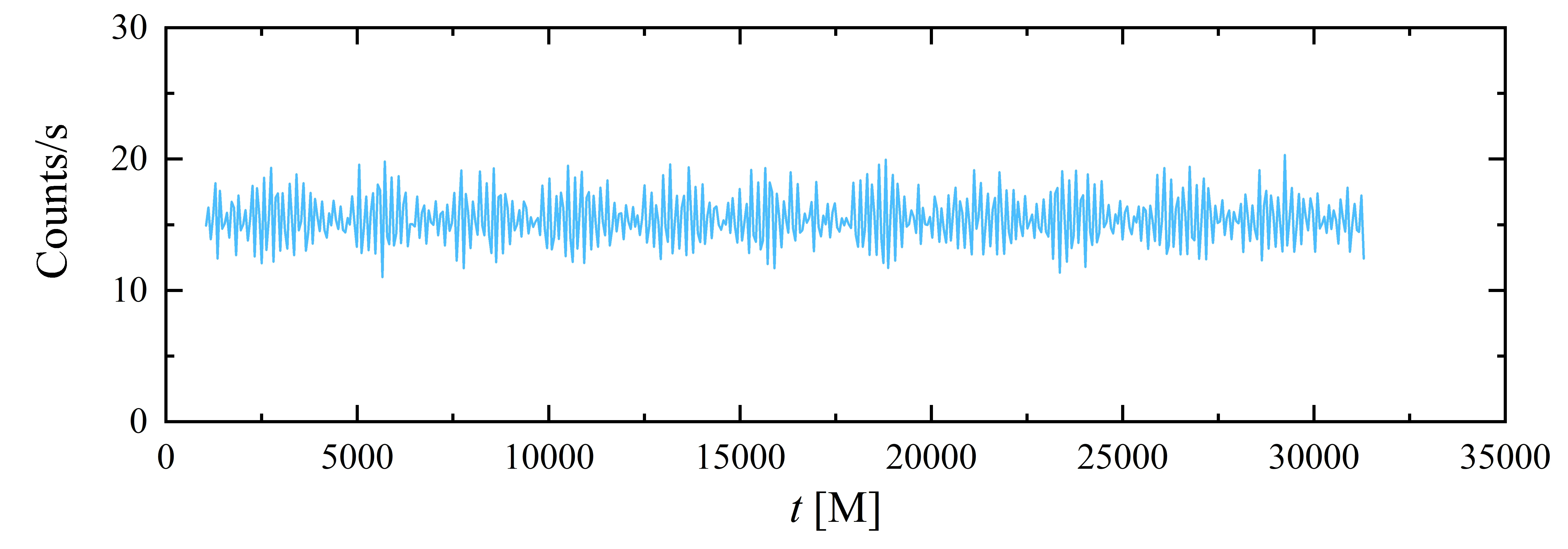
In a new study, scientists simulated a rotating black hole, around which spacetime is so curved that even light cannot escape. In such an environment, superheated gas clumps move in orbits like musicians in an orchestra: some keep a strict rhythm, others break into chaotic cacophony. For a long time, astronomers couldn't distinguish order from chaos just by watching the light from a black hole. But now, by recording the brightness variation, light curve, and analyzing its power spectrum, scientists have found the key. The power spectrum shows at which frequencies the light pulses. For regular orbits, it produces sharp, isolated peaks, like a single pure note. For chaotic ones, it shows wide, blurred humps, resembling wind noise. Surprisingly, even in such noise, a pattern emerges: from the peak's width, you can calculate how strong the chaos is. So chaos smears the signal, but it's this blurring that lets us measure its strength. The discovery gives astronomers a tool to search for chaos in real black holes.
Chaos doesn't mean complete disorder: it contains hidden patterns that are just hard to predict.
In Liu Cixin's 'The Three-Body Problem,' the chaos of three suns makes the climate unpredictable, much like chaotic orbits around a black hole affect its glow.