Light Curves of Chaotic Hot Spots in Curved Spacetime ✛
Context
This work stands apart: the nearest neighbors deal with quantum states, instantons, and teleportation, not observational astrophysics. There are already studies of chaos in quantum circuits, crystals, and black holes, but they are either theoretical or pertain to microscopic systems. This paper takes a step toward real observations: it links chaotic dynamics to a specific measurable signal, the light curve.
Methods
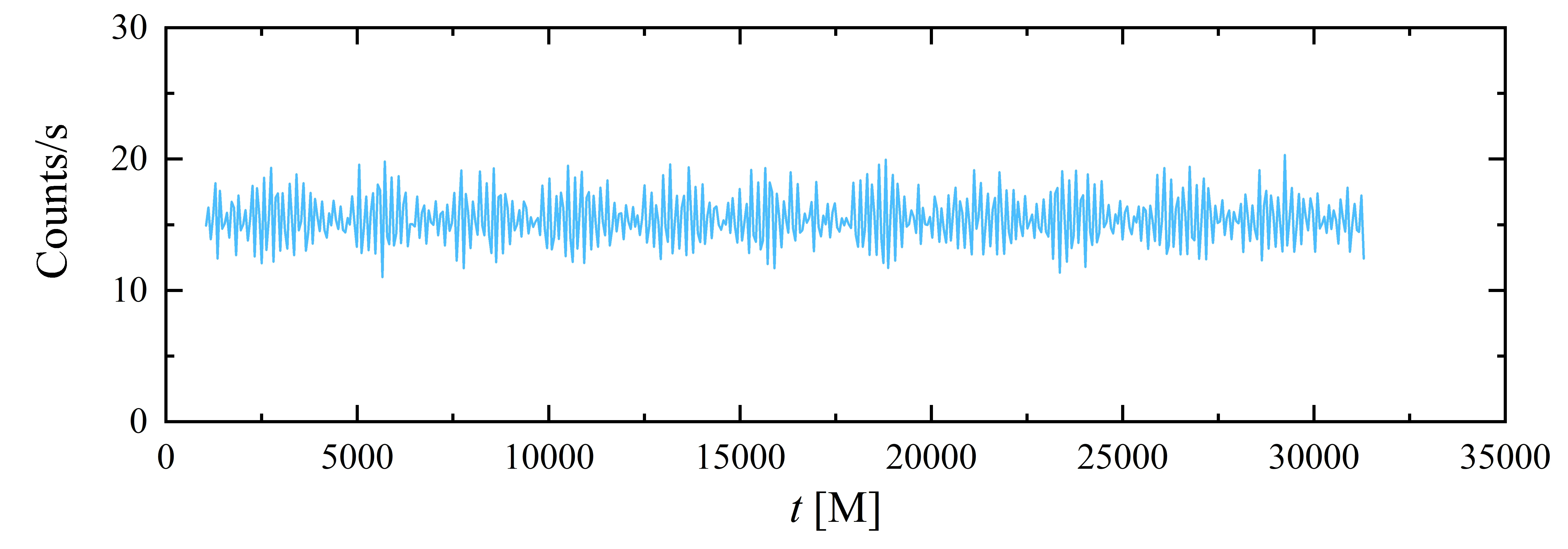
The authors numerically integrated the equations of motion of a charged hot spot in the Kerr metric with an external uniform electromagnetic field. For six orbits (three regular and three chaotic), they computed the maximum Lyapunov exponent and the fast Lyapunov indicator to confirm the type of dynamics. Then, using ray tracing in the ODYSSEY code, they simulated light curves for an observer inclination of 17° and a field of view of 60×60 black hole masses with a resolution of 6000×6000 pixels.
Results
Regular orbits produce light curves with clear periodicity, resembling a heartbeat, and their power spectra contain isolated narrow peaks. Chaotic orbits, in contrast, generate irregular fluctuations with a wide range of amplitudes, and their power spectra resemble noise: continuous broad bands of small amplitude. Even when a regular orbit does not show explicit periodicity in the light curve, its spectrum still reveals sharp peaks, unlike the chaotic case.
Implications
Unlike neighboring works that study chaos in quantum systems or as a theoretical possibility, here a concrete observational test is proposed. This is the first attempt to use light curves to detect chaos in curved spacetime. The result gives astrophysicists a tool to probe the nature of accretion flows and the properties of gravity in strong fields.
Future development
The method can be extended to other configurations: hot spots with spin, additional fields, or modified theories of gravity. With the advent of more sensitive X-ray and infrared telescopes, it will become possible to search for chaotic signatures in real data, for example, from flares of Sgr A*.
Impact
The work will impact observational black hole astrophysics and tests of general relativity.
Next steps
Test the method on realistic accretion models and compare with existing observations of flares in the Galactic center.
Key open problems
In astrophysics, the question of how to distinguish chaotic dynamics from stochastic processes in accretion disks remains unresolved. This work proposes a spectral criterion that may help separate these scenarios.
The knowledge machine's view
This section is addressed to the author of the paper and their colleagues. Neighbouring works were found by meaning-based search across our archive, not by word overlap. We do not review: we show the field around the work.
What the work does
This study numerically simulates light curves of hot spots moving in a Kerr field with an external uniform electromagnetic field. For regular and chaotic orbits, Lyapunov exponents are calculated and light curves are generated via ray tracing. The power spectra of regular orbits are found to consist of narrow peaks, while those of chaotic orbits show continuous broad bands of low amplitude.
Where its strength is
The work offers a concrete observational test for detecting chaos in curved spacetime, linking chaotic dynamics to a measurable signal: the light curve. This is the first attempt of its kind, providing astrophysicists with a tool to probe the nature of accretion flows.
Where it could go next
- It might be interesting to see how the proposed method for distinguishing regular and chaotic orbits via power spectra of light curves relates to studies of chaos in black hole dynamics, for example, the work on the birth of chaos under spin perturbation.based on: A Tiny Spin Kick Turns Black Hole Dance into Chaos arXiv:2604.20533
- Closely related is a study on quasar flickering, which discusses observational features of variability; perhaps it offers ideas on how chaotic dynamics might manifest in real data.based on: Why quasars flicker differently than we thought arXiv:2606.01496
- There is also work on jittering black hole jets, which also addresses observational manifestations of dynamics in strong gravitational fields; comparing with it could help broaden the context for applying the method.based on: Trembling Jets of Black Holes arXiv:2603.06294
Worth trying
- Test whether the difference in power spectra persists when system parameters, such as observer inclination or electromagnetic field strength, are varied.
- Investigate how accounting for more realistic accretion models, for instance with multiple hot spots, affects the power spectra.
- Compare the obtained spectral features with observations of quasars or X-ray binaries to search for signs of chaos.
Why this may matter
If the method holds up in realistic models, it could become the first practical way to observationally detect chaos in strong gravitational fields, which is important for testing theories of gravity and understanding accretion.
Nearby works in our archive
- How a Black Hole Breaks the Rules of Chaossimilarity 0.55
- A Tiny Spin Kick Turns Black Hole Dance into Chaossimilarity 0.54
- How a Black Hole Warps Timesimilarity 0.54
- Trembling Jets of Black Holessimilarity 0.54
- How a Spinning Black Hole Bends Light in a New Waysimilarity 0.54
- Dancing Black Holes Put the Universe's Geometry to the Testsimilarity 0.53
- Why quasars flicker differently than we thoughtsimilarity 0.53
The archive is sparse around this work: the closest review is only 0.55, against a usual 0.64. It looks like few have drilled nearby.
The Lyapunov exponent for chaotic orbits starts to diverge after about 1000 black hole masses of time: for a supermassive black hole this is millions of years, but for a stellar-mass one, only fractions of a second.
In the movie 'Interstellar', the accretion disk and hot spots around the black hole Gargantua are visualized; this work shows how the flickering of such spots could reveal chaos in their motion.
Key numbers
- observer inclination: 17 degrees
- field of view: 60×60 black hole masses
- image resolution: 6000×6000 pixels
- initial hot spot distance: 10.5 black hole masses
- Lyapunov exponent divergence time: about 1000 black hole masses