Clouds of Molten Rock on an Alien Planet ✛
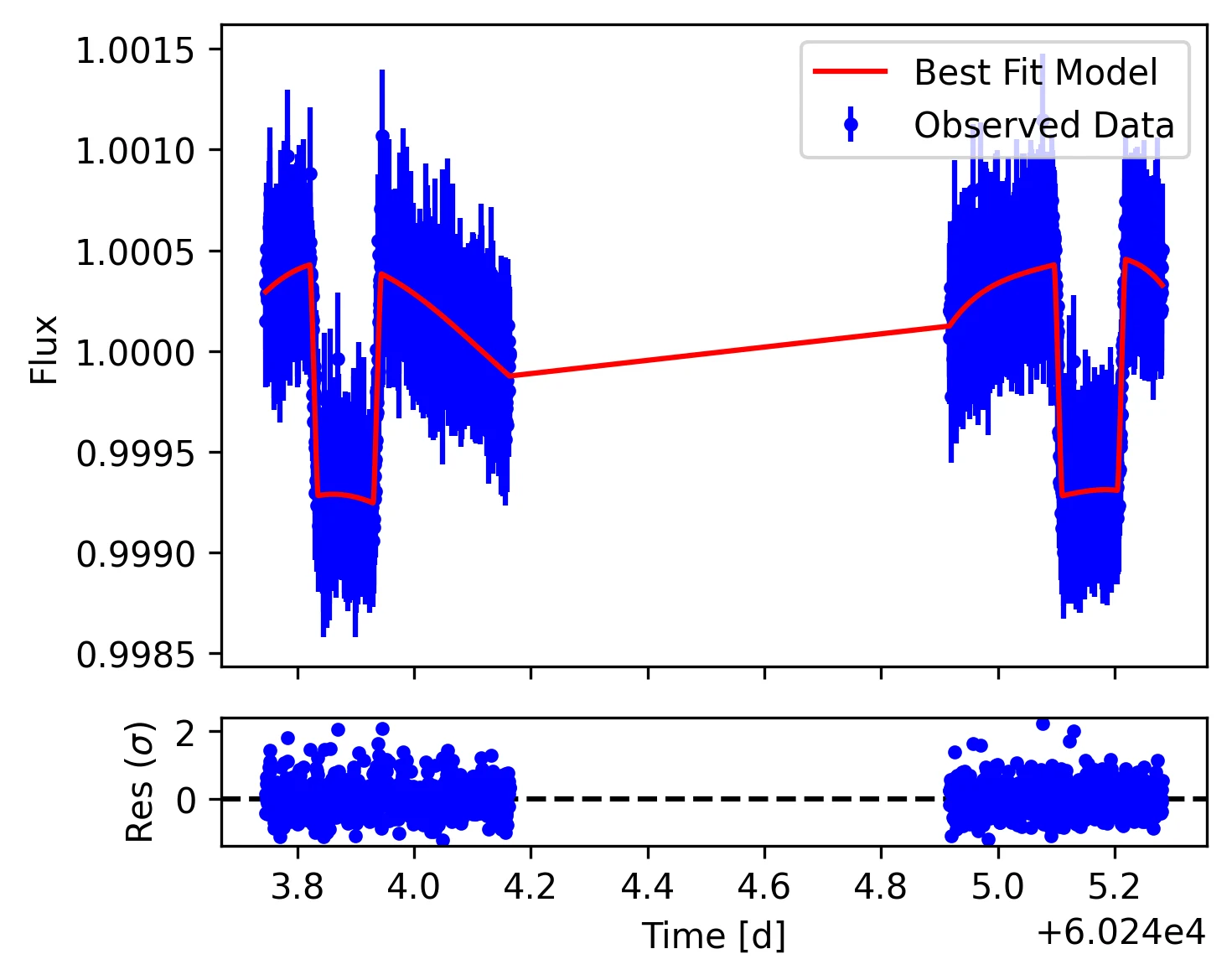
Planet WASP-121b is an exoplanet (a planet orbiting a distant star), a scorching gas ball that circles its star so closely that a year lasts just 1.3 Earth days. Its dayside is a true cosmic furnace: temperatures in the thousands of degrees melt and vaporize even metals.
Using spectroscopy on the James Webb Space Telescope, scientists peered into this inferno. By splitting the light, they spotted water vapor (H₂O), carbon monoxide, and particles of silicon and titanium oxides — the same stuff that makes up rocks. But the standout find was clouds of calcium titanate — the white powder used to paint walls.
This is the first detection of mineral clouds in a cosmic oven. They act like a sponge, soaking up titanium from the atmosphere and rendering it invisible. The air holds far more carbon than oxygen — almost like in a star. And every second the planet sheds around 100,000 tons of its mass — the star is blowing it away, leaving a comet-like tail. These data are key to the evolution of ultra-hot worlds.
Every second, WASP-121b loses 100,000 tons of its material — the star blows its atmosphere away into a comet-like tail.