Titanate Clouds Above a Scorching Giant ✛
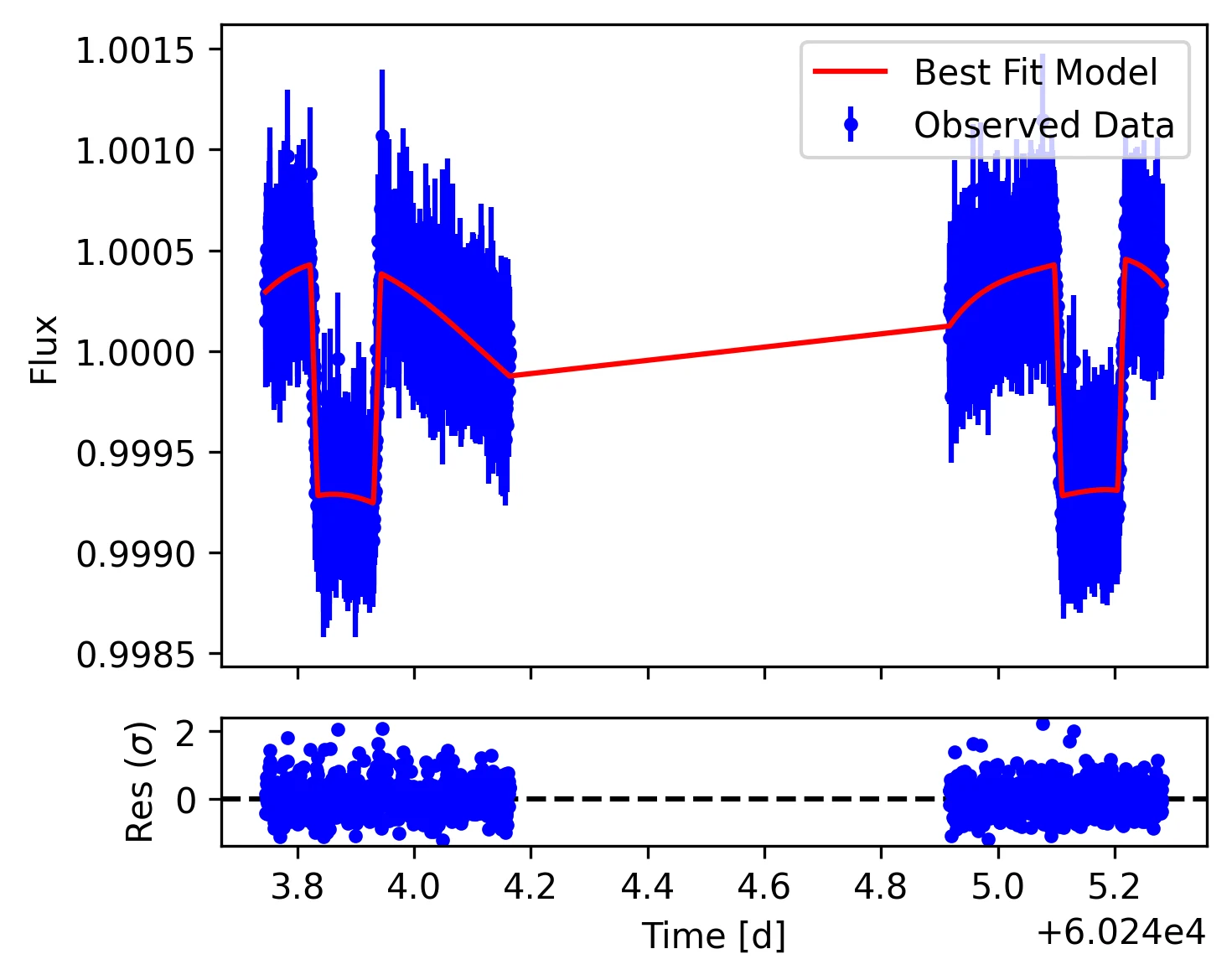
The dayside of WASP-121b is scorching at 2358 kelvins, hotter than the surface of many stars. Here, in perpetual light, the atmosphere does not just boil: it melts rock and turns it into gas. But not all gas stays gaseous. Some condenses into clouds, and those clouds hide titanium the way a trap hides its prey.
The dayside spectrum, captured by the James Webb Space Telescope from 0.6 to 5.1 micrometers, showed something unexpected: titanium oxide (TiO) in the gas phase was far less abundant than models predicted. Instead, the data revealed signs of condensate, solid particles that scatter light. A free-chemistry retrieval (fitting an atmospheric model to the observations) yielded confident detections of water (13.4σ), carbon monoxide (14.7σ), silicon monoxide (4.9σ), titanium oxides (5.4σ), and vanadium oxides (6.6σ). The clouds were detected at 10.2σ significance, with the titanate component at 6.7σ. This is the first direct proof that titanate clouds exist in the atmosphere of any exoplanet.
The trap snapped shut: titanium, which should have remained a gas at these temperatures, has bonded into CaTiO3 crystals. That is why it is missing from the gas phase; it is hidden in the clouds. The carbon-to-oxygen ratio (C/O) turned out to be supersolar: 0.963 ± 0.024. This means the planet formed far from its star, beyond the snow line (the distance where water freezes), and then migrated inward. The metallicity, the fraction of elements heavier than helium, came out to 4.7 times solar, also pointing to a birth in the cold outskirts of the system.
Previously, models of ultra-hot Jupiter atmospheres did not account for the condensation of refractory compounds into clouds, so estimates of elemental abundances could be skewed. Now it is clear that some titanium and other metals are "hidden" in particles, and this must be considered when interpreting spectra. In the future, titanate clouds will be sought on other scorching giants, and three-dimensional models will help understand how these traps are transported between the day and night sides. Thus, clouds over a distant planet become a key to the story of its birth and wanderings.
Calcium titanate (CaTiO3) is the mineral perovskite, which lent its name to an entire class of materials used in solar cells.