Titanate Clouds Over a Scorching Giant ✛
Context
Ultra-hot Jupiters, gas giants with dayside temperatures above 2000 K, have long been suspected of forming clouds from refractory compounds, but direct evidence was lacking. This work joins a series of recent JWST studies of exoplanet atmospheres: companion papers have already reported water vapor, carbon monoxide, and even possible variability in WASP-121b's atmosphere. Here, however, the team not only detected hot gas but also caught the condensate itself: clouds of calcium titanate, previously predicted by models for the hottest planets.
Methods
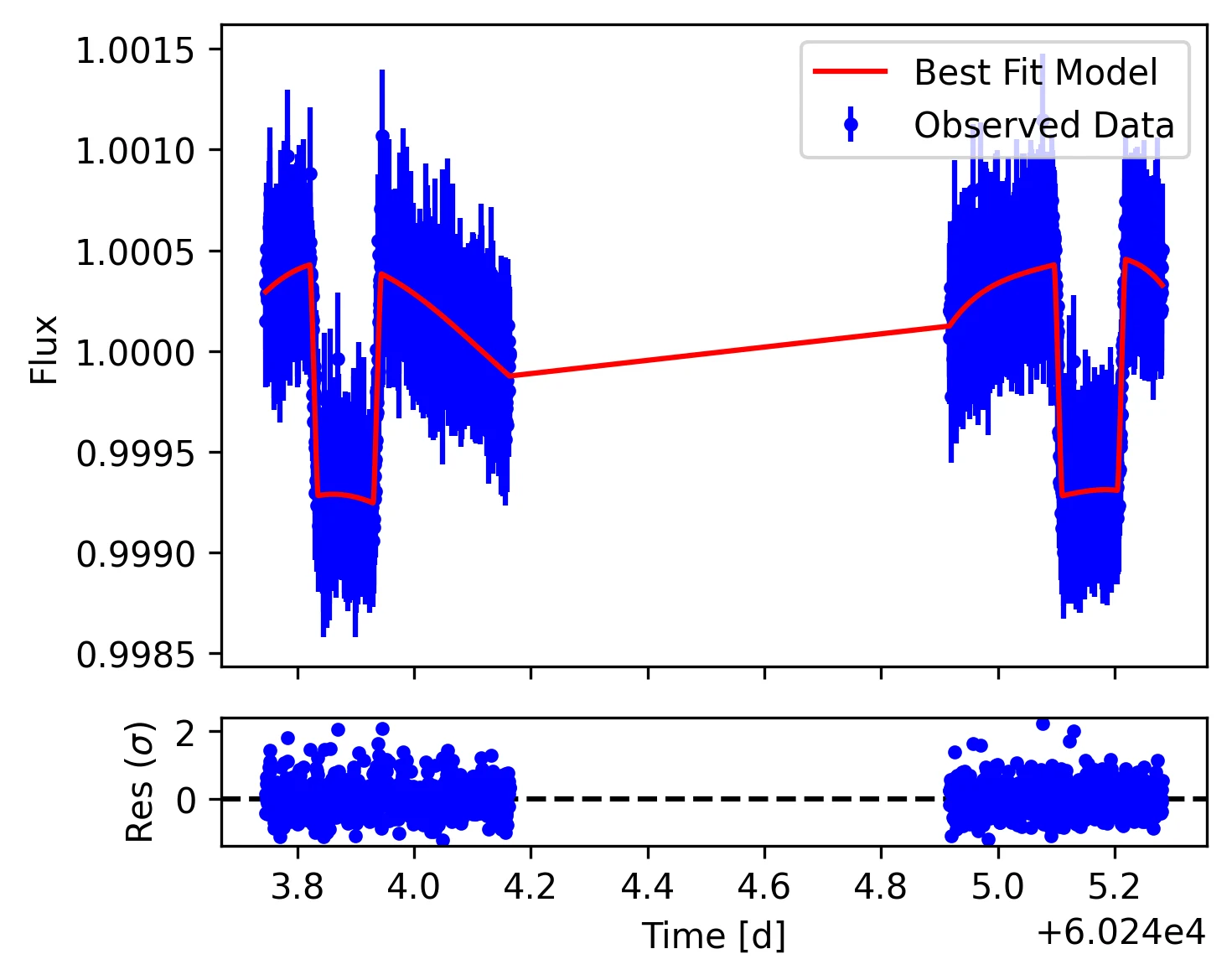
The study used archival JWST observations from programs #1201 and #1729: phase curves from the NIRISS and NIRSpec/G395H instruments, covering wavelengths from 0.6 to 5.1 μm. Data were processed with two independent pipelines, Eureka! and exoTEDRF, allowing cross-validation of the results. Spectral light curves were modeled with the custom code ExoELF, and the extracted emission spectrum was then analyzed with the retrieval code petitRADTRANS. The model included all major molecules as well as several types of condensates, including CaTiO3. To assess the significance of each species, additional retrievals were run with that species removed from the model.
Results
A free-chemistry retrieval yielded robust detections of H2O (13.4σ), CO (14.7σ), SiO (4.9σ), TiO (5.4σ), and VO (6.6σ), along with a tentative hint of HCN (0.9σ). Clouds in the dayside atmosphere were detected at 10.2σ significance, with the titanate component (CaTiO3) at 6.7σ. This is the first detection of titanate clouds in any exoplanet atmosphere. The TiO abundance came out significantly below equilibrium, interpreted as titanium being locked up in condensate. The team derived a super-solar C/O = 0.963 ± 0.024, a sub-solar Si/O = 0.034 ± 0.024, and a metallicity of 4.7 (+2.0/−1.4) times solar. A survey of planets showed a sharp rise in C/O at an equilibrium temperature near 1890 K.
Implications
This work provides the first observational confirmation that titanate clouds exist in the atmosphere of an ultra-hot Jupiter. Unlike companion studies that stopped at detecting gas molecules, here the team directly identified the condensed phase and showed that it accounts for the TiO deficit. This changes our picture of chemistry on the hottest exoplanets: some refractory elements are hidden in clouds, which must be taken into account when interpreting spectra and estimating abundances.
Future development
Titanate clouds are likely to be sought on other ultra-hot Jupiters, especially with future JWST observations over a broader wavelength range. Three-dimensional atmospheric models that include transport of condensates between the dayside and nightside will be needed. It will also be important to test how universal the C/O transition near 1900 K is, which requires a larger sample of planets with precise measurements.
Impact
The results will influence models of exoplanet atmospheres and the interpretation of JWST data for hot Jupiters.
Next steps
Expand the sample of ultra-hot Jupiters with precise spectra and combine with high-resolution data to probe the role of dynamics.
Key open problems
An open question remains: how strongly does condensation of refractory compounds skew metallicity and C/O estimates for hot giants, and what does that mean for conclusions about their formation?
The knowledge machine's view
This section is addressed to the author of the paper and their colleagues. Neighbouring works were found by meaning-based search across our archive, not by word overlap. We do not review: we show the field around the work.
What the work does
The study analyzes archival JWST observations (NIRISS and NIRSpec/G395H) of the dayside of WASP-121b across 0.6–5.1 μm. Using retrieval analysis (petitRADTRANS), the authors obtained an emission spectrum with secure detections of H2O, CO, SiO, TiO, VO, and, for the first time, clouds of CaTiO3. They estimated abundances: C/O = 0.963 ± 0.024 and a metallicity of 4.7 times solar, pointing to formation beyond the snow line.
Where its strength is
This is the first direct detection of titanate clouds in an exoplanet atmosphere, showing that they explain the deficit of gaseous TiO. It provides key observational evidence for the condensation of refractory compounds in ultra-hot Jupiters.
Where it could go next
- A related paper discusses a planet where the day side melts hydrogen and the night side hides clouds. It might be interesting to explore how titanate clouds are distributed between the day and night sides of WASP-121b and how they affect phase curves.based on: A Planet Where Day Melts Hydrogen and Night Hides Clouds arXiv:2605.01589
- In our archive, there is an analysis of a smoldering giant with methane and haze around a dead star. It may be worth comparing the chemical composition and condensation processes in ultra-hot Jupiters and cooled giants to identify common patterns.based on: Smoldering Giant: Methane and Haze over a Dead Star arXiv:2607.01316v1
- There is also a paper on a carbon-rich giant around a dead star. One could examine how the super-solar C/O ratio of WASP-121b relates to the composition of other carbon-enriched planets and what that implies for formation pathways.based on: A Carbon Forge on a Windy Planet Around a Pulsar arXiv:2509.04558
Worth trying
- Apply the same retrieval approach to the nightside of WASP-121b to check whether titanate clouds are present there.
- Compare WASP-121b spectra with models that include TiO condensation into CaTiO3 for other ultra-hot Jupiters.
- Assess how the presence of clouds affects metallicity and C/O estimates at different phases.
Why this may matter
The discovery of titanate clouds changes our understanding of ultra-hot Jupiter chemistry: some refractory elements are hidden in condensates, which must be accounted for when interpreting spectra and estimating composition. This may be a common feature of the hottest exoplanets.
Nearby works in our archive
- A Planet Where Day Melts Hydrogen and Night Hides Cloudssimilarity 0.60
- What a Giant Planet Was Baked Fromsimilarity 0.59
- Smoldering Giant: Methane and Haze over a Dead Starsimilarity 0.57
- A Planet's Rotation Revealed Its Fiery Secretssimilarity 0.56
- A Cold Giant Wrapped in Icy Cloudssimilarity 0.55
- A Carbon Forge on a Windy Planet Around a Pulsarsimilarity 0.54
The archive is sparse around this work: the closest review is only 0.60, against a usual 0.64. It looks like few have drilled nearby.
Calcium titanate (CaTiO3) is the mineral perovskite, which lent its name to an entire class of materials used in solar cells.
Key numbers
- dayside temperature: about 2358 K
- significance of titanate cloud detection: 6.7σ
- C/O ratio: 0.963 ± 0.024
- metallicity: 4.7 times solar
- wavelength range: 0.6–5.1 μm