The Higgs Field Opens a Passage Through a Black Hole ✛
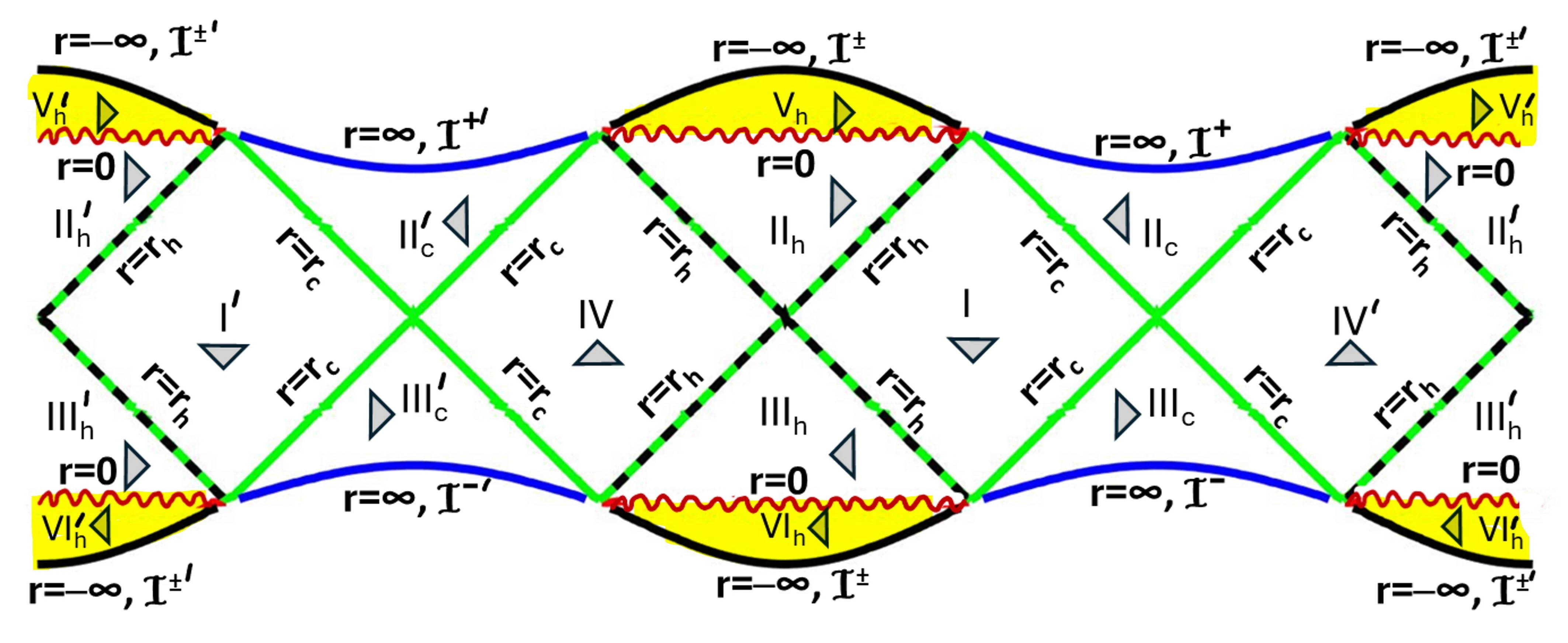
The Higgs field is an invisible ocean that fills the cosmos. In its calm state, its “waters” merely slow particles down slightly, creating the effect of mass. But at the heart of a black hole, monstrous gravity turns the ocean into a furious whirlpool: it not only pulls in but also pushes out with tremendous force. Antigravity emerges, counteracting spacetime curvature and preventing it from collapsing into a point.
This is a prediction of the i(SM+GR) theory, which unites Einstein’s gravity with the Standard Model of particles. Instead of a singularity, a dead end that Hawking and Penrose considered the end of physics, space continues. The black hole becomes a tunnel through which one can pass and perhaps glimpse the era before the Big Bang. The most surprising part: for all this to work, the Higgs field flips the sign of its energy — from a slowing agent to an accelerator of space.
The Higgs field is responsible for only a small fraction of the mass of ordinary matter, but without it, electrons would have no mass, and atoms could not exist.
A tunnel through a black hole resembles the wormholes of science fiction — bridges between distant corners of the universe.