A Black Hole as a Bridge: Beyond the Singularity Lies a World of Antigravity ✛
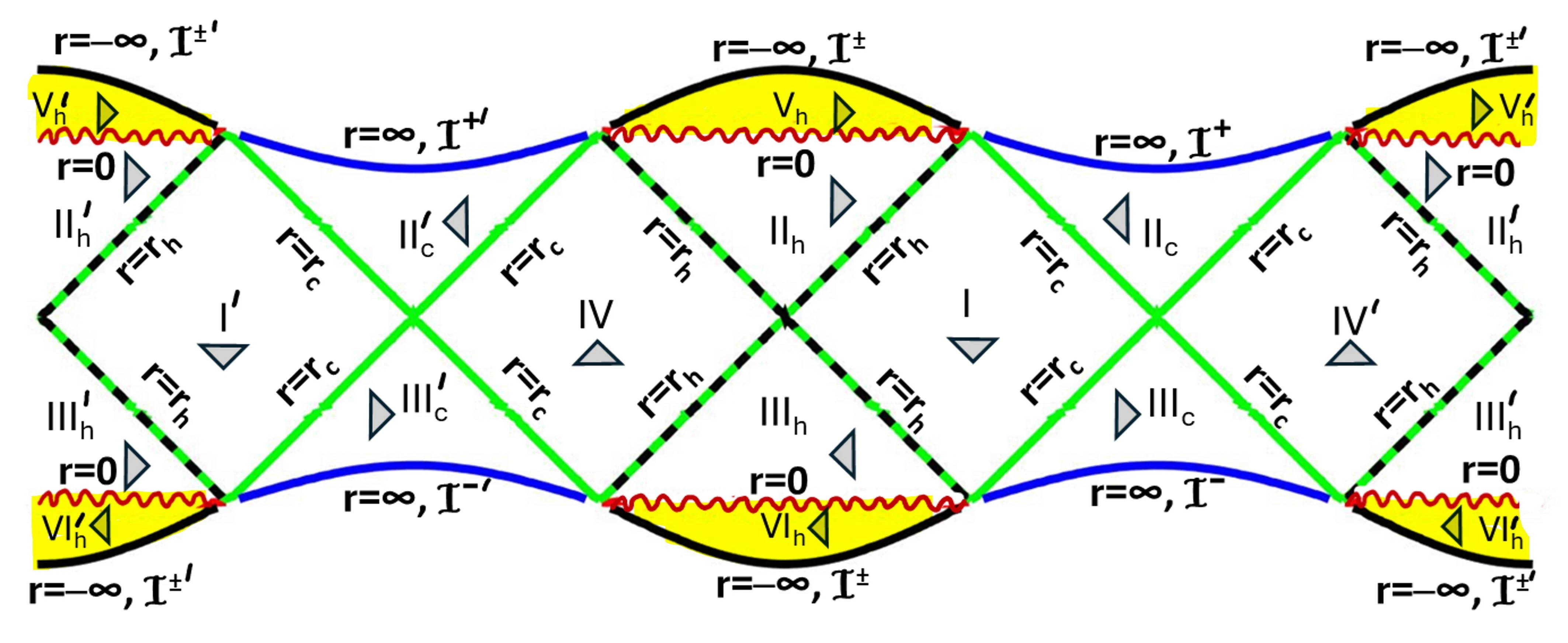
A century ago, Einstein's equations predicted black holes, but inside them physics broke down: particle trajectories ended at the singularity, a point of infinite curvature. It was a dead end, the end of spacetime. Now physicist Itzhak Bars proposes a radical twist: the singularity is not a wall but a door. Beyond it lies an entire region where gravity changes sign and begins to repel.
In this picture, a black hole is a bridge between two worlds. Outside, where we live, gravity attracts: it keeps planets orbiting stars and bends light. Inside, beyond the event horizon, under certain conditions antigravity emerges, a force that pushes matter apart. The key to the transition is the Higgs field, the very one that gives mass to all particles. Under ordinary conditions its contribution is negligible, but near the singularity it starts to dominate. When the ratio of the Higgs field to another scalar field exceeds one, gravity switches from attraction to repulsion.
This is not just a mathematical trick. In the new geometry, dubbed AdSSdS (anti-de Sitter–Schwarzschild–de Sitter), particle trajectories become complete: they do not end at the singularity but continue into the antigravity region. Massless particles, such as photons, gluons, and gravitons, pass through freely. Massive particles can do the same because their mass momentarily drops to zero. Information that falls into a black hole is not destroyed but carried into another region of spacetime.
This echoes the idea that black holes might be wormholes or portals to other universes. In science fiction, for instance in the movie "Interstellar," characters pass through and interact with a singularity. Bars's work makes such a scenario physically meaningful: the singularity becomes traversable, and beyond it lies an antigravity world with negative curvature, shaped like a saddle. This is anti-de Sitter space, already familiar to theorists from the holographic principle. Perhaps AdS/CFT holography describes not an abstract model but the real depths of black holes.
Practical implications could show up in astrophysics. Precise metric profiles near the singularity could alter predictions for gravitational lensing and galaxy rotation curves, the very observations usually attributed to dark matter. If antigravity regions of different black holes are connected, they might form a hidden network influencing the large-scale structure of the universe. This is still a hypothesis, but it offers a clear direction for testing.
In the antigravity region of a black hole, the masses of all Standard Model particles vanish, and the electroweak symmetry SU(2)×U(1) is restored exactly at the singularity.
The idea of traversable singularities and antigravity inside black holes echoes the movie "Interstellar," where characters pass through and interact with a singularity.