The Higgs Field Governs the Interior Spacetime of Black Holes ✛
Context
Black holes and cosmology have traditionally been described by geodesically incomplete spacetimes: particle trajectories terminate at singularities. Most approaches to quantum gravity, including string theory, also rely on incomplete background fields. This misses potentially important physical effects comparable in significance to quantum corrections. Bars's work places geodesic completeness at the forefront: first at the classical level, then in quantum theory. Nearby on the archive are papers on black holes without singularities and on their scalar 'hair', but this paper differs by introducing entire antigravity regions beyond the singularity, rather than merely smoothing it.
Methods
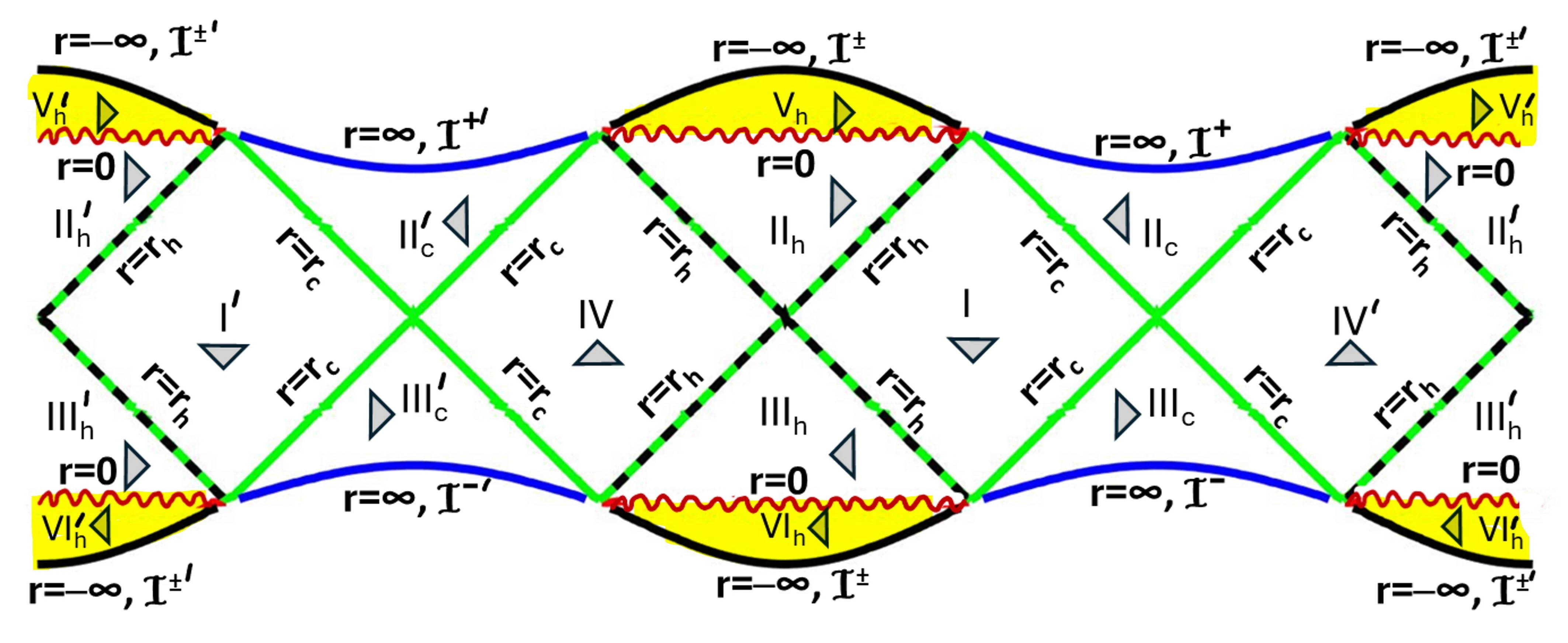
The foundation is the i(SM+GR) action with local scale (Weyl) symmetry. It includes scalar fields ρ (singlet) and H (Higgs doublet), conformally coupled to curvature, and contains no dimensionful Newton constant. Instead, a dynamical gravitational constant G(x) emerges, whose sign is determined by the gauge-invariant field h² = 2H†H/ρ². The equations of motion are solved asymptotically away from singularities, and then a continuous geometry is constructed that unites gravity and antigravity regions through an extended radial coordinate r, ranging from −∞ to +∞. Kruskal–Szekeres coordinates and Penrose diagrams are used to analyze the causal structure.
Results
A new solution is obtained: the AdSSdS (anti-de Sitter–Schwarzschild–de Sitter) black hole. In the region r > 0, it is an ordinary Schwarzschild–de Sitter black hole with event horizon rh and cosmological horizon rc. In the region r < 0, there is an antigravity part with no horizon, asymptotically anti-de Sitter with negative curvature R− = −36λ/(8πG̃_N), where G̃_N is the as-yet unknown strength of antigravity. The key parameter is the dimensionless Higgs field h = s/ρ: for h² < 1 gravity attracts, for h² > 1 it repels. At the singularity r = 0, both scalar fields vanish, but their ratio is finite and equal to one, so all Standard Model particle masses vanish. Massless particles (photons, gluons, gravitons) pass freely through the singularity, while massive ones can do so because their mass goes to zero. Geodesics become complete: particles do not terminate but continue into the antigravity region.
Implications
The work radically changes the view of information in black holes. Instead of information loss at the singularity, it is transferred to antigravity regions accessible to interior observers. Unitarity should be defined for the complete spacetime, not just the exterior region I. This also provides classical channels of communication between regions I and IV, echoing the ER = EPR idea. Furthermore, the antigravity region turns out to be a genuine anti-de Sitter space, linking AdS/CFT holography to real black hole physics.
Future development
The next step is a detailed study of the dynamics of the fields ρ(r) and s(r) near the singularity, which will allow computing precise metric and mass profiles. This could lead to observable deviations from the standard Schwarzschild metric outside the horizon, affecting galactic rotation curves and gravitational lensing. It also remains to study how antigravity regions of different black holes are connected: whether they form a single network or are isolated. Extending local scale symmetry to string theory may provide a path to quantum gravity.
Impact
Astrophysics (black hole observations, dark matter), quantum information, string theory, cosmology.
Next steps
Compute exact profiles of scalar fields and metric near the singularity; test predictions against astrophysical data.
Key open problems
The work directly addresses the black hole information paradox and the problem of singularities in general relativity. It offers a classical solution that does not require as-yet unknown quantum gravity. The connection to holography and string theory opens a path toward unification with quantum mechanics.
The knowledge machine's view
This section is addressed to the author of the paper and their colleagues. Neighbouring works were found by meaning-based search across our archive, not by word overlap. We do not review: we show the field around the work.
What the work does
The paper introduces a locally conformally symmetric theory i(SM+GR) in which the Higgs field controls the sign of the gravitational constant. An AdS–SdS black hole solution is obtained, where an antigravitational region emerges beyond the singularity. It is shown that geodesics extend through the singularity, and particle masses vanish at the transition point.
Where its strength is
The strength of the work lies in radically extending black hole geometry by adding an antigravitational region, which allows the full spacetime to be viewed as geodesically complete and permits information to pass through the singularity. This provides a concrete mechanism linking the Higgs field to the global causal structure.
Where it could go next
- It might be interesting to see how the proposed mechanism of mass vanishing relates to work on how a black hole switches off particle mass, and to clarify the conditions under which massive particles can pass through the singularity.based on: How a Black Hole Turns Off Particle Mass arXiv:2607.24469
- A nearby approach deals with black holes without singularities; comparing with it might help identify which consequences of the antigravitational region can be tested observationally.based on: Black Holes Without Singularities: A New Approach arXiv:2607.07790
- The idea of classical communication channels between regions I and IV resonates with work on the imprint of a black hole on the fabric of spacetime; one could explore whether this yields new predictions for gravitational waves.based on: Black Hole Leaves a Mark on the Fabric of Spacetime arXiv:2606.11728
Worth trying
- Test how the quasinormal mode spectrum changes when the antigravitational region is taken into account.
- Consider the collapse of a spherical shell in the i(SM+GR) theory to trace the dynamical formation of the antigravitational region.
- Assess whether signals from particles that have passed through the singularity could be detected in the exterior region.
Why this may matter
If geodesic completeness is indeed achieved within a locally conformal theory, this could become a new selection principle for quantum gravity models and reshape the formulation of the black hole information problem.
Nearby works in our archive
- How a Black Hole Turns Off Particle Masssimilarity 0.62
- Black Holes Without Singularities: A New Approachsimilarity 0.58
- Black Hole Leaves a Mark on the Fabric of Spacetimesimilarity 0.56
- Black Holes That Grow Scalar 'Hair' from Rapid Spinsimilarity 0.55
- The Ringing of Black Holes That Remember the Pastsimilarity 0.55
- Neutron stars could be more compact than black holessimilarity 0.55
The closest work in the archive sits at 0.62 by meaning — the usual level for our corpus.
In the antigravity region of a black hole, all Standard Model particle masses vanish, and the electroweak symmetry SU(2)×U(1) is exactly restored at the singularity.
The idea of traversable singularities and antigravity inside black holes resonates with Christopher Nolan's film 'Interstellar', where characters pass through a wormhole and interact with a singularity.
Key numbers
- ratio h² in weak gravity: 10⁻³³
- curvature of antigravity region R−: −36λ/(8πG̃_N)
- radius of cosmological horizon rc: 1.65×10²⁶ m
- ratio rc/rh: 2.36×10¹⁷ × (r☉/r0)