The Thermal Noise of Emptiness: How to Catch Unruh Radiation in a Laser Beam ✛
In 1976, Canadian physicist Bill Unruh asked a simple question: what does an observer see when accelerating through empty space? The answer turned out to be strange: emptiness ceases to be empty. An accelerating observer bathes in thermal radiation with a temperature proportional to the acceleration. For an acceleration of $10^{20}$ g, a billion billion times Earth's gravity, this temperature is about 4000 K, like the surface of a red star. But it is born from pure vacuum.
Catching this radiation is like spotting a faint candle flame next to a searchlight. In a real experiment, electrons accelerated by a laser not only feel the Unruh thermal bath but also scatter the laser's own photons, producing Compton radiation, a powerful background. The authors of the new work built a full three-dimensional model of both processes for two facilities: FACET-II (a0=5, energy 10 GeV) and LUXE (a0=23.6, energy 16.5 GeV). They tracked where Unruh photons and Compton photons fly and compared their spectral-angular distributions.
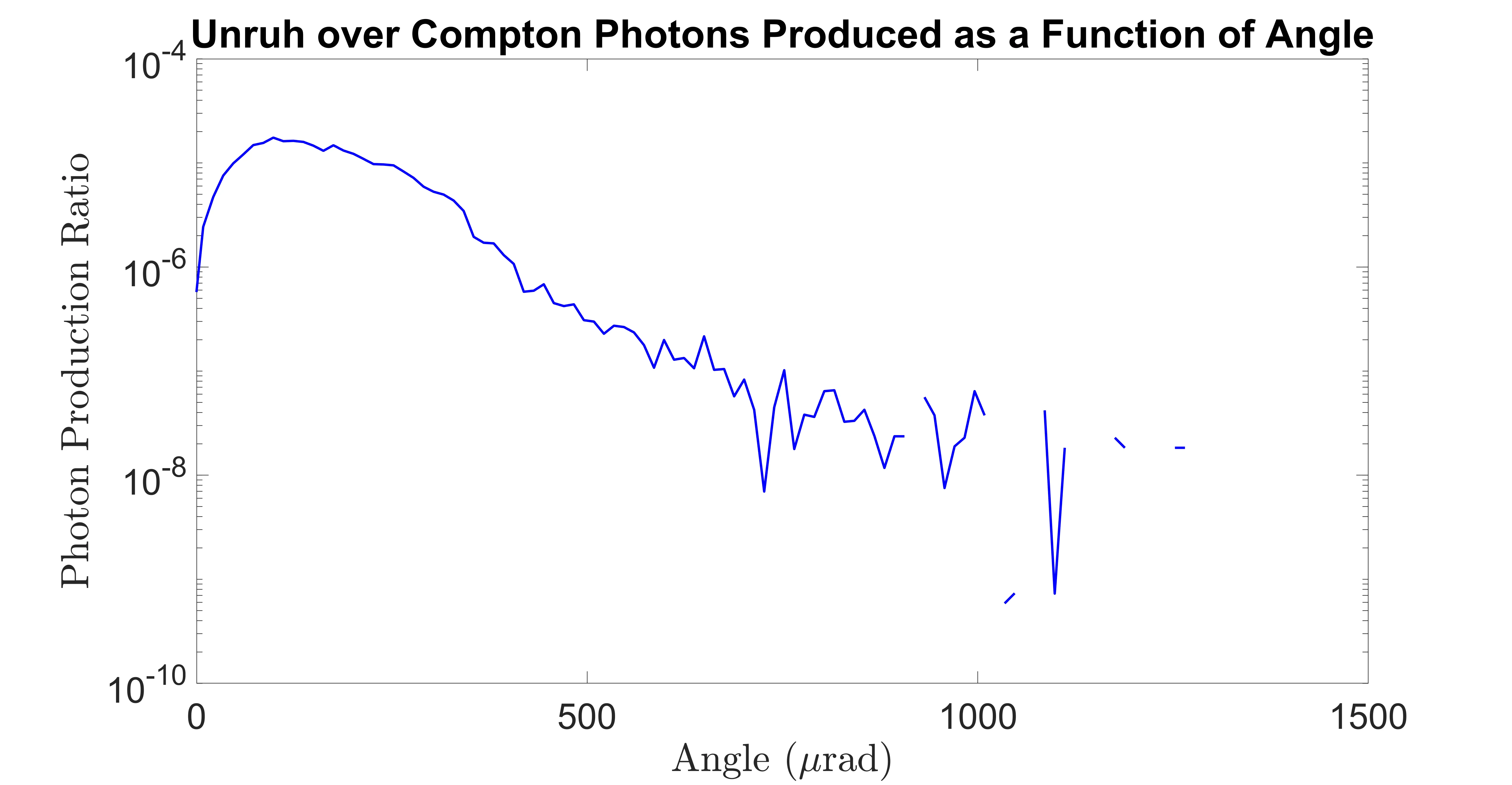
The result resembles a star map where you need to find a faint galaxy among bright stars. For FACET-II parameters, the signal-to-background ratio peaks at about $10^{-5}$ in the angular range of 150–400 microradians, but the absolute signal is extremely small. However, for LUXE, where the laser field is 23.6 times stronger than the critical field, the ratio increases by more than two orders of magnitude, exceeding $10^{-3}$. The peak occurs at an angle of about 800 microradians and photon energies of 2–6 GeV. Why is that? The production rate of Unruh photons grows with the quantum parameter χ faster than Compton radiation, so a more intense laser gives the signal an advantage.
The authors did not stop at single electrons. They considered dense beams where collective effects can amplify the field. Using the Vlasov equation, they found that at densities above $10^{21}$ cm^-3, the plasma frequency exceeds the laser frequency, enhancing the total field and the Unruh temperature. This opens a new direction that had not been considered before.
The work turns the search for the Unruh effect from a theoretical problem into a practical program. Previously, it was unclear whether a weak signal could be distinguished from the Compton background in real experiments. Now it is shown that at certain angles and energies (200–800 microradians, 2–6 GeV) the signal-to-background ratio reaches $10^{-3}$ at LUXE, making detection potentially possible. This is achieved thanks to a full three-dimensional model of both processes and a comparison of their distributions for specific facilities. The results can serve as a guide for planning experiments at FACET-II and LUXE in the coming years.
The candle next to the searchlight is no longer invisible: if you know where to look. The detection windows found in this work are the first maps of such places. Perhaps it is there, in a narrow cone of radiation, that the thermal noise of emptiness will first appear.
The Unruh temperature for an acceleration of $10^{20}$ g is about 4000 K, like the surface of a red star, but it is born from pure vacuum.
In Stanislaw Lem's novel "Fiasco," astronauts accelerating to relativistic speeds encounter unexpected thermal radiation, an echo of the Unruh effect that researchers here are trying to catch in the laboratory.